

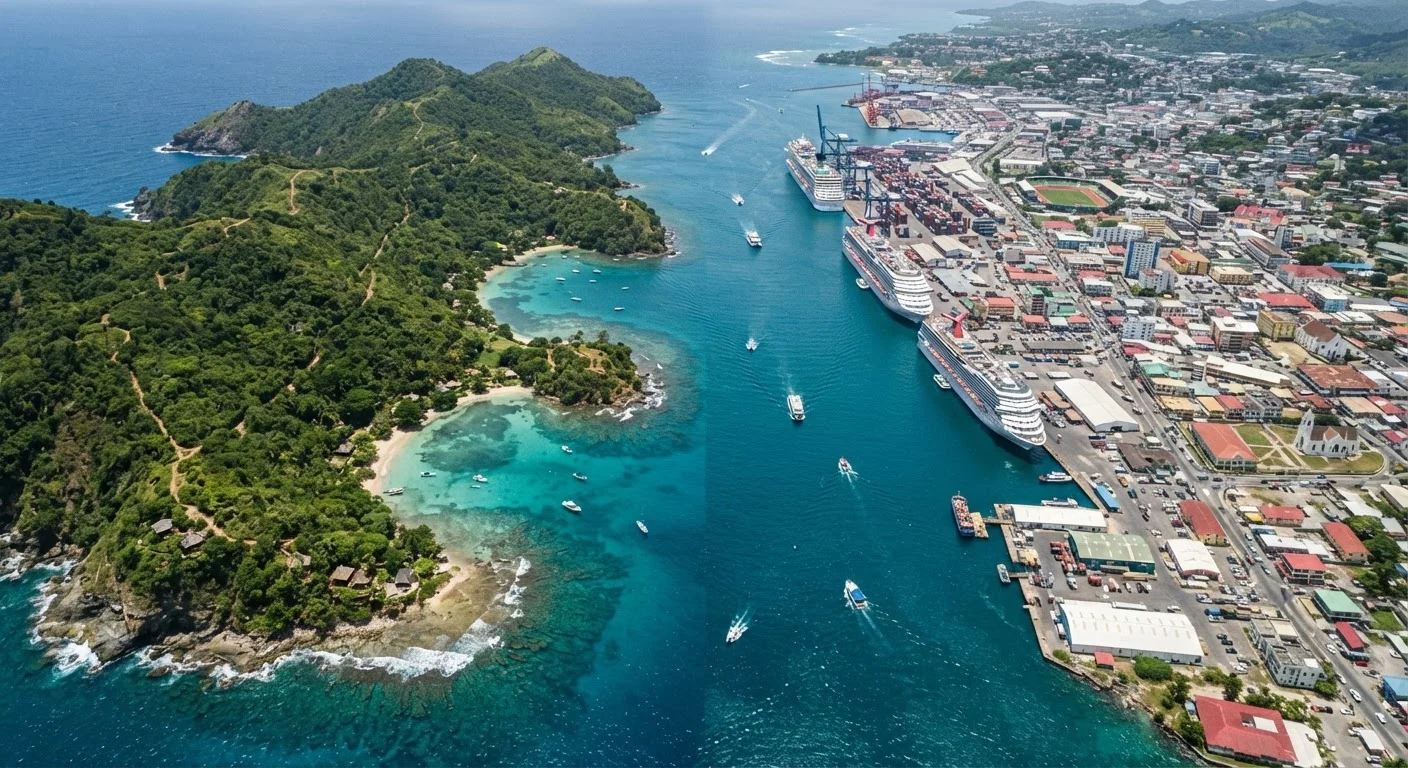
Option A
Small Island Base
The immersive, slower-paced retreat.
Best for: Travelers who want depth over breadth — one culture, one coastline, one unhurried pace for the duration of the trip.
Option B
Major Hub Base
The connected, flexible launching point.
Best for: Travelers who want to cover multiple islands or need reliable infrastructure, flight frequency, and varied dining and nightlife.
What 'Base' Actually Means in Caribbean Trip Planning
Choosing a base isn't just picking a hotel location — it determines how much time you spend in transit, how easy it is to pivot plans, and whether your daily experience feels integrated or logistically stressful. In the Caribbean, this decision carries particular weight because island geography creates real friction: inter-island ferries run on limited schedules, small-island airports may only serve a handful of carriers, and road infrastructure varies enormously.
A major hub — think San Juan (Puerto Rico), Bridgetown (Barbados), Nassau (Bahamas), or Sint Maarten — functions as a regional air and ferry node. You trade a quieter setting for genuine connectivity. A small island base — places like Carriacou, Bequia, Culebra, or the less-developed out-islands — offers seclusion and a more local texture, but requires more planning to reach and to leave.
This isn't a question of which is better overall. It's a question of which trade-offs you're willing to live with for the duration of your trip. The framework below covers the practical dimensions that matter most. For a broader look at how structure affects enjoyment, see how flexible versus fixed itineraries interact with base choice.
Logistics, Connectivity, and Getting Around
| Criterion | Small Island Base | Major Hub Base |
|---|---|---|
| Flight frequency | Limited; often 1–3 carriers | High; multiple daily options |
| Cost to reach | Often requires connecting leg | Direct routes more common |
| Accommodation variety | Limited; book early | Wide range of options |
| Crowd levels | Generally lower | Higher, especially in season |
| Medical facilities | Basic; evacuation may be needed | More complete infrastructure |
| Cultural immersion | Deeper local texture | More varied, more international |
| Island-hopping ease | More complex logistics | Straightforward from hub |
| Daily pace | Slow, settled | Flexible, activity-dense |
Major hubs typically anchor regional airline routes operated by carriers serving the Eastern and Western Caribbean. That means more departure windows, easier rebooking if a flight is canceled, and access to rental car fleets large enough to serve demand. On a small island, the single-runway airstrip may see only a few propeller-plane services per day — sometimes weather-dependent — and rental inventory is limited enough that booking months in advance is advisable.
Inter-island movement also looks different. From a hub, you may be able to take a short regional flight or a catamaran day trip to neighboring islands without repositioning your entire luggage situation. From a small island base, reaching another destination often involves a multi-leg journey that eats a full travel day.
That said, within a small island, getting around is often simpler. Many are compact enough to traverse by bicycle or shared taxi, and you're rarely far from the water. Hubs, by contrast, can mean navigating urban congestion and higher ground-transport costs.
Cost Realities and What They Don't Tell You
2–3x
Typical cost multiplier for inter-island prop flights vs. main-route fares
Regional Caribbean air travel on short-hop prop carriers is priced per-seat at rates that often exceed per-mile costs on major international routes.
~600
Islands in the Caribbean archipelago
Of those, fewer than 30 have international airports with scheduled commercial service, making hub connectivity a meaningful logistical variable.
30–50%
Share of Caribbean visitors who cite beaches as primary draw
Caribbean Tourism Organization surveys consistently show beach access as the dominant trip motivator, relevant context for evaluating small vs. hub coastal access.
The sticker price of accommodation on a small island can look lower than a hub property of comparable quality — but that comparison rarely holds once you factor in how you arrived. Reaching a small island often requires a connecting flight on a regional prop carrier after your transatlantic or transnational leg, adding both cost and time. Some travelers also need to factor in boat transfers, which can run anywhere from a modest fare to a meaningful expense depending on the route.
On the flip side, hub destinations tend to have more competitive accommodation markets — more properties means more pricing variety. Groceries and everyday goods in hubs are also generally more accessible and predictably priced; on small islands, most staples are imported and priced accordingly.
One cost travelers consistently underestimate: the expense of leaving a small island for a day trip versus doing the same trip from a hub. If island-hopping is part of your plan, modeling the actual transport cost before committing to a small-island base is worthwhile. This is one area where working through a travel agent's regional expertise can surface real savings through consolidated ticketing.
Experience Quality and Daily Rhythms
The experiential argument for a small island base is genuine, not just marketing language. Fewer cruise ship arrivals, smaller crowds at snorkel spots, fishermen at the dock each morning, restaurants where the owner knows your name by day two — these are real features of smaller destinations, not abstractions. If cultural immersion and a decompressed pace are central to why you're traveling, a small-island base often delivers on that better than a hub.
Major hubs, however, shouldn't be dismissed as shallow or purely transactional. Many of the Caribbean's most culturally layered destinations — historic Bridgetown, Old San Juan, Willemstad in Curaçao — happen to also be hubs. The urban richness of those places is part of the experience, not a distraction from it.
Group dynamics also play a role. Mixed-interest groups — where one person wants hiking, another wants beach bars, and a third wants museums — tend to fare better in hubs where options exist in parallel rather than sequentially. For more on navigating that kind of planning challenge, see group travel planning trade-offs.
Travel conditions, transport schedules, entry requirements, and local infrastructure can change. Always verify current information through official government and carrier sources before booking or traveling.
The content on this site is for informational purposes only and is not a substitute for professional advice. Always consult a qualified professional for guidance specific to your situation.