

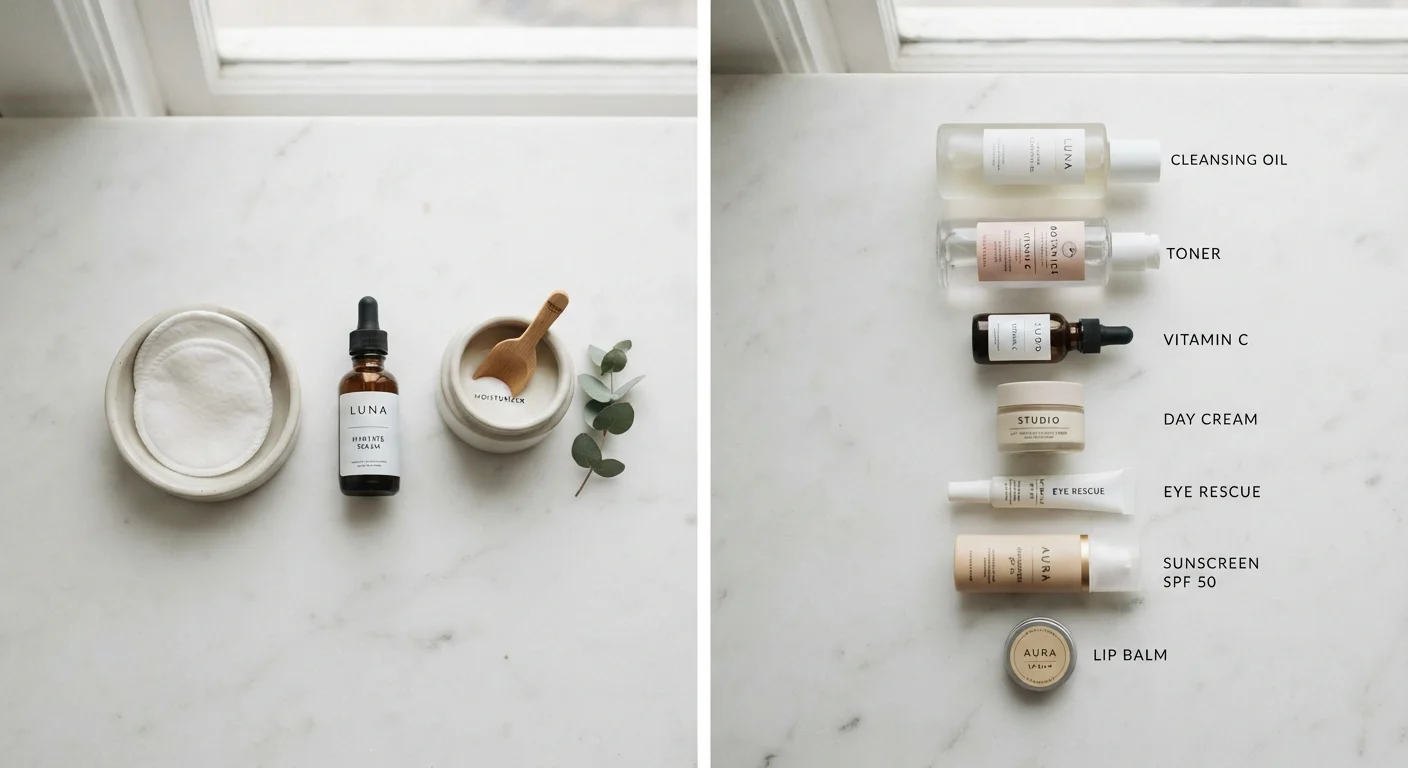
Option A
Minimal Routine
The stripped-back, consistent foundation approach.
Best for: Those prioritizing adherence, sensitive skin management, or starting a sustainable skincare habit.
Option B
Multi-Step Routine
The layered, targeted treatment strategy.
Best for: Those addressing multiple concurrent skin concerns - such as hyperpigmentation, aging, and dehydration - simultaneously.
What Each Approach Actually Involves
A minimal routine typically means three to four steps: a gentle cleanser, a moisturizer, and a broad-spectrum SPF in the morning. At night, cleansing and moisturizing alone can be sufficient. The focus is on protecting and maintaining the skin barrier rather than treating multiple concerns at once.
A multi-step routine extends that base with targeted actives - serums containing ingredients like retinoids, vitamin C, AHAs, niacinamide, or peptides - layered in a specific order to maximize absorption and minimize interference. Korean-inspired regimens popularized 10-step formats, though most dermatologists note that six or fewer targeted steps is more practical and less risky for most skin types.
It's worth clarifying that "minimal" doesn't mean negligent, and "multi-step" doesn't mean excessive - what matters is whether every step has a clear purpose. See signs your routine may be working against you for a useful self-check.
What the Evidence Supports
Research in dermatology consistently shows that sunscreen and a skin-barrier-supportive moisturizer provide the greatest measurable impact on skin health, photoaging prevention, and long-term texture improvement. These are the non-negotiable anchors of any evidence-backed routine, minimal or extended.
The case for multi-step routines is strongest when specific concerns are present. Retinoids have robust clinical evidence for improving fine lines and stimulating collagen production. Topical vitamin C has demonstrated antioxidant activity and some brightening effect in peer-reviewed studies. Niacinamide shows consistent results for reducing transepidermal water loss and addressing uneven tone.
However, evidence also shows that layering too many actives simultaneously can compromise the skin barrier, trigger inflammation, or reduce individual ingredient efficacy through pH conflicts - for example, pairing low-pH vitamin C with niacinamide at high concentrations can reduce the effectiveness of both.
90%+
Of photoaging attributed to UV exposure
Dermatological research broadly attributes the majority of visible skin aging - including wrinkles, laxity, and dark spots - to cumulative UV exposure, underscoring SPF as the highest-impact single step.
~50%
Reduction in retinoid benefit with inconsistent use
Clinical studies on topical retinoids consistently show that results depend heavily on sustained, regular application - irregular use significantly diminishes measurable outcomes.
The honest takeaway from the literature: the right ingredients applied consistently do the work - not the total number of steps.
The Adherence Factor - Why Simplicity Wins More Often
One underappreciated variable in skincare is behavioral: routines only work if you actually do them. Habit research suggests that the more steps a behavior requires, the greater the friction - and the more likely it is to be skipped under time pressure or fatigue.
A five-minute minimal routine performed every single morning will, over months, outperform a 20-minute multi-step routine done three times a week. This is especially true for outcomes like SPF protection, where gaps in application directly translate to measurable UV damage accumulation.
Habit stacking - linking skincare steps to existing behaviors like brushing teeth or morning coffee is one practical way to increase adherence to any routine length. If you're deciding between approaches, honestly assess how much time you realistically have each morning before choosing your format.
When to Reassess Your Routine Length
If your skin feels persistently tight, red, or reactive, that's a signal to simplify - not to add more products. Stripping back to a basic cleanse-moisturize-SPF structure for two to four weeks can help reset a compromised barrier. Once your skin is stable, you can reintroduce one active at a time, spaced at least a week apart, to identify what your skin genuinely tolerates.
Side-by-Side: Key Differences at a Glance
The table below summarizes how each approach compares across practical decision factors. Neither is universally superior - the right choice depends on your skin's current condition, your specific goals, and how reliably you can stick to a given routine.
| Criterion | Minimal Routine | Multi-Step Routine |
|---|---|---|
| Daily time commitment | 2-5 minutes | 10-20+ minutes |
| Barrier irritation risk | Low | Moderate to high (if layering actives) |
| Ingredient conflict risk | Minimal | Requires careful formulation awareness |
| Adherence likelihood | Higher | Lower without strong habit formation |
| Targeting specific concerns | Limited | Strong, with right actives |
| Best skin type fit | Sensitive, reactive, or beginner | Stable, resilient, or experienced |
| Evidence base for core steps | Strong (SPF, moisturizer) | Variable by ingredient |
For a deeper look at how your morning and evening windows serve different skincare purposes, our AM vs. PM routine breakdown explains which steps belong where - useful for both minimal and multi-step formats.
This article is for general informational and educational purposes only, not medical or dermatological advice. If you have a skin condition or concern, consult a qualified healthcare or skincare professional before making significant changes to your routine.
The content on this site is for informational purposes only and is not a substitute for professional advice. Always consult a qualified professional for guidance specific to your situation.