

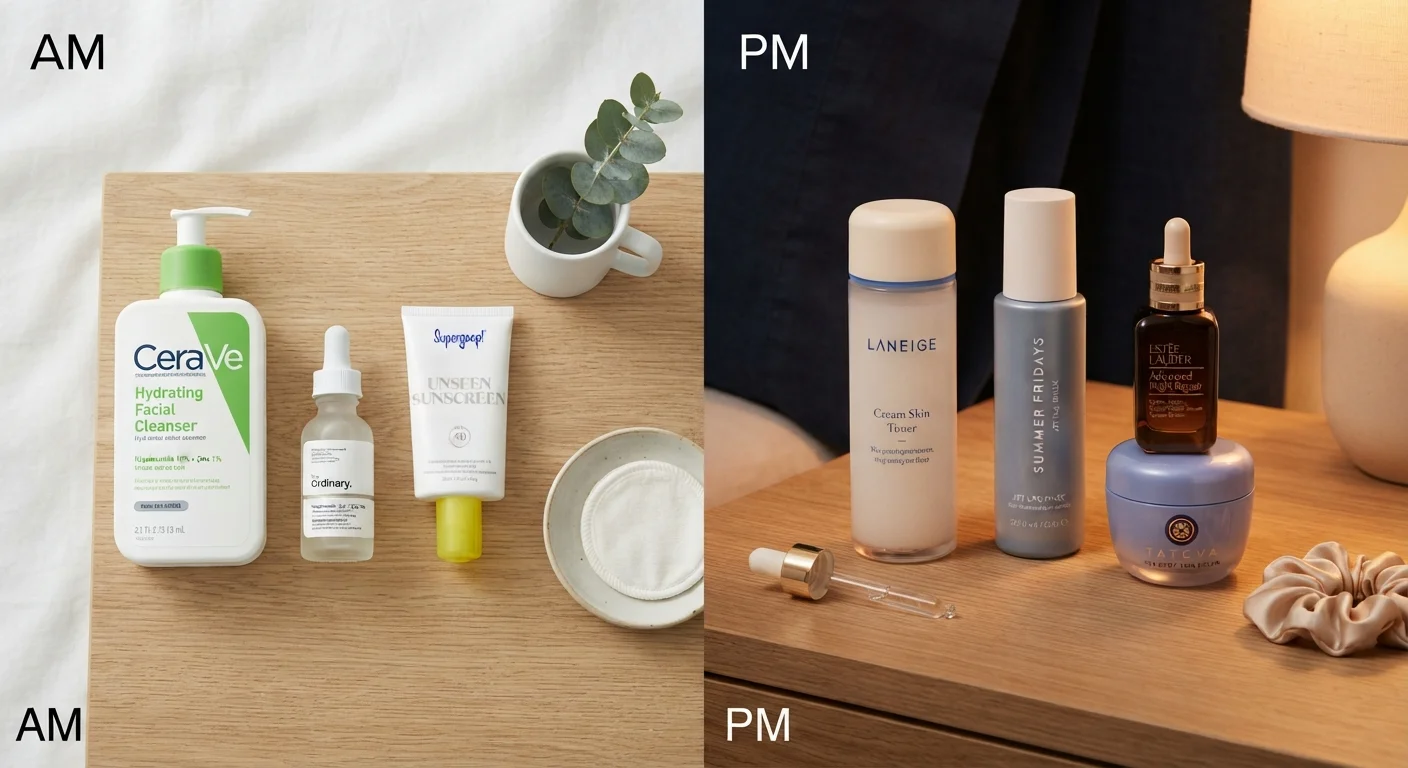
Option A
Morning Routine
The protective, prep-focused start to your skin's day.
Best for: Defending skin against UV exposure, pollution, and moisture loss throughout the day.
Option B
Evening Routine
The repair-and-restore phase that works with your skin's biology.
Best for: Clearing daily buildup and delivering active ingredients during the skin's natural overnight repair cycle.
Why the Time of Day Actually Matters
Your skin doesn't operate on a flat schedule. It follows a circadian rhythm - an internal biological clock that shifts its priorities depending on the time of day. In the morning, skin ramps up its defenses: sebum production increases, blood flow rises near the surface, and the skin prepares to encounter UV radiation, pollution, and environmental stressors. By evening, those defenses wind down and the skin shifts into repair mode, increasing cell turnover and becoming more permeable to the ingredients you apply.
Understanding this rhythm is the practical foundation of a well-structured routine. It's not about using more products - it's about using the right products at the right time. For a broader look at how these patterns connect to daily wellbeing, see how AM and PM routines affect your day overall.
| Criterion | Morning Routine | Evening Routine |
|---|---|---|
| Primary purpose | Protection from environmental stressors | Repair, treatment, and restoration |
| Key non-negotiable | Broad-spectrum SPF | Thorough double cleanse |
| Best for active ingredients | Antioxidants (e.g. vitamin C) | Retinoids, AHAs, BHAs, peptides |
| Skin permeability | Lower - barrier more defended | Higher - absorbs actives more readily |
| Cell turnover activity | Lower during daytime hours | Peaks during sleep |
| Typical time commitment | 3-5 minutes (can be minimal) | 5-10 minutes (more steps beneficial) |
| Moisture approach | Lightweight, non-occlusive | Richer, barrier-focused |
What a Morning Routine Should Actually Do
The morning routine's core job is protection. This means forming a shield between your skin and the day ahead - not stripping or treating it aggressively.
A functional morning sequence generally includes:
- A gentle cleanser or water rinse - removing overnight product residue without disrupting the skin barrier
- An antioxidant serum (commonly vitamin C) - neutralizing free radicals from UV and pollution before they cause oxidative damage
- A lightweight moisturizer - sealing in hydration and supporting barrier integrity
- Broad-spectrum SPF 30 or higher - the non-negotiable final step, every single day
Applying actives like retinoids or AHAs in the morning is generally counterproductive: many are photosensitive and degrade in sunlight, and they can increase UV sensitivity. If you're pressed for time, a 5-minute morning routine can cover all the essentials without requiring an elaborate sequence.
80%
Of premature skin aging attributed to UV
Research published in dermatology literature estimates that roughly 80% of visible facial aging is caused by UV exposure - reinforcing daily SPF as the morning routine's most critical step.
23:00-03:00
Peak window for skin cell renewal
Studies on skin circadian biology indicate that epidermal cell division and repair activity are highest between approximately 11 PM and 3 AM, supporting the case for PM active ingredient use.
What an Evening Routine Should Actually Do
Evening is when skin earns its most meaningful changes. The skin's natural repair processes - cell turnover, collagen synthesis, barrier restoration - are most active during sleep. This makes the PM window the strategic choice for treatment-oriented ingredients.
A functional evening sequence generally includes:
- A thorough cleanse - removing sunscreen, makeup, and pollutants that would otherwise interfere with overnight repair
- An active treatment - retinoids, exfoliating acids (AHAs/BHAs), or peptide-based serums applied to freshly cleansed skin
- A richer moisturizer or sleeping mask - barrier-replenishing ingredients like ceramides, niacinamide, or squalane work best with extended contact time
Because skin becomes more permeable at night and isn't immediately exposed to sunlight after application, actives absorb more effectively and work without UV interference. For a deeper look at the biology behind this, what your skin does while you sleep is worth reading before you build your PM sequence.
The Honest Answer: Neither Routine "Wins"
Framing AM versus PM as a competition misses the point. They're designed to do fundamentally different things, and gaps in one routine can't be patched by doubling down on the other. Skipping SPF every morning doesn't become less damaging because you apply retinol at night. Neglecting evening cleansing doesn't become less significant because you applied antioxidants in the morning.
That said, if consistency is a real constraint, evidence suggests that morning SPF and evening cleansing are the two most impactful single steps across both routines. Everything else builds from there.
If you're evaluating how much complexity your routine actually needs, the evidence on minimal versus multi-step routines offers a grounded comparison. And for those considering an even more stripped-back approach, the case for a one-product routine lays out the honest trade-offs.
A Note on Skin Type and Routine Complexity
The right routine structure varies by individual skin type, concerns, and any underlying conditions. Oily skin may benefit from lighter PM moisturizers, while dry or compromised skin may need richer formulations at both times of day. People managing conditions like rosacea, eczema, or acne should work with a dermatologist before introducing actives such as retinoids or exfoliating acids.
This article is for general informational and educational purposes only. It is not a substitute for advice from a qualified dermatologist or healthcare professional. If you have a skin condition or concern, consult a licensed professional before starting or changing your skincare routine.
The content on this site is for informational purposes only and is not a substitute for professional advice. Always consult a qualified professional for guidance specific to your situation.