

Why Biology, Not Products, Sets the Timeline
When a new skincare product fails to deliver results, the most common assumption is that the product is the problem. In many cases, it isn't. The real issue is a mismatch between expectations and biology.
Your skin is a living organ operating on its own schedule. The outermost layer - the stratum corneum - is constantly renewing itself through a process called cell turnover. Old cells flake away from the surface while fresh keratinocytes migrate up from the basal layer beneath. In young adults, this cycle completes in roughly 28 days. As we age, it slows, sometimes extending to 45-60 days.
This timeline has a direct consequence for skincare: any ingredient applied topically can only demonstrate its effects once enough renewal cycles have occurred for change to register at the surface. Applying a retinol or a vitamin C serum three times and concluding it doesn't work is a bit like watering a seed for three days and deciding plants aren't real. The biological machinery is there - it simply needs time and repetition to respond.
This is also why nighttime routines matter so much - the skin's repair processes peak during sleep, making nightly application of actives especially aligned with the body's own schedule.
The Cumulative Effect: How Consistency Builds Results
Consistency works through a principle sometimes called cumulative dose. Each application of an active ingredient - a moisturizing humectant, a barrier-repairing ceramide, a collagen-stimulating retinoid - adds a small, incremental signal to the skin. No single application is transformative. But repeated daily exposure over weeks trains cellular behavior in measurable ways.
28 days
Average skin cell turnover cycle in adults
Dermatological literature consistently cites a 28-day epidermal renewal cycle in young adults, slowing with age - the basis for why skincare results require weeks to appear.
8-12 weeks
Minimum timeframe for clinical efficacy studies
Most peer-reviewed trials of topical actives such as retinoids and AHAs use an 8-12 week trial period to capture meaningful, statistically significant changes in skin appearance.
3 steps
Core steps with broad evidence support
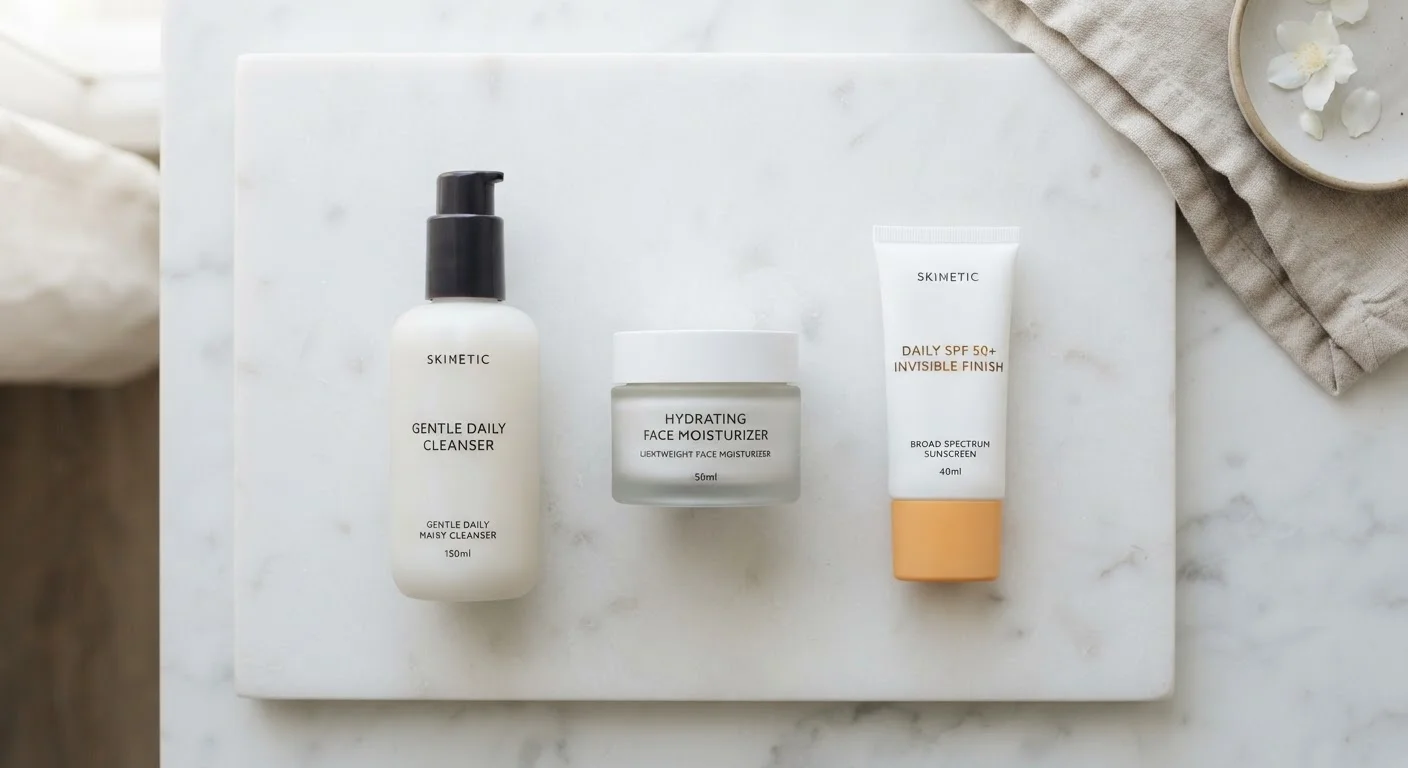
Cleanser, moisturizer, and broad-spectrum SPF form the three-step foundation consistently supported by dermatological guidance for maintaining skin health in most adults.
Clinical trials of topical retinoids, for example, typically run for 12 weeks at minimum, and most show that the greatest measurable gains in skin texture and tone occur between weeks 8 and 12 - not at week two. This means many people abandon effective ingredients just before results become visible.
The same logic applies to barrier health. Consistent moisturizer use doesn't just hydrate the surface temporarily; over time it supports the skin's ability to retain water on its own by reinforcing lipid structures within the stratum corneum. That effect compounds - but only if application is regular.
If you're unsure whether your current habits are supporting or sabotaging your skin, these signs of over-complication are worth reviewing.
Simplicity as a Strategy
One of the most counterproductive patterns in modern skincare is routine complexity. Consumers are frequently encouraged to add steps, layer products, and experiment with the latest ingredients - often all at once. This approach undermines consistency in two important ways.
First, a multi-product routine is harder to maintain daily. The more steps involved, the more friction stands between intention and follow-through. Research on habit formation consistently shows that simpler behaviors have higher adherence rates. A two-step routine completed every day beats a seven-step routine completed twice a week.
Second, adding multiple new products simultaneously makes it impossible to identify what's working or causing a reaction. Isolating variables - introducing one product at a time and waiting several weeks before adding another - is the most reliable way to learn what your specific skin responds to.
Build the Habit Before Adding Complexity
If you're starting fresh or rebuilding your routine, commit to just cleanser, moisturizer, and SPF for a full month before adding anything else. Once that habit is automatic, you can introduce one new active ingredient at a time. This approach protects your skin from overload and makes it far easier to evaluate what's actually working.
For most people, the foundational three - cleanser, moisturizer, and SPF - performed daily covers the vast majority of skin health outcomes science supports. Anything added beyond that should be introduced slowly and evaluated honestly after a full renewal cycle.
Adapting your routine seasonally is valid and often necessary - learn how seasonal shifts affect your skin - but even those adjustments should be made incrementally, not all at once.
This article is for general informational and educational purposes only and does not constitute medical or dermatological advice. For personal skin concerns, consult a qualified dermatologist or healthcare professional.
Frequently Asked Questions
Most dermatologists suggest allowing at least one full skin renewal cycle - around 4 weeks - before judging basic improvements like texture or hydration. For actives targeting pigmentation or fine lines, 8-12 weeks is more realistic. Consistency throughout that window is essential.
Not necessarily. Product efficacy depends on formulation and ingredient concentration, not price point. A well-formulated, affordable cleanser used daily will consistently outperform a luxury serum applied once a week. Frequency and regularity matter more than cost.
Occasional missed days are unlikely to derail results significantly, but habitual skipping disrupts the cumulative signal your skin needs to respond. Think of it like physical exercise - inconsistent effort produces inconsistent outcomes.
An initial purging or adjustment phase is common, particularly with exfoliating acids or retinoids, as accelerated cell turnover brings congestion to the surface faster. This typically resolves within 4-6 weeks. If irritation is severe or persistent, consult a dermatologist.
A cleanser, moisturizer, and broad-spectrum SPF form a complete and clinically supported foundation. Consistently maintaining these three steps protects barrier function and prevents photoaging - the two most impactful outcomes most people are trying to achieve.
The content on this site is for informational purposes only and is not a substitute for professional advice. Always consult a qualified professional for guidance specific to your situation.