

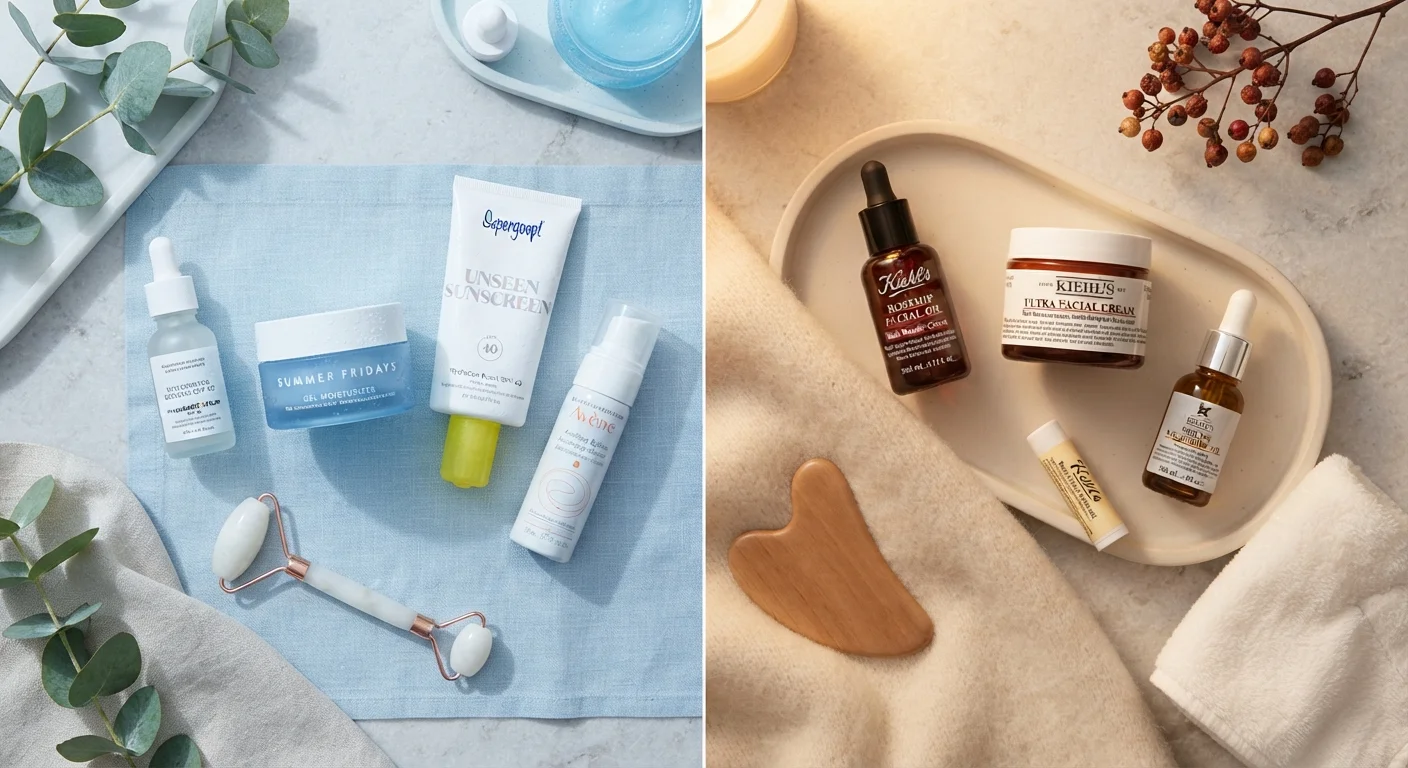
Why Seasons Disrupt Your Skin and Hair
Your skin and hair don't live in a vacuum - they respond continuously to the environment around them. In summer, higher humidity keeps the skin's outer barrier plumper and more pliable, while sweat and sebum production increase. In winter, indoor heating and cold outdoor air strip ambient moisture dramatically, and transepidermal water loss (TEWL - the rate at which water evaporates through the skin) rises significantly.
The result is that a routine calibrated for humid, warm conditions can become inadequate or counterproductive the moment the seasons shift. A lightweight gel moisturizer that felt perfect in August may leave skin feeling tight and irritated by November. A clarifying shampoo that kept oily roots in check all summer may leave a winter scalp flaky and overly sensitive.
Understanding this mechanism is the starting point. Once you see your routine as an environmental response system rather than a fixed protocol, seasonal adjustments feel logical rather than disruptive. For a deeper look at how the skin's renewal cycle interacts with routine consistency, see why consistency matters more than products.
Common Mistakes That Derail Your Winter Routine
Most seasonal skin and hair complaints trace back to a handful of predictable errors. Recognizing these patterns makes it easier to course-correct quickly rather than cycling through products looking for a solution that isn't product-related at all.
Keeping the same lightweight moisturizer through winter and expecting it to perform the same way.
Why it happens: Routines that work well tend to feel "done," so most people resist changing what wasn't broken - until the season makes it suddenly inadequate.
Dropping SPF in winter because the sun feels less intense.
Why it happens: Cold, cloudy days make UV exposure feel negligible, and this perception is reinforced when people stop burning or tanning.
Over-exfoliating to combat winter flakiness, which worsens the problem.
Why it happens: Dry, flaky skin looks like it needs physical or chemical exfoliation, and in summer that logic often holds. In winter, the flaking is frequently a barrier issue, not a cell-turnover issue.
Using the same clarifying or volumizing shampoo year-round when the scalp becomes dry in winter.
Why it happens: Hair type is often treated as fixed, so the products chosen for summer oiliness stay in the shower long after conditions have changed.
Switching every product at once when the routine stops working, making it impossible to know what helped.
Why it happens: When skin suddenly looks worse, the instinct is that everything is wrong. A full reset feels decisive, but it eliminates the ability to isolate cause and effect.
Don't Mistake Barrier Damage for Dryness
Tight, stinging, or reactive skin in winter is often a sign of a compromised skin barrier rather than simple dehydration. Piling on more products - especially those with active ingredients like retinoids or AHAs - can worsen the situation. If your skin becomes visibly inflamed, red, or painful after routine changes, step back to the most basic cleanser and moisturizer and consult a dermatologist before reintroducing actives.
If you notice persistent dryness, breakouts, or dullness after adjusting for the season, the issue may run deeper than seasonal change. Signs your current routine isn't working covers how to systematically diagnose and adjust.
Practical Adjustments That Actually Stick
Seasonal adaptation works best when it's targeted rather than total. The goal is to modify two or three key steps - not rebuild from scratch - so you maintain the consistency your skin depends on. How routine priorities shift by skin type is a useful companion read here.
~40%
Increase in TEWL in winter vs. summer
Research published in dermatology literature suggests transepidermal water loss can rise by roughly 40% in cold, low-humidity conditions compared to warm, humid environments.
80%
Of UVA rays that penetrate cloud cover
According to the Skin Cancer Foundation, up to 80% of the sun's UV rays can pass through clouds, underscoring the importance of year-round SPF use.
For skin, the highest-impact winter swap is typically your moisturizer: moving from a water-based gel to a cream or lotion with occlusive ingredients (such as petrolatum, shea butter, or squalane) helps slow TEWL. Applying it to slightly damp skin amplifies absorption. Your evening routine is especially important here - what your skin does overnight explains why nighttime is the skin's primary repair window.
For hair, consider reducing wash frequency slightly in winter and swapping to a more hydrating formula if your scalp allows. Over-washing an already-dry winter scalp accelerates moisture loss. If you're unsure whether your haircare changes are working, a structured pre-change checklist can help you make targeted decisions rather than starting over. You can also explore foundational guidance on the haircare hub.
SPF Is Non-Negotiable in Winter Too
A very common and consequential winter mistake is quietly abandoning daily sun protection. UVA radiation - the type most strongly associated with premature aging and certain skin changes - is present at relatively consistent levels throughout the year, regardless of season or cloud cover. Skipping SPF in winter, even for just a few months, means accumulated unprotected UV exposure. Build it into your morning routine as a non-negotiable step, not a warm-weather optional.
This article is for general informational purposes only and is not a substitute for advice from a qualified dermatologist or healthcare professional.
The content on this site is for informational purposes only and is not a substitute for professional advice. Always consult a qualified professional for guidance specific to your situation.