

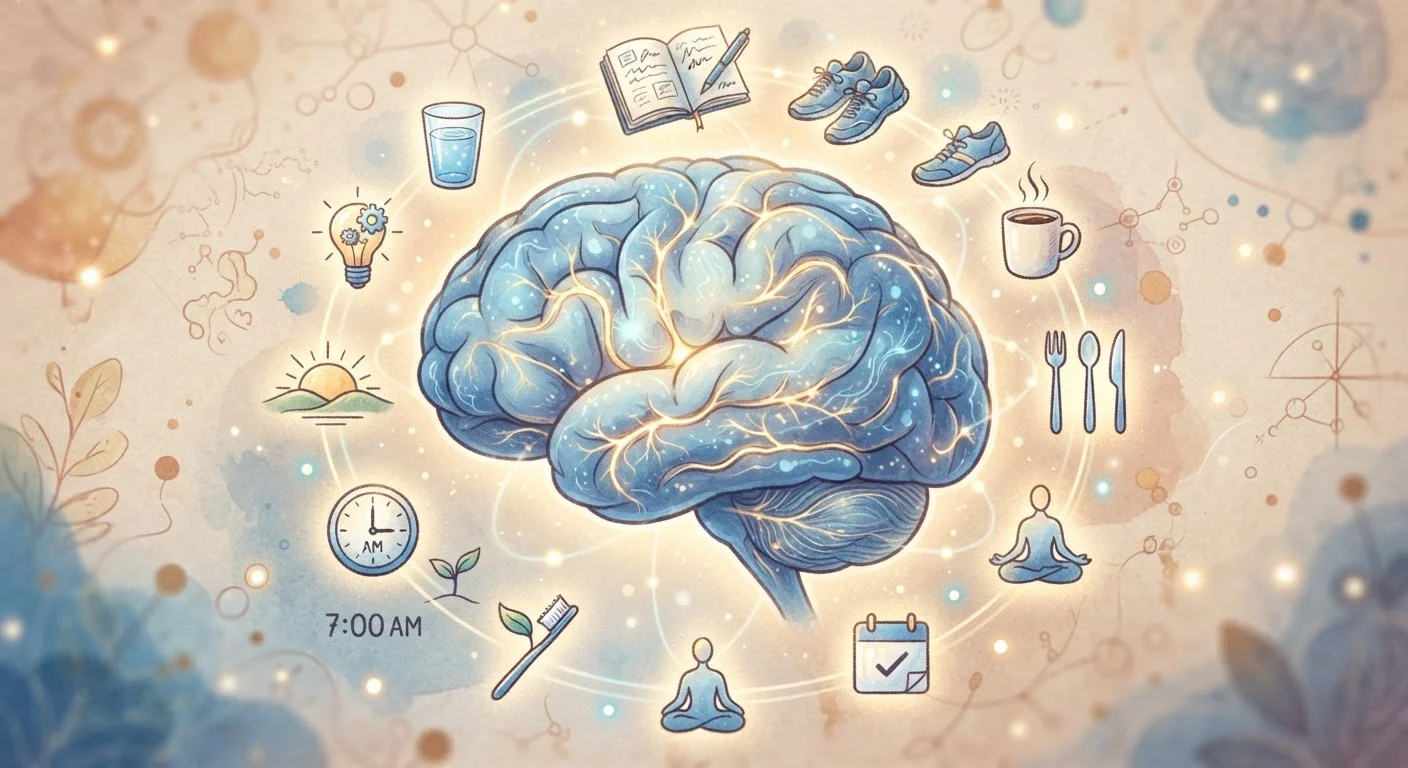
What Happens in Your Brain When a Habit Forms
Every habit you have — morning coffee, an evening walk, reaching for your phone — is the product of a biological process. When you repeat a behavior consistently in a given context, your brain begins to automate it through a region called the basal ganglia, a cluster of structures deep in the brain associated with procedural learning and motor control.
Neuroscientists describe this process as chunking: the brain compresses a sequence of actions into a single automatic routine. Once chunked, the behavior requires far less conscious effort, freeing up cognitive resources for other tasks. This is why experienced drivers can navigate familiar routes almost without thinking — the route has been chunked.
The neurochemical driver is dopamine. Contrary to popular understanding, dopamine isn't purely about pleasure — it's centrally involved in anticipation and learning. When a behavior leads to a rewarding outcome, dopamine reinforces the neural pathway, making the brain more likely to repeat that behavior when the same trigger appears. Over time, the dopamine signal actually shifts: rather than firing at the reward itself, it fires at the cue that predicts the reward — a sign that a habit has formed.
18–254
Days for a habit to become automatic
According to a 2010 University College London study by Phillippa Lally and colleagues, published in the European Journal of Social Psychology.
~66 days
Median time to habit automaticity
The same UCL study found the midpoint across participants was approximately 66 days — far longer than the commonly cited 21-day myth.
91%
Higher follow-through with implementation intentions
A meta-analysis by Peter Gollwitzer found that specifying when, where, and how a behavior will occur substantially increases the likelihood of acting on intentions.
Understanding this mechanism matters practically. It means habits are not a product of motivation or willpower alone — they are the result of repeated associations between a context, a behavior, and an outcome. You can work with this system rather than against it.
The Habit Loop: Cue, Routine, Reward
The most widely used framework in habit science — and arguably the most useful — is the habit loop: a three-part cycle of cue, routine, and reward. Originally described in research from the MIT Media Lab and later popularized in behavioral science literature, this model explains how habits are initiated, executed, and reinforced.
- Cue: A trigger that tells the brain to initiate a behavior. Cues can be a time of day, a location, an emotional state, another person, or a preceding action.
- Routine: The behavior itself — physical, mental, or emotional — that the brain has learned to execute automatically in response to the cue.
- Reward: The positive outcome that follows, which signals to the brain that the loop is worth repeating.
Most problematic habits share this same structure. Understanding that a cue and a reward are driving an unwanted routine — rather than a personal failing — is an important reframe. It also opens a practical door: you can keep the cue and the reward intact while substituting a different routine, a technique sometimes called habit substitution.
“You do not rise to the level of your goals. You fall to the level of your systems. Habits are the systems that determine what your life looks like day to day.”
— James Clear, Author and researcher on habit formation and behavioral change
For a plain-language breakdown of the terms used in habit science — including implementation intentions, identity-based habits, and behavioral activation — see our habit science glossary.
How Long Does Habit Formation Actually Take?
The often-cited claim that habits form in 21 days traces back to a misreading of a 1960 self-help book, not scientific research. The most rigorous study to examine this question — a 2010 study by Phillippa Lally and colleagues at University College London — found that automaticity developed over a range of 18 to 254 days, with a median around 66 days. The wide range reflects individual differences in the behavior, the person, and the context.
Several factors influence how quickly a habit becomes automatic:
- Simplicity of the behavior — drinking a glass of water after waking automates faster than a 30-minute workout.
- Consistency of context — performing the behavior in the same location or after the same trigger accelerates encoding.
- Reward salience — behaviors followed by immediate, noticeable rewards tend to entrench more quickly.
Give Your Habit Time Before Judging It
If a new behavior still feels effortful after two or three weeks, that's completely normal — not a sign it isn't working. Automaticity takes longer for more complex behaviors. Commit to at least six weeks of consistent repetition before evaluating whether to adjust or abandon a habit.
The practical takeaway: don't treat the first few weeks as a test of whether a habit is working. Think of the formation period as an investment. Early repetitions feel effortful precisely because automaticity hasn't arrived yet — that friction is normal, not a signal to stop.
Designing Habits You'll Actually Keep
The most robust habit-design principle from behavioral science is deceptively simple: start smaller than feels necessary. BJ Fogg, a behavioral scientist at Stanford University, has described a technique he calls Tiny Habits — anchoring a micro-behavior to an existing routine and celebrating immediately after. The goal is not performance but consistency, because consistency is what produces automaticity.
Practical design principles backed by research:
- Use implementation intentions: Rather than deciding to "exercise more," specify when, where, and how — "I will walk for 10 minutes after I finish lunch on weekdays." Studies consistently show this format significantly improves follow-through.
- Stack habits: Attach a new behavior to an existing one ("After I pour my morning coffee, I will write one sentence in my journal").
- Reduce friction: Make the desired behavior the path of least resistance. Lay out workout clothes the night before. Keep fruit on the counter, not in a drawer.
- Design your environment: Your surroundings shape behavior as powerfully as intention does. See our environment design guide for actionable spatial strategies.
Anchor your new habit to something you already do automatically — not to a scheduled time. Existing behaviors are more reliable triggers than clock-based reminders.
Automaticity research shows that context-dependent cues (like a preceding action) produce faster habit encoding than time-based cues, which are easier to override or forget.
Celebrate immediately after completing the behavior — even a small internal acknowledgment. The feeling of success is what the brain encodes, not just the action.
Dopamine reinforcement depends on a perceived positive outcome. BJ Fogg's research on tiny habits emphasizes that engineered positive emotion accelerates habit wiring.
Common Pitfalls and How to Recover
Even well-designed habits encounter disruption — travel, illness, stress, schedule changes. Research on habit maintenance suggests that missing one instance has negligible impact on long-term automaticity, provided the behavior resumes promptly. The danger is not the single miss; it is the narrative that the miss signals failure, which triggers abandonment.
One Miss Is Not a Broken Habit
The most common reason habits fail is treating a single lapse as evidence of permanent failure. Research is clear: occasional misses have minimal long-term impact. What matters is resuming as quickly as possible — ideally the very next opportunity — without self-criticism or dramatic restarts.
Other common pitfalls:
- Overly ambitious starting points: Committing to a behavior that requires high motivation leaves you with nothing when motivation dips. Scale down until the behavior feels almost too easy.
- Relying on motivation rather than systems: Motivation is variable by nature. Environmental design, scheduling, and pre-commitment devices are more reliable scaffolding.
- Conflating tracking with performing: Habit trackers are useful tools, but tracking a habit is not the same as doing it. Keep the behavior as the metric, not the streak.
If a habit stalls, diagnosing the specific point of breakdown — cue, routine, or reward — is more useful than starting over from scratch. Often a small adjustment to the trigger or context is enough to restart momentum.
Sustaining Habits for the Long Term
Sustaining a habit past the formation window depends on a handful of reinforcing factors. Identity alignment — thinking of the behavior as an expression of who you are rather than a task you must complete — is among the most consistently cited in behavioral research. Shifting from "I'm trying to run" to "I'm someone who moves every day" changes the internal motivation structure.
Social context also plays a role. Behaviors that are visible to or shared with others tend to persist longer, likely due to both social accountability and normative influence. This doesn't require formal accountability partners — even living with someone who shares a habit reinforces it.
Keystone Habits Can Cascade
Not all habits carry equal weight. Some behaviors — often involving sleep, movement, or structured routines — appear to trigger positive changes in adjacent areas of life without deliberate effort. If you can only focus on one habit at a time, prioritize the one most likely to create downstream benefits in other areas you care about.
Finally, habits exist in clusters. Research on behavioral cascades suggests that establishing one keystone habit — such as regular physical activity or consistent sleep timing — can produce downstream improvements in related behaviors without deliberate effort. Starting with one high-leverage habit often makes the next one easier.
For a structured starting point, explore our month of small habit experiments — each grounded in research and designed to be genuinely achievable alongside a normal daily schedule.
This article is for general informational and educational purposes only. It is not a substitute for professional medical, psychological, or behavioral health advice. If you have concerns about your mental health or wellbeing, please consult a qualified healthcare professional.
The content on this site is for informational purposes only and is not a substitute for professional advice. Always consult a qualified professional for guidance specific to your situation.