

Our Verdict
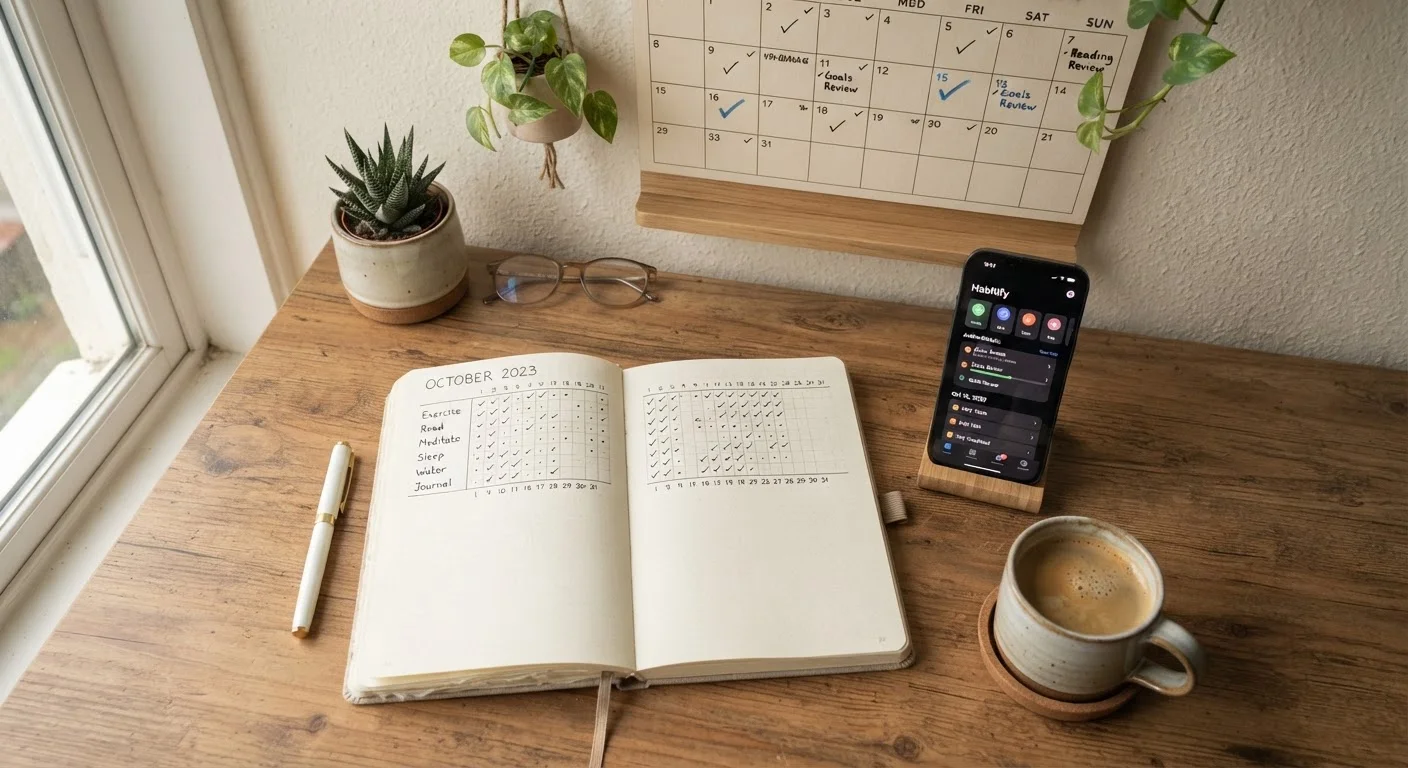
Paper journals, apps, and calendars each serve different cognitive styles and habit complexities. The most effective tool is the one you'll actually use consistently — which depends on how you prefer to process information, how many habits you're tracking, and how much friction you can tolerate in a daily routine.
| Best for | Recommended |
|---|---|
| Reflective thinkers tracking multiple habits with context | Paper Journal |
| Data-driven individuals who want reminders and progress analytics | Habit App |
| Visual, low-tech learners focused on one or two core habits | Wall or Desk Calendar |
| Those struggling with consistency in any single method | Combined Approach (Calendar + App) |
Why the Tracking Method Matters
Building a new habit is only half the challenge — maintaining awareness of it is the other. Research in behavioral psychology suggests that the act of monitoring a behavior increases the likelihood of performing it, a principle sometimes called the observer effect in self-regulation. But not every tracking format supports every person equally.
The tool you choose shapes how much friction stands between you and a daily check-in. Too much friction — complicated apps, journals you never open, calendars buried in a drawer — and tracking quietly disappears. Too little structure, and the method offers no real accountability. Understanding what each approach does and doesn't do well helps you pick one that fits your actual life, not an idealized version of it. For guidance on building the habit of tracking itself, habit stacking is a useful companion strategy.
Paper Journals: Depth Over Convenience
Writing by hand is slower than tapping a screen — and for habit tracking, that slowness can be an advantage. Studies on handwriting and memory suggest that the physical act of writing engages deeper cognitive processing than typing, which may help reinforce commitment to a habit. A paper journal also invites reflection: notes, context, and mood can accompany a simple checkmark, giving you richer data over time.
The downsides are real, though. Journals don't send you reminders, can't calculate streaks automatically, and require you to carry them or remember to find them. They work best for people who already journal, enjoy analog routines, or are tracking a small number of habits with qualitative nuance — things like sleep quality, stress levels, or emotional states that resist a simple yes/no format.
Keep Your Tracker Where You'll See It
Location is often the deciding factor in whether a tracking system sticks. Place your journal on your pillow, set your app widget on your home screen, or hang your calendar at eye level near a daily touchpoint like the coffee maker. Reducing the distance between habit and tracker — literally — lowers the chance you'll forget to log.
If you're new to paper tracking, a simple grid — days of the month across the top, habits down the side — is all you need. Elaborate layouts aren't required for results.
Habit Apps: Structure With a Learning Curve
Dedicated habit apps offer features that paper simply cannot: automated reminders, streak counters, visual progress charts, and sometimes community accountability. For people who spend significant time on their phones anyway, the low friction of a two-tap check-in is a genuine advantage. Streak-based tracking can be a powerful short-term motivator, though research also shows that streak pressure can backfire — leading to anxiety or quitting entirely after a missed day.
Apps tend to serve data-oriented personalities well, particularly when tracking several habits simultaneously. The risk is notification fatigue: once app alerts blend into the background buzz of a smartphone, the accountability function disappears. Periodically reviewing your app's data — rather than just logging — extracts more value from the format. Before adding more habits through any app, a structured weekly audit can help you assess what's genuinely working.
40%
Of daily actions driven by habit
Research published in the journal Personality and Social Psychology Bulletin estimates roughly 40% of daily behaviors are habitual rather than deliberate decisions.
66 days
Average time to form a new habit
A study by Phillippa Lally and colleagues at University College London found habit automaticity developed on average after 66 days, though individual ranges varied widely.
Calendars: Simple, Visible, Underrated
A standard wall or desk calendar is arguably the most underrated habit tracking tool. Its power is environmental: placed where you'll see it every day — a kitchen wall, a desk — it provides a passive, persistent reminder without any device interaction. The classic "don't break the chain" method, popularized in productivity circles, uses exactly this format: mark each successful day with an X and let the growing chain become its own motivation.
Calendars work best for single-habit goals with a binary outcome (did it or didn't). They lack the nuance of a journal and the analytics of an app, but their visibility and near-zero friction make them surprisingly effective for habit beginners or anyone who has struggled with more complex systems. If you're experimenting with new routines, a month of small habit experiments pairs naturally with a simple calendar tracker.
| Paper Journal | Habit App | Wall/Desk Calendar | |
|---|---|---|---|
| Ease of setup | Immediate, no tech needed | Moderate — account and configuration | Immediate, no tech needed |
| Daily friction | Low if journal is accessible | Very low with reminders enabled | Near zero — always visible |
| Reminder capability | None — self-initiated only | Automated push notifications | Passive visual cue only |
| Depth of reflection | High — notes and context easy | Low to moderate | Minimal — binary marking |
| Progress analytics | Manual — visual scan only | Automatic charts and streaks | Basic — chain length only |
| Best habit volume | 1–5 habits with nuance | 3–10+ habits simultaneously | 1–2 simple habits |
| Ideal user style | Reflective, analog-oriented | Data-driven, tech-comfortable | Visual, minimalist, beginner |
Choosing the Right Fit — or Combining Methods
There is no universal winner. The most effective habit tracker is the one that reduces friction enough for you to use it daily without thinking much about it. Ask yourself: Do I prefer writing or tapping? Do I want to analyze data or simply log completion? Am I tracking one habit or several?
A combined approach can address gaps in any single method. A visible calendar can anchor a morning routine habit while an app tracks more complex, data-dependent behaviors like hydration or movement. The key is keeping the total system simple enough that maintaining it doesn't itself become a burdensome habit. For daily routines of any kind — health-focused or otherwise — the same principle applies: the simpler the system, the more likely it endures.
This article is for general informational purposes only and is not a substitute for personalized advice from a qualified health or behavioral professional.
The content on this site is for informational purposes only and is not a substitute for professional advice. Always consult a qualified professional for guidance specific to your situation.