

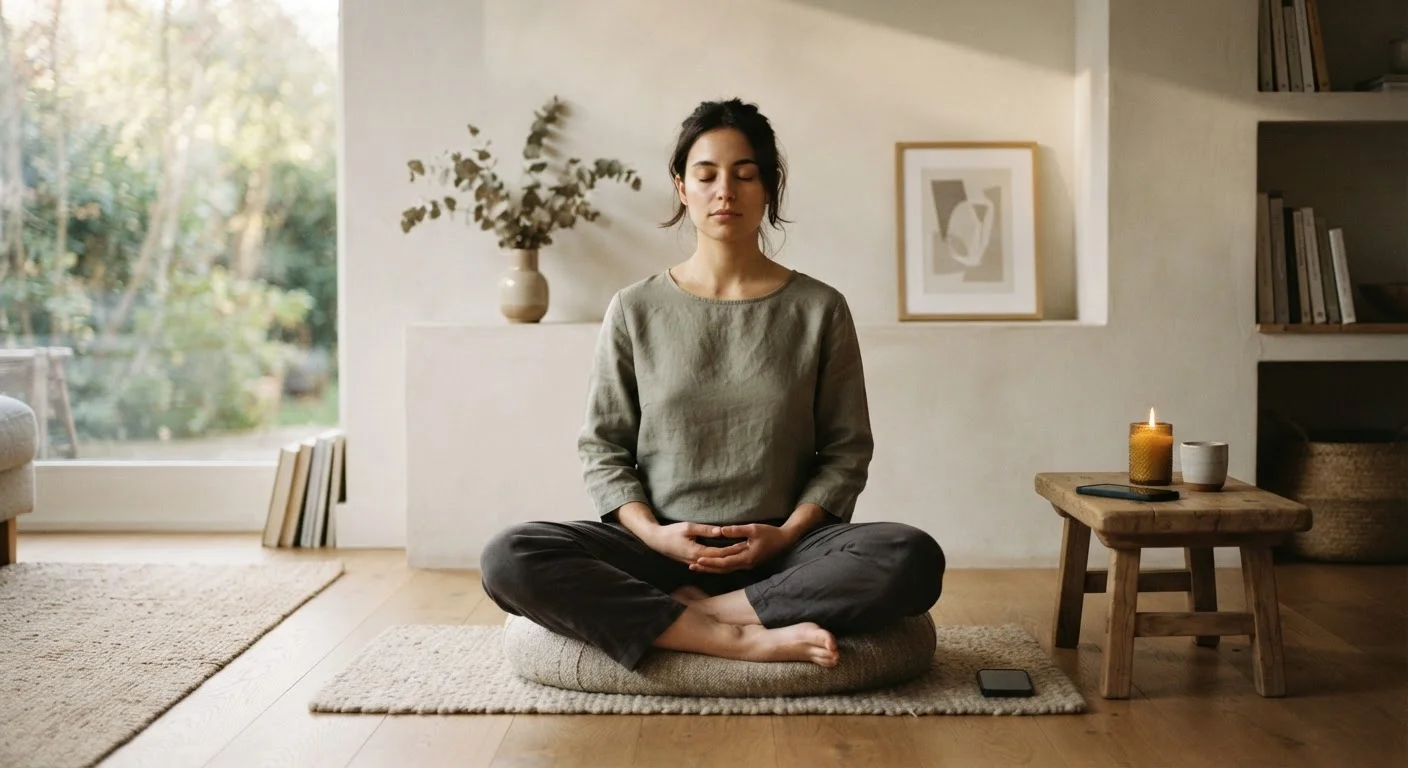
Option A
App-Guided Mindfulness
The structured, audio-led approach for consistent support.
Best for: People who are new to mindfulness or want reliable session-by-session guidance and accountability.
Option B
Self-Directed Mindfulness
The autonomous, internalized practice for experienced meditators.
Best for: Practitioners who have built foundational skills and want to deepen awareness on their own terms.
What Actually Changes When the Guide Disappears
Mindfulness apps work by externalizing the structure of a session. A narrator tracks the time, cues the breath, signals transitions, and anchors attention when it drifts. That scaffolding is genuinely useful — but it also means the app is doing cognitive work that, over time, the practitioner would ideally be doing independently.
When you remove the guide, several things shift simultaneously. You become responsible for initiating and sustaining attention, judging when the mind has wandered, and deciding when a session is complete. For someone with an established practice, this feels natural. For someone still learning, it can feel like the floor dropping out.
This isn't a flaw in either format — it reflects a developmental arc. If you're entirely new to the practice, our beginner's guide to mindfulness covers the foundational concepts worth understanding before choosing a format.
| Criterion | App-Guided Mindfulness | Self-Directed Mindfulness |
|---|---|---|
| Structure | Externally provided by narrator | Internally generated by practitioner |
| Best entry point | Beginners and returners | Experienced practitioners |
| Equipment needed | Phone, app, often earbuds | None |
| Consistency support | Streaks, reminders, programs | Relies on self-motivation |
| Skill-building depth | Moderate — guide handles key cues | Higher — practitioner manages all cues |
| Portability | Limited by device and connectivity | Fully portable, always available |
| Informal integration | Less natural mid-day | Integrates easily into daily moments |
The Case for Staying App-Guided
Guided apps lower the activation energy needed to begin a session. Research into habit formation consistently shows that reducing friction — the effort required to start a behavior — is one of the most reliable ways to build consistency. An app that opens to a ready-to-play session eliminates the planning burden that often causes self-directed attempts to stall.
There's also a motivational dimension. Structured programs with progressive sessions, streaks, and varied content maintain novelty, which can sustain engagement through the early weeks when practice hasn't yet become intrinsically rewarding. For people managing busy schedules or high baseline stress, that external momentum matters.
The limitation is real, though: when the app is unavailable — dead battery, no headphones, travel disruption — the practice tends to disappear with it. Dependency on the external guide can quietly prevent the internal skill from maturing.
~14%
U.S. adults who meditate regularly
According to a National Health Interview Survey analysis, roughly 14% of U.S. adults reported meditating in the past 12 months, a figure that roughly tripled between 2012 and 2017.
8 weeks
Typical study duration showing stress reduction
Mindfulness-Based Stress Reduction (MBSR) programs, which are among the most studied formats, are structured as eight-week courses — a benchmark widely referenced in clinical research.
2–3×
More likely to sustain habit with accountability
Behavioral research consistently finds that external accountability mechanisms — reminders, progress tracking, social prompts — can substantially increase short-term habit adherence compared to intention alone.
The Case for Going Self-Directed
Self-directed practice is where many researchers and long-term teachers believe the deepest benefits emerge. When you hold the entire structure of a session — intention, attention regulation, and meta-awareness — you are exercising the very cognitive capacities mindfulness is designed to strengthen. The practice and the skill become the same thing.
Informally, self-directed mindfulness integrates more naturally into daily life. A two-minute breath-awareness pause at a desk, a mindful walk between meetings, a deliberate moment of present-focus before a difficult conversation — none of these require an app. This kind of informal integration is explored in more depth in our companion piece on formal vs. informal mindfulness practice.
The entry barrier is higher. Without foundational technique, self-directed sessions can drift into unfocused sitting rather than genuine mindfulness. The distinction matters: passive mind-wandering and deliberate attention regulation look similar from the outside but are neurologically distinct.
Mind-Wandering Is Not Failure
A common misconception is that a 'good' mindfulness session involves an empty mind. Established research frames mind-wandering as a natural feature of cognition — the practice lies in noticing it and returning attention, not preventing it entirely. Both app-guided and self-directed formats work with this reality; the guide simply makes the noticing step more explicit early on.
How to Know When You're Ready to Transition
There's no fixed timeline, but several indicators suggest a practitioner has internalized enough to practice independently. If you can accurately notice when your attention has wandered and gently return it — without the app prompting you — that's a meaningful signal. If you find yourself anticipating the narrator's cues before they arrive, the guide may no longer be adding value.
The transition doesn't have to be abrupt. Many practitioners use a hybrid approach: app-guided sessions during high-stress periods or when re-establishing consistency, and self-directed practice when conditions allow. This flexibility is a feature, not a compromise.
If you want a structured way to evaluate where your current practice stands, our mindfulness self-audit checklist offers a practical framework. For making the most of shorter sessions in either format, see our guidance on getting more out of a short mindfulness session.
This article is for general informational and educational purposes only and is not a substitute for professional mental health advice, diagnosis, or treatment. If you are experiencing significant psychological distress, please consult a qualified healthcare professional.
The content on this site is for informational purposes only and is not a substitute for professional advice. Always consult a qualified professional for guidance specific to your situation.