

What R-Value Actually Means
R-value is the single most important number in insulation shopping — and one of the most misunderstood. It measures a material's resistance to heat flow: the higher the R-value, the better the material slows the transfer of heat. R-value is additive, so two layers of R-13 batts together yield R-26.
Critically, R-value measures conductive heat resistance only. It doesn't account for air leaks or moisture — two separate (and sometimes larger) contributors to energy loss. This means a high-R wall can still perform poorly if it isn't properly air-sealed. Insulation and air-sealing are complementary strategies, not interchangeable ones.
The U.S. Department of Energy publishes recommended R-values by climate zone and home location (attic, walls, floors, crawlspaces). Homes in colder northern climates typically need higher R-values — attic recommendations range from around R-38 to R-60 — while warmer southern climates may call for R-30 to R-38 in attics. Always verify what applies to your specific ZIP code before purchasing materials.
Common Insulation Materials: A Plain-Language Comparison
No single insulation material is right for every location or budget. Each has trade-offs across cost, ease of installation, moisture resistance, and performance.
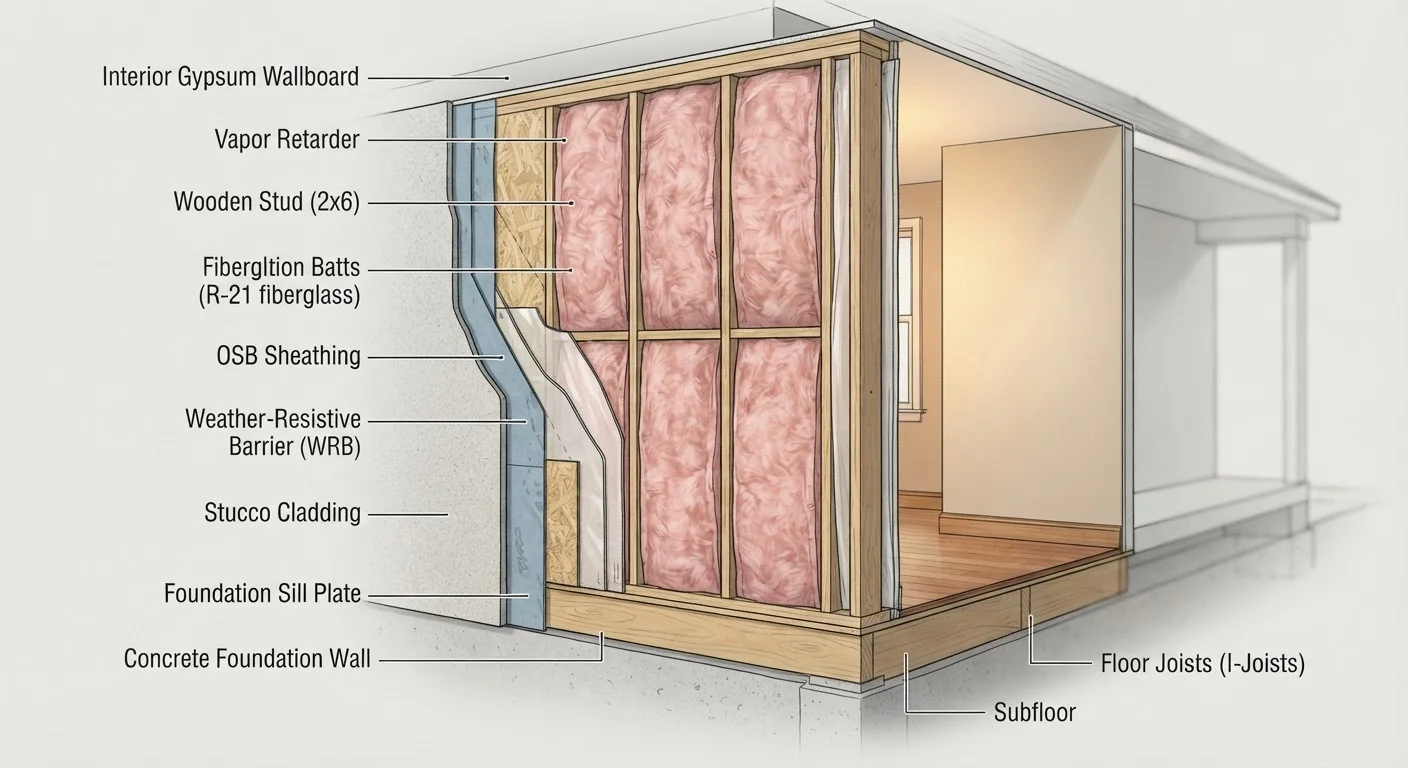
- Fiberglass batts: The most familiar type — the pink or yellow rolls found in hardware stores. Designed to fit between standard stud and joist spacing. Easy to handle but must be installed without gaps or compression to reach rated R-value.
- Mineral wool (rock wool or slag wool): Denser than fiberglass, with better fire resistance and some moisture tolerance. Generally performs more consistently even with minor installation imperfections.
- Blown-in cellulose: Made from recycled paper, treated with fire retardant. Works well for filling irregular spaces, especially attic floors. Settles over time, which can reduce effective R-value.
- Spray polyurethane foam (SPF): Available in open-cell (lower R-value, softer) and closed-cell (higher R-value, also acts as vapor barrier) forms. Excellent air-sealing properties, but professional installation is nearly always required. Costs significantly more than batt insulation.
- Rigid foam boards: Polystyrene or polyisocyanurate panels used on exterior walls, under slabs, and in basements. High R-value per inch, moisture-resistant, but requires careful sealing at edges and joints.
Installation quality matters as much as material choice. A perfectly specified product installed with gaps or compression will underperform a simpler material installed correctly. See when licensed professionals are required — spray foam, in particular, often warrants professional involvement due to off-gassing and application complexity.
Where Heat Actually Escapes: Prioritizing the Right Spots
Most homes lose heat through a handful of predictable locations. Knowing these lets you prioritize improvements rather than insulating blindly.
Attic and Ceiling
Heat rises, making the attic the single highest-priority location in most homes. An under-insulated attic can account for a significant share of total heating and cooling loss. The attic floor (or the roof deck in unvented designs) is typically the most cost-effective place to add insulation.
Walls
Exterior walls matter, but are harder and more expensive to improve after construction. In older homes, cavities are often partially filled or empty. Dense-pack blown-in insulation through small holes is a less invasive retrofit option than opening drywall.
Floors Over Unconditioned Spaces
Floors above garages, crawlspaces, or open foundations lose significant heat through the bottom. Insulating between floor joists — or insulating the crawlspace walls — improves comfort and energy performance.
Basement Walls and Rim Joists
The rim joist (where floor framing meets the foundation) is a consistently overlooked air leak point. It's often accessible and relatively straightforward to address with cut-and-cobble rigid foam or spray foam.
Air Leaks Around Penetrations
Gaps around electrical boxes, plumbing pipes, recessed lighting, and attic hatches can collectively rival the heat loss of an open window. Sealing these before adding insulation dramatically improves real-world performance. Insulation improvements are among the home upgrades most likely to improve daily comfort, particularly in homes built before the 1980s.
The content on this site is for informational purposes only and is not a substitute for professional advice. Always consult a qualified professional for guidance specific to your situation.