

Start here
What a Budget Actually Is (and Isn't)
Step 1
Step 1: Know Your Take-Home Income
Step 2
Step 2: List Every Expense
Step 3
Step 3: Choose a Framework That Fits
Step 4
Step 4: Track Your First Month
Next steps
Where to Go From Here
What a Budget Actually Is (and Isn't)
A budget is not a punishment. It's a plan — a written record of where your money is going before it quietly disappears. The goal isn't to cut everything enjoyable out of your life; it's to make deliberate choices so spending reflects your actual priorities.
Net income
The amount you actually receive after taxes and deductions are taken out of your paycheck — the real number available for spending and saving.
Fixed expense
A cost that stays the same each month, such as rent or a car payment, making it predictable but harder to reduce quickly.
Variable expense
A cost that changes month to month based on your choices, like groceries, dining out, or entertainment — this is where most budgeting flexibility lives.
50/30/20 rule
A simple budgeting framework that splits take-home pay into three buckets: 50% for needs, 30% for wants, and 20% for savings or debt repayment.
Zero-based budgeting
A method where every dollar of income is assigned a specific purpose so that income minus all planned expenses equals zero — leaving nothing unaccounted for.
Pay yourself first
A savings strategy where you automatically move money to savings or debt repayment as soon as income arrives, before spending on anything else.
Many first-time budgeters avoid starting because they fear seeing how bad things are. But clarity is the point. You can't improve what you haven't measured. A budget gives you a factual starting line, not a verdict on your character.
This guide is organized as general financial education, not personalized advice. For decisions specific to your situation — especially if you're carrying significant debt or facing a financial hardship — consider speaking with a licensed financial counselor or adviser.
Step 1: Know Your Take-Home Income
Before you can plan spending, you need to know what you're working with. Use your net income — the amount that actually lands in your bank account after taxes, Social Security, and any pre-tax deductions like health insurance or a 401(k). This is the real number your lifestyle runs on.
If your income is consistent, one recent pay stub is enough. If it varies — due to hourly shifts, freelance work, or gig income — average your last three to four months and use that as a conservative baseline. Overestimating irregular income is one of the most common early budgeting mistakes.
Use Net Pay, Not Your Salary
It's tempting to plan around your annual salary figure, but your take-home pay after taxes and deductions is what you actually control. Always base your budget on net income — the number that hits your bank account. Using gross pay leads to budgets that look balanced on paper but routinely fall short in practice.
Write this number at the top of a blank page or spreadsheet. Every decision in your budget flows from it.
Step 2: List Every Expense
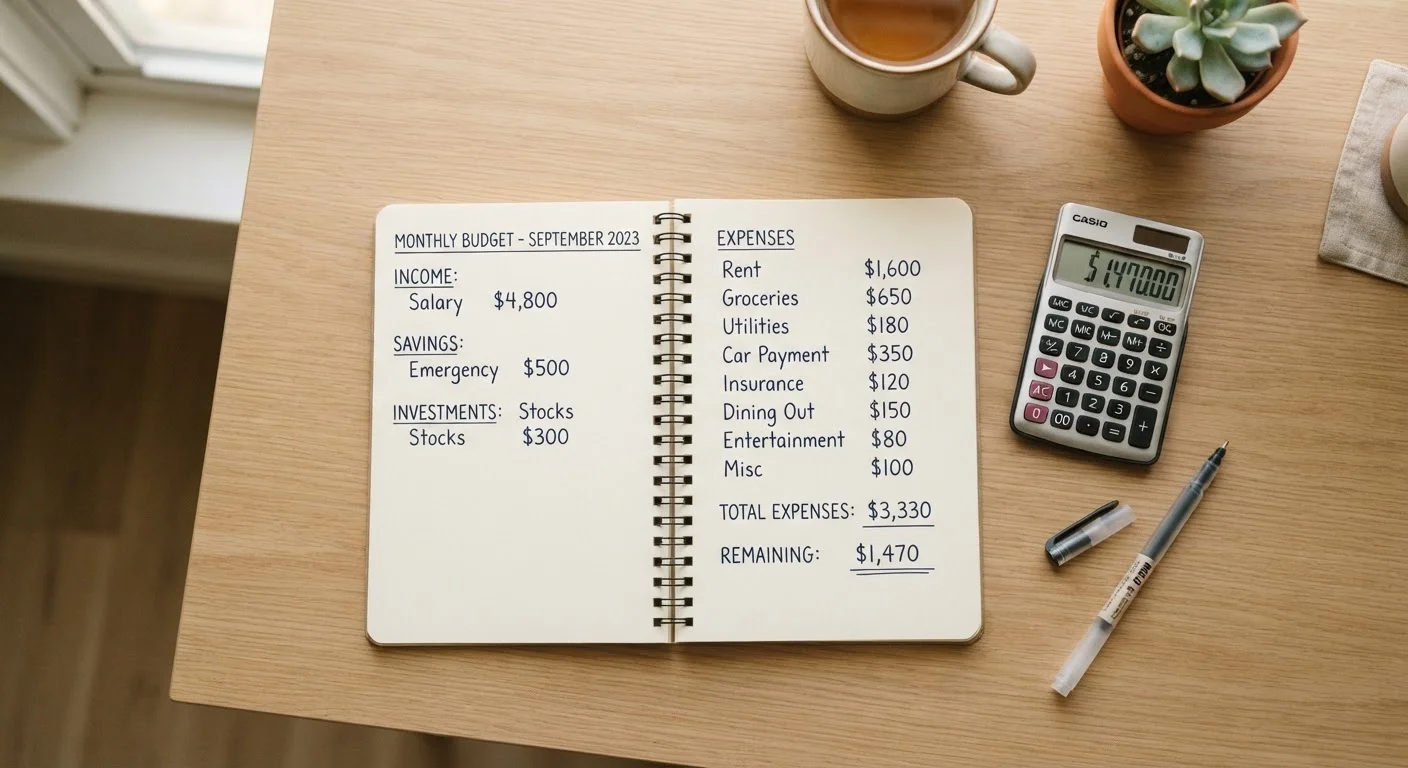
Next, write down everything you spend money on — not what you think you spend, but what your bank and credit card statements actually show. Pull the last two months of statements and go line by line.
Organize expenses into two types:
- Fixed expenses: Costs that stay the same each month — rent or mortgage, car payment, insurance premiums, subscriptions.
- Variable expenses: Costs that fluctuate — groceries, dining out, gas, clothing, entertainment, personal care.
Fixed expenses are harder to change quickly. Variable expenses are where most adjustment happens. Seeing this split clearly often surprises people — and that surprise is useful information.
Don't forget irregular expenses: annual fees, car registration, holiday gifts. Divide these by 12 and add them as a monthly line item so they don't blindside you later.
Step 3: Choose a Framework That Fits
Once you know your income and expenses, you need a structure. Frameworks give you guardrails without requiring you to track every penny forever. Here are three commonly used approaches:
- 50/30/20 Rule
- Allocate 50% of take-home pay to needs (housing, food, utilities, transportation), 30% to wants (dining, entertainment, hobbies), and 20% to savings or debt repayment. This is the most beginner-friendly starting point.
- Zero-Based Budgeting
- Assign every dollar a purpose so income minus expenses equals zero. This method demands more attention but leaves nothing unaccounted for.
- Pay Yourself First
- Automatically move a set amount to savings or debt payoff immediately when income arrives, then budget the remainder. This builds savings as a non-negotiable habit rather than an afterthought.
None of these frameworks is universally superior. Start with whatever creates the least friction — a budget you'll use beats a perfect one you abandon. For a more detailed monthly breakdown process, see Building a Monthly Budget From Scratch.
Your Framework Can Evolve
The framework you start with doesn't have to be permanent. Many people begin with the 50/30/20 rule for simplicity, then shift to zero-based budgeting once they want tighter control over specific categories. What matters most in the beginning is picking one approach and sticking with it long enough to gather real data about your spending habits.
Step 4: Track Your First Month
A budget on paper is a hypothesis. Your first month of tracking tests it against reality.
Pick a tracking method you'll actually sustain: a notes app, a free spreadsheet, a budgeting app, or even a small notebook. At least once a week, log what you spent in each category and compare it to your plan. This weekly check-in is what turns a budget from a one-time document into a live financial tool.
Expect to be wrong. Most first-month budgets underestimate grocery spending, forget a subscription or two, and misjudge variable categories. That's normal. The goal is not perfection — it's awareness. Every discrepancy between your plan and your reality is a data point telling you something true about your habits.
Understanding why you spend the way you do is just as important as tracking the numbers. The Complete Guide to Understanding Your Own Spending Patterns covers the behavioral side of spending in detail.
Don't Abandon Your Budget After One Bad Month
An overspent category in month one is not a sign that budgeting doesn't work for you — it's a sign your initial estimates needed calibration. Resist the urge to quit when the first month feels messy. Adjust the plan, not your commitment to the process. Most budgets don't feel natural until the third or fourth month of practice.
Where to Go From Here
After one full month of tracking, you'll have something most people never build: a factual, personalized picture of your financial life. From here, the work becomes refinement — adjusting categories, building an emergency fund, and eventually connecting your budget to longer-term goals.
Budgeting also changes as your life does. Income shifts, families grow, goals evolve. The Complete Picture: Budgeting Across Every Stage of Adult Life walks through how priorities shift from your first paycheck to retirement planning.
Once your budget is stable and you're consistently setting money aside, the natural next step is making that money work for you. Investing for the First Time is a practical introduction to the concepts every beginner needs before putting money to work. The broader Investing hub covers those ideas in more depth.
The most important thing now is to start — not when you earn more, not after the next bill clears, but with the income and information you have today.
This article is for general informational and educational purposes only and does not constitute personalized financial, tax, or legal advice. For guidance specific to your financial situation, consult a qualified and licensed financial professional.
Frequently Asked Questions
You can budget at any income level — the process works whether you earn $1,500 or $15,000 a month. Budgeting is simply telling your money where to go. Starting when money is tight is often when it matters most.
The 50/30/20 rule is widely recommended as a starting point because it requires only three categories: needs, wants, and savings or debt repayment. It's flexible enough to adapt as your situation changes.
Either works — the best tool is the one you'll actually use. A simple notebook or a free spreadsheet is perfectly sufficient for your first month. Apps can add automation later once you've established the habit.
That gap is exactly what a budget is designed to surface. Once you see it clearly, you can evaluate which variable expenses to reduce and whether there are income opportunities to pursue. A qualified financial counselor can help if the shortfall is significant.
Most people notice clearer financial awareness within the first month. Meaningful savings or debt progress typically appears over three to six months of consistent tracking and adjustment.
Yes — even comfortable earners benefit from intentional planning. Without a budget, money tends to drift toward unplanned spending rather than goals like building savings, investing, or future purchases.
The content on this site is for informational purposes only and is not a substitute for professional advice. Always consult a qualified professional for guidance specific to your situation.