

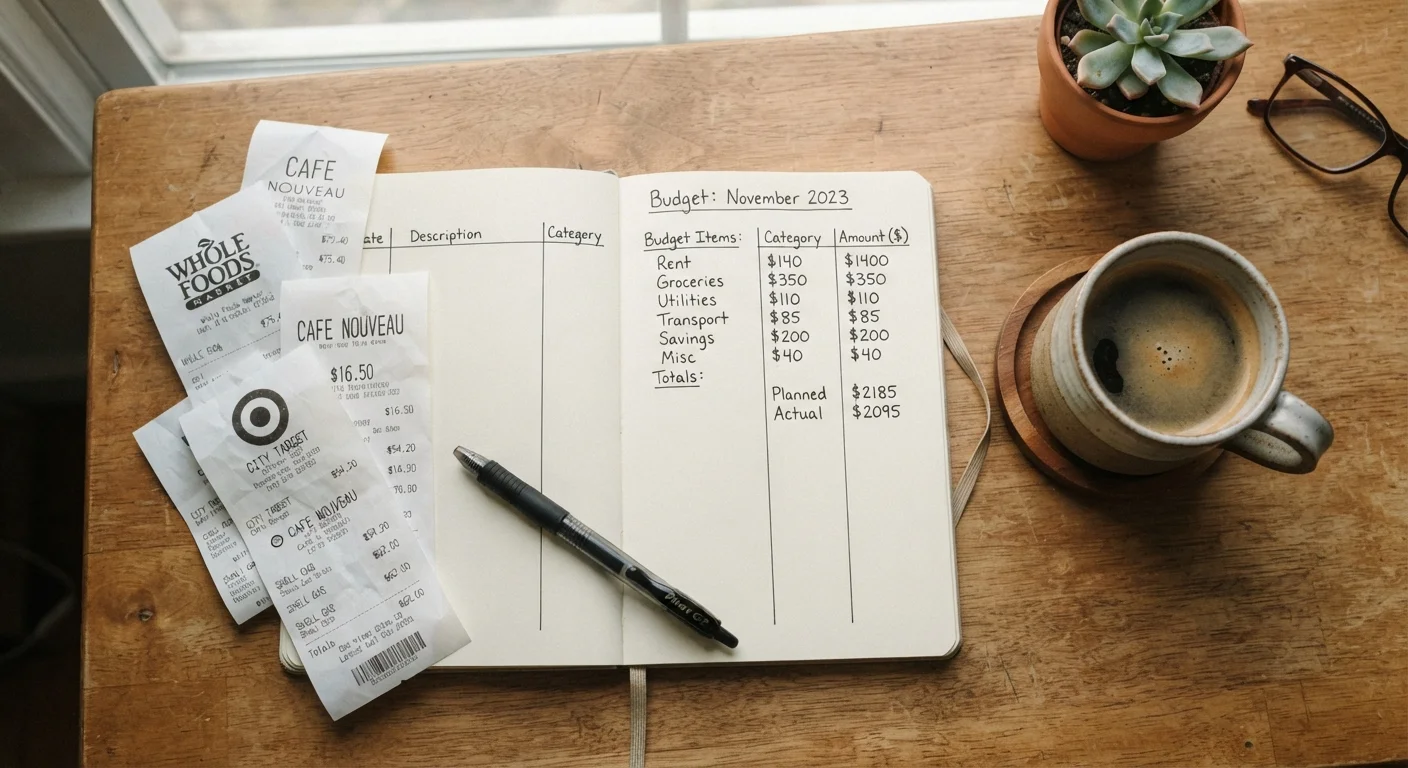
Why Spending Patterns Matter More Than Budgets
A budget tells you where money should go. Your spending pattern reveals where it actually goes — and why. That gap between intention and reality is where most financial frustration lives.
Patterns are more useful than snapshots. A single month's bank statement might look unusual due to a car repair or a holiday trip. But three months of data starts to expose recurring tendencies: categories you consistently overspend, subscriptions you forgot you had, or purchases that feel urgent in the moment but don't hold up on reflection.
Understanding your patterns is also the prerequisite for any meaningful budgeting work. Without that honest baseline, even a well-structured budget becomes guesswork. See our guide to thoughtful spending decisions for a broader framework on evaluating purchases with clarity before you get into the numbers.
Start With Observation, Not Judgment
When you first map your spending, resist the urge to immediately label categories as 'good' or 'bad.' Simply document what you find. Judgment too early in the process leads to rationalization rather than honest assessment — and accurate data is the only foundation that actually helps.
The Psychology Behind How You Spend
Spending is rarely as rational as we'd like to think. Several well-documented behavioural tendencies shape purchasing decisions without most people realizing it.
- Present bias: We tend to over-value immediate rewards relative to future ones. This is why a purchase feels more compelling right now than it will after a night's sleep.
- Anchoring: The first price you see shapes your sense of what's reasonable — even if that reference point is arbitrary.
- Social comparison: Purchases often signal status or belonging, sometimes unconsciously. Spending in categories where you feel socially visible tends to drift upward over time.
- Mental accounting: People treat money differently depending on how they received it — a tax refund feels more expendable than a paycheck, even though it's identical in value.
None of these tendencies make you a poor decision-maker. They're shared human traits. Recognizing them is simply the first step to making them less automatic. For a structured look at how these factors interact in a single purchase decision, see The Anatomy of a Smart Shopping Decision.
Before categorizing spending, flag every transaction where you felt mild regret or uncertainty afterward — even briefly. That emotional signal is often more informative than the dollar amount.
Regret is a useful diagnostic tool. It indicates a misalignment between the purchase and your actual values, which raw category totals won't surface on their own.
Track spending in at least three consecutive months before drawing conclusions. One month is nearly always distorted by a one-time expense or an atypical week.
Behavioural research consistently shows that people underestimate their average spending when relying on a single recent period, particularly in discretionary categories.
How to Map Your Actual Spending
Mapping spending accurately requires pulling data rather than relying on memory. Memory is selective and tends to minimize spending in categories we feel ambivalent about.
- Gather 60–90 days of transactions from every account you use — checking, credit cards, digital wallets. One source is rarely the complete picture.
- Categorize every transaction — housing, food, transport, subscriptions, entertainment, personal care, and so on. Use whatever groupings feel meaningful to your life, not a generic template.
- Flag recurring versus discretionary items. Fixed costs (rent, insurance, loan payments) are distinct from variable discretionary spending. Both matter, but they require different kinds of attention.
- Calculate category totals and express them as a percentage of take-home income. Percentages are more useful than dollar amounts for comparing across months or life stages.
A structured checklist for this exact process is available in our practical spending audit.
~30%
Average share of income spent on housing
The U.S. Bureau of Labor Statistics Consumer Expenditure Survey consistently finds housing accounts for roughly 30% of average household spending, though this varies significantly by region and income level.
48 hours
Delay window that reduces impulse purchases
Consumer behaviour research broadly supports a short deliberate pause before non-urgent purchases as an effective, low-effort method for reducing regretted spending.
Evaluating Value, Timing, and Trade-Offs
Once you can see where your money goes, the more important question is whether that allocation reflects what you actually value.
Value
Value is personal and contextual. A gym membership that costs $60/month is excellent value if you use it regularly and it supports your health; it's poor value sitting unused. Ask: does this spending produce outcomes — practical, emotional, or social — that I'd consciously choose if I were designing my own life?
Timing
Some spending is time-sensitive by nature (a needed repair, a perishable item). But much discretionary spending benefits from a deliberate pause. A 48-hour delay before non-urgent purchases is a simple mechanical filter that catches impulse decisions without requiring willpower.
Trade-Offs
Every dollar spent is a dollar not available for something else. Opportunity cost — what you give up — is rarely visible at point of purchase but always real. Naming the trade-off explicitly ("this weekend trip means I won't hit my savings target this month") doesn't mean the choice is wrong, but it makes it a conscious one.
Opportunity Cost Is Always Real
Every spending decision has a trade-off, even when it feels invisible. Money committed to one category is unavailable for another — whether that's an emergency fund, a future goal, or debt reduction. Making trade-offs conscious rather than hidden is one of the most impactful shifts in spending awareness. It doesn't require saying no more often — just knowing what you're saying yes and no to at the same time.
Building More Intentional Spending Habits
Lasting change in spending behaviour rarely comes from motivation alone. It comes from changing the structure around decisions.
- Automate savings before spending: Moving money to savings at the moment income arrives removes the temptation to spend it first. This is sometimes called "paying yourself first."
- Use friction deliberately: Remove stored card details from retail sites, unsubscribe from promotional emails, or set a small waiting period rule for purchases above a threshold you define.
- Review monthly, not just at crisis points: A 15-minute monthly check of your spending categories prevents drift from becoming a pattern. It's much easier to correct a small misalignment than a large one.
- Separate aspiration from necessity: It helps to keep a written list of future goals — a trip, a home improvement, an emergency fund target — visible when making discretionary spending decisions. Concrete alternatives compete more effectively with impulse purchases than abstract savings goals.
If you're newer to this process, the ground-up guide to building your first budget walks through foundational steps. For a longer-term view, budgeting across every stage of adult life covers how financial priorities shift over time. The Consuming hub also gathers core consumer knowledge for more intentional everyday decisions.
This article is for general informational and educational purposes only and does not constitute personalised financial advice. For guidance specific to your circumstances, consult a qualified financial professional.
The content on this site is for informational purposes only and is not a substitute for professional advice. Always consult a qualified professional for guidance specific to your situation.