

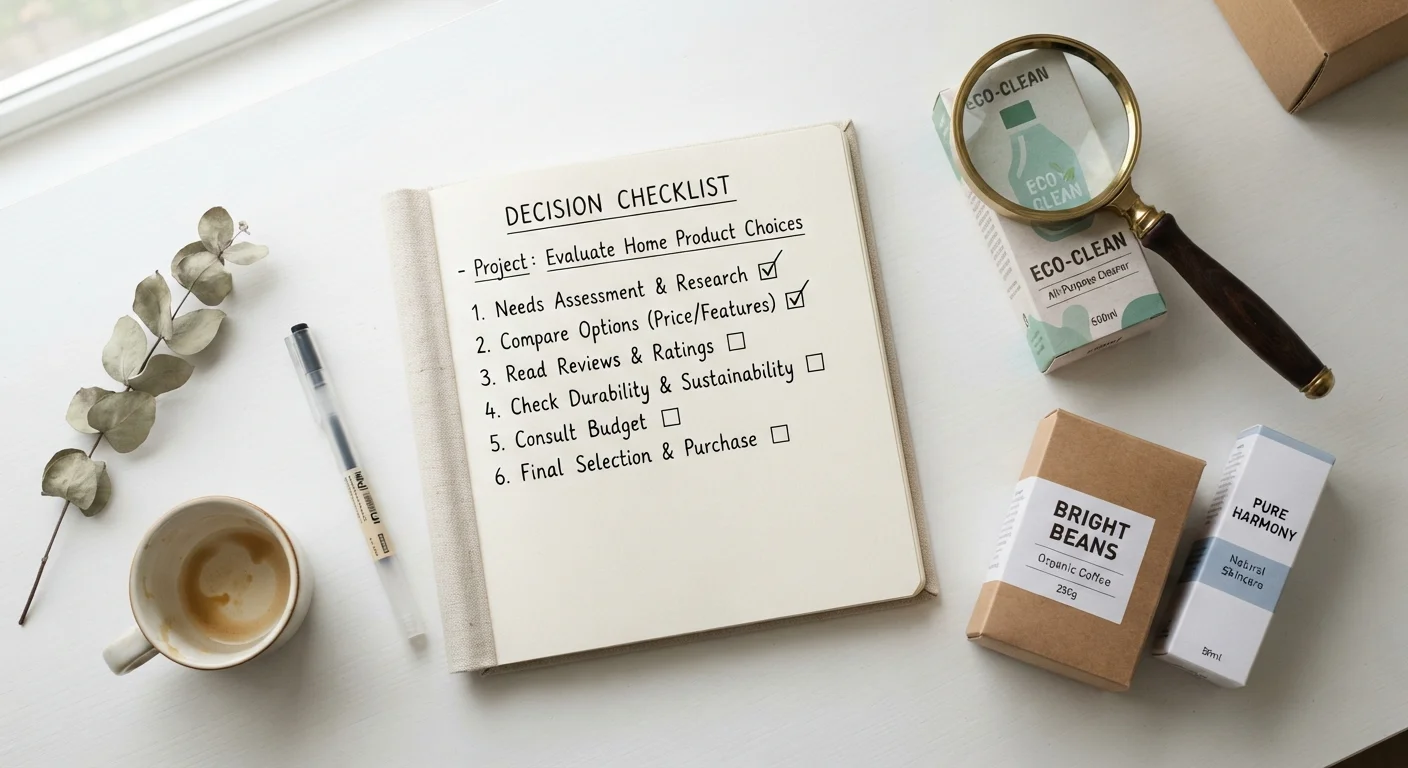
Start With the Actual Need, Not the Product
The most common shopping mistake happens before anyone opens a browser: people shop for a product category when they should be shopping for a solution to a specific problem. A reader who walks into a purchase knowing exactly what gap they need to fill — not just "I need a blender" but "I need something that handles frozen ingredients daily without constant cleaning" — will make a categorically different decision than one who browses by brand reputation alone.
This distinction matters because manufacturers design products for broad markets, not your specific situation. A feature that justifies a higher price point for one household is dead weight for another. Before evaluating anything, write down the primary job this purchase needs to do, the context in which you'll use it, and any hard constraints like space, budget ceiling, or compatibility with things you already own.
Understanding the difference between impulse and considered purchases is also worth revisiting at this stage — sometimes the "need" itself is worth interrogating before any money changes hands.
Write the Problem Before You Search
Before opening any shopping tab, write one or two sentences describing the specific problem you're solving. This anchors your research and makes it easier to reject products that don't fit — no matter how well-reviewed they are for someone else's situation.
Understanding What Features Actually Matter
Every product category has a hierarchy of specifications: a small handful that meaningfully affect real-world performance, and a much longer list that exists primarily to justify price tiers or fill spec sheets. Learning to tell these apart is the core skill of an informed buyer.
The practical method: look for the specifications that independent reviewers and experienced users — not the manufacturer — consistently cite as differentiators. In appliances, this is often motor wattage and build material. In software, it's often workflow compatibility over feature count. In clothing and footwear, it's often construction method over brand identity.
~33%
Shoppers who research before major purchases
Consumer research studies consistently find a significant portion of buyers do minimal pre-purchase research for purchases over $100, according to behavioral economics literature.
2–3x
Lifetime cost vs. purchase price for some product categories
For appliances and electronics with consumables or subscriptions, total ownership costs frequently exceed the initial price several times over across a product's usable life.
If you're entering a category you don't know well, a structured approach to unfamiliar purchases can help you identify which variables actually move the needle before you get lost in marketing copy.
When evaluating any spec, ask yourself: 'Under what real-world condition would I notice this difference?' If you can't construct a realistic scenario, the spec probably doesn't matter for your use case.
Manufacturers often compete on specifications that produce measurable differences in lab conditions but are imperceptible in typical daily use — a distinction that experienced buyers learn to apply across categories.
Search for the product name alongside words like 'long-term review' or 'after six months' — these surface durability and satisfaction patterns that don't appear in first-impression coverage.
Initial reviews are written before failure modes, wear patterns, or compatibility issues emerge. Longitudinal user feedback is a more reliable signal for purchase decisions where longevity matters.
Evaluating Long-Term Fit and Total Cost
Purchase price is rarely the whole story. A well-considered purchase accounts for the full cost of ownership — which includes maintenance, consumables, repair access, energy use, and eventual disposal or resale. A cheaper upfront option that requires expensive proprietary parts or has no repair infrastructure can cost significantly more over its usable life.
Long-term fit goes beyond dollars. Ask: Will this still match how I use it in two or three years? Is it sized for where I'll be, not just where I am now? Does it integrate with other systems I rely on, or will it create lock-in? Understanding your own spending patterns is useful context here — buyers who know their habits are less likely to over-invest in products they'll use infrequently.
Total Cost of Ownership Can Dwarf Purchase Price
For products with recurring costs — ink, filters, subscriptions, proprietary accessories — the purchase price can represent a minority of what you'll actually spend. Always estimate at least one to two years of operating costs before comparing options on sticker price alone. This single step changes the apparent value ranking of many purchase decisions significantly.
Reading the Market Without Getting Misled
Product marketing is designed to create perceived differentiation, not necessarily communicate meaningful differences. Common tactics include loading spec sheets with impressive-sounding numbers that don't reflect real-world performance, using vague qualitative terms ("premium," "professional-grade," "advanced") without measurable definitions, and anchoring higher-priced items next to inflated originals to make mid-range options look like deals.
Consumer-facing labels and certifications vary widely in rigor. Some are independently verified by credible third parties; others are self-declared. When a label matters for your decision — energy efficiency, material sourcing, safety testing — it's worth checking who issues it and what the verification process actually involves. The core consumer knowledge hub covers label literacy in more depth.
Not All Third-Party Reviews Are Independent
Review platforms vary widely in how they handle conflicts of interest. Some aggregate verified purchaser feedback; others mix in incentivized or unverified submissions. When researching, look for reviewers who disclose their methodology and funding, and triangulate across multiple independent sources rather than relying on a single aggregator's score.
Making the Final Call With Confidence
A structured decision process doesn't mean endless deliberation. Once you've defined your need, filtered features by relevance, calculated total cost, and sanity-checked the marketing claims, you're in a position to make a defensible choice — one you can stand behind because you understand what you're trading off and why.
The final check before committing: Does this option satisfy the primary job defined at the start? If not, no combination of attractive secondary features makes it the right purchase. If yes, and the cost of ownership is within range, the decision is sound. Buyer's remorse is almost always rooted in a skipped step earlier in this process, not in the final moment of choosing.
For ongoing decisions across categories, revisiting the smart spending hub can reinforce these habits as a durable framework rather than a one-time exercise.
“Consumers who articulate their goals before shopping are significantly more satisfied with their purchases — not because they spend more, but because they've defined what success looks like in advance.”
— Consumer Decision Research Literature, Behavioral economics findings on pre-purchase goal clarity and post-purchase satisfaction
The content on this site is for informational purposes only and is not a substitute for professional advice. Always consult a qualified professional for guidance specific to your situation.