

Our Verdict
Debt consolidation is a genuine tool for simplifying repayment and potentially reducing interest costs — but it is not a reset button. Without changes to underlying spending patterns, many borrowers accumulate new balances on top of their consolidated loan. Used with discipline and a clear repayment plan, it can meaningfully accelerate the path out of debt.
Best suited to consumers with multiple high-interest unsecured debts, a stable income, and the commitment to avoid running up new balances while repaying the consolidated loan.
What Debt Consolidation Actually Does
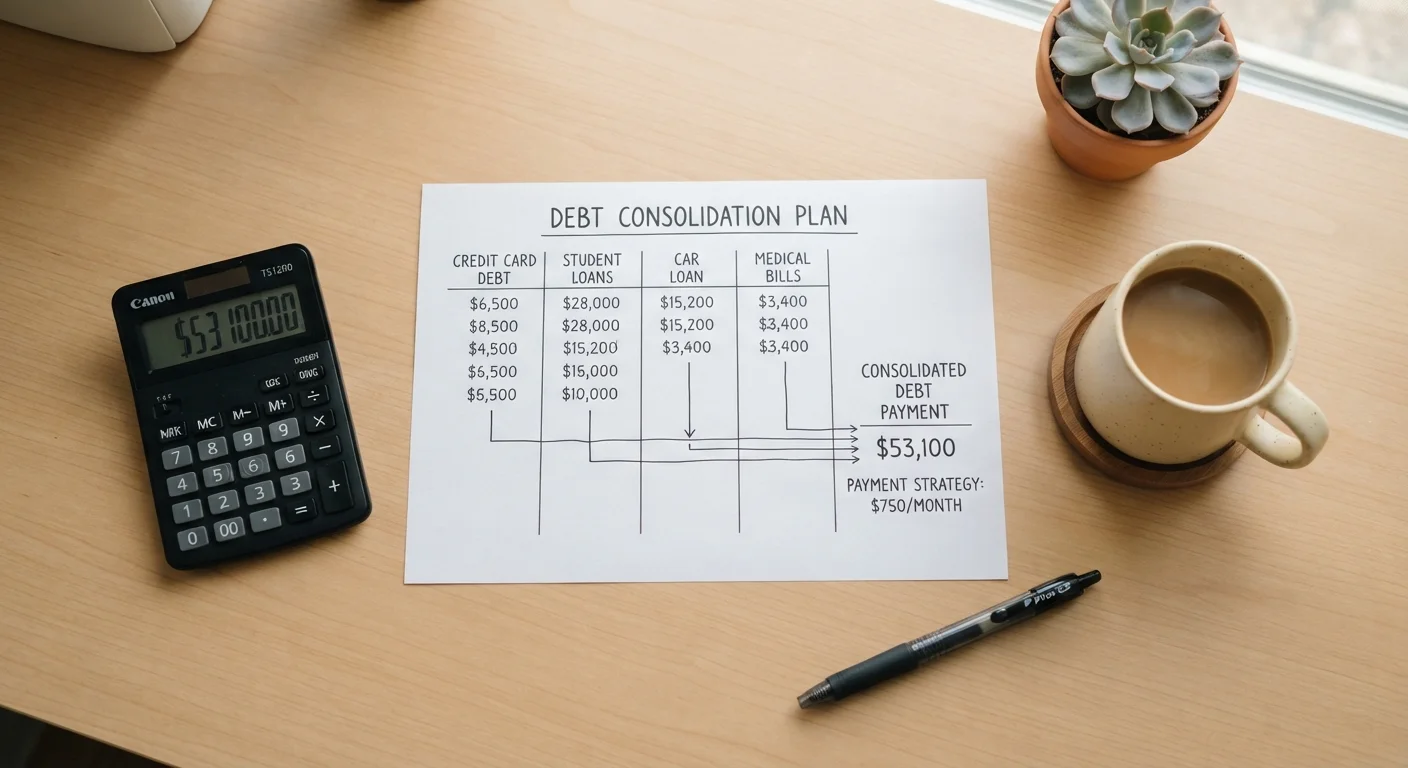
Debt consolidation means combining several separate debts — typically credit card balances, medical bills, or personal loans — into a single new loan or credit facility. The goal is usually to secure a lower interest rate, reduce the number of monthly payments you track, or extend the repayment timeline to lower your monthly obligation.
The two most common routes are a personal consolidation loan (a fixed-rate installment loan used to pay off existing balances) and a balance transfer credit card (which moves balances onto a card with a promotional low or zero percent APR for a set period). Home equity loans and debt management plans offered through nonprofit credit counseling agencies are additional options, each with different risk profiles.
What consolidation does not do is reduce the principal you owe. You are reorganizing the debt, not erasing it. Understanding this distinction is the foundation of making consolidation work. For a broader view of how different debts affect your financial profile, see which types of debt lenders scrutinise most closely.
Consolidation Is a Tool, Not a Strategy
Debt consolidation changes the structure of what you owe — not the amount or the habits that created it. Financial counselors commonly observe that consolidation succeeds when paired with a written spending plan and a commitment to not adding new revolving debt. The Consumer Financial Protection Bureau (CFPB) recommends seeking a nonprofit credit counseling agency if you are unsure which consolidation path fits your situation.
The Real Advantages
When the conditions are right, consolidation offers concrete benefits that go beyond convenience.
Simplifies multiple payments into one monthly bill
Tracking a single due date and statement reduces the risk of missed payments, which are among the most damaging events for a credit score.
Can lower your effective interest rate
Borrowers with good credit may qualify for a consolidation loan at a rate significantly below their existing card APRs, reducing the total interest paid over the life of the debt.
May reduce monthly payment burden
A longer repayment term can lower the monthly payment amount, creating breathing room in a tight budget — though this typically increases total interest paid.
Can improve credit utilization quickly
Paying off revolving card balances with an installment loan lowers your credit utilization ratio, which can result in a measurable score improvement within one to two billing cycles.
~$8,000
Average US household credit card balance
Federal Reserve data indicates average revolving credit card debt per household has remained in the range of several thousand dollars, making interest rate reduction through consolidation a meaningful lever.
3–5%
Typical balance transfer fee charged
Most balance transfer cards charge this percentage of the transferred amount as an upfront fee, which should be factored into any savings calculation before proceeding.
A lower interest rate directly reduces the total amount you repay over time. If you are carrying balances at 24% APR and qualify for a consolidation loan at 12%, every dollar of principal works harder. A single monthly payment also reduces the cognitive load of juggling due dates, minimum payments, and separate lender portals — which in turn lowers the risk of a missed payment damaging your credit.
For borrowers on a fixed income or tight budget, extending the repayment term can meaningfully reduce monthly cash outflow, freeing room in a spending plan for essentials or a small emergency fund. That said, a longer term typically means more interest paid overall, so this trade-off deserves careful calculation before committing.
The Risks Worth Taking Seriously
Consolidation carries real downsides that are easy to overlook when you are focused on a lower rate or a simpler statement.
Does not reduce the principal owed
Consolidation restructures debt rather than forgiving it. Fees and a longer term can mean the total amount repaid exceeds what was originally owed.
Risk of accumulating new balances post-consolidation
Paying off cards frees up credit limits, and without a disciplined spending plan, many borrowers run balances back up — compounding their total debt load.
Upfront fees can offset interest savings
Balance transfer fees of 3–5% and personal loan origination fees can represent hundreds of dollars, narrowing or eliminating the financial benefit for smaller balances.
Secured consolidation puts assets at risk
Using home equity to consolidate unsecured debt converts obligations that had no collateral into debt backed by your property, significantly raising the stakes of a default.
Short-term credit score dip from hard inquiry
Applying for a new credit product generates a hard inquiry and reduces the average age of your accounts, both of which can cause a temporary score decrease.
The most common pitfall is behavioral: once existing card balances are paid off by the new loan, the available credit on those cards can tempt renewed spending. This is sometimes called the "consolidation trap" — the borrower ends up with the original consolidated debt plus fresh balances, putting them in a worse position than before.
There are also structural costs. Balance transfer cards frequently charge a transfer fee of 3–5% of the moved balance. Personal loans may carry origination fees. If you use a home equity product, unsecured debt becomes secured against your property — meaning a default risk that did not previously exist. For strategies that balance repayment with protecting your credit standing, see managing debt while protecting your credit standing.
How Consolidation Affects Your Credit Score
The credit score impact of consolidation is mixed and depends heavily on how you manage the transition. Applying for a new loan or card triggers a hard inquiry, which typically causes a small, temporary dip. Opening a new account also shortens your average account age — a factor in most scoring models.
On the positive side, if you use the consolidation to pay down credit card balances, your credit utilization ratio (the percentage of revolving credit you are using) will fall — and lower utilization is one of the fastest ways to improve a score. Consistent, on-time payments on the new account build positive history over time.
The net effect on your score depends on your starting profile and how you behave after consolidating. For a clear-eyed look at what actually moves scores versus what is myth, see the truth behind common credit score myths. If your credit is currently thin or damaged, rebuilding tools may be worth exploring first — secured cards, credit-builder loans, and becoming an authorised user outlines practical options.
This article is for general informational and educational purposes only and does not constitute personalised financial, legal, or tax advice. Consult a licensed financial advisor or credit counselor for guidance specific to your situation.
The content on this site is for informational purposes only and is not a substitute for professional advice. Always consult a qualified professional for guidance specific to your situation.