

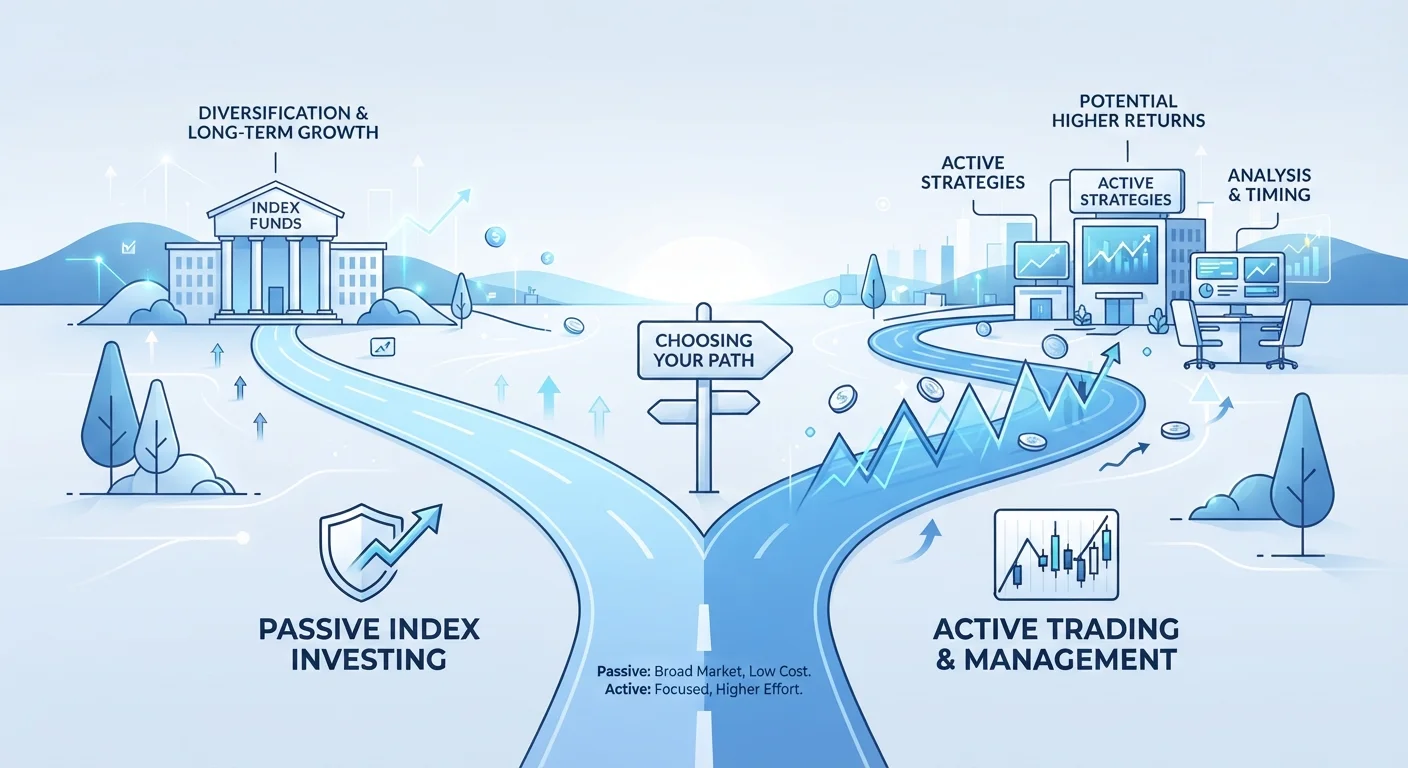
Option A
Index Funds
The passive, low-cost market-matching approach.
Best for: Investors who want broad market exposure with minimal fees and no need to pick individual securities.
Option B
Actively Managed Funds
The research-driven, manager-guided strategy.
Best for: Investors willing to pay higher fees in pursuit of returns that outpace a market benchmark.
What Each Approach Actually Does
Before diving into comparisons, it helps to understand what each fund type is actually doing with your money. If you're new to investing, our beginner's guide to investing covers the foundational concepts worth knowing first.
Index funds are passively managed. Rather than a team of analysts deciding which securities to buy or sell, the fund simply mirrors a market index — such as the S&P 500 — holding the same securities in the same proportions. When the index changes, the fund adjusts accordingly. The goal isn't to beat the market; it's to match it as closely as possible.
Actively managed funds take the opposite stance. A portfolio manager — backed by a research team — makes ongoing decisions about which securities to hold, when to buy, and when to sell. The stated goal is to outperform a designated benchmark index by identifying mispriced assets or timing market movements more effectively than the average investor.
Both fund types pool money from many investors and spread it across multiple securities, so both offer built-in diversification. The core difference lies in strategy, cost, and the underlying belief about whether markets are efficiently priced. For more on the underlying asset classes involved, see our overview of stocks, bonds, and cash.
How They Compare: Costs, Performance, and Complexity
The most consequential difference between these two fund types isn't strategy — it's cost. Fees compound over time just as returns do, which means even a seemingly small gap in expense ratios can have a material impact over decades.
| Criterion | Index Funds | Actively Managed Funds |
|---|---|---|
| Management style | Passive — tracks an index | Active — manager makes decisions |
| Typical expense ratio | Often 0.03%–0.20% | Often 0.50%–1.50% or higher |
| Goal | Match benchmark performance | Outperform the benchmark |
| Long-term track record | Outperforms majority of active funds net of fees | Most underperform benchmarks over 10–15 years |
| Investor involvement needed | Minimal — low maintenance | Moderate — requires manager evaluation |
| Tax efficiency | Generally higher (fewer trades) | Can vary; higher turnover may increase tax events |
Performance is where the debate gets most heated. The S&P Indices Versus Active (SPIVA) research, published by S&P Dow Jones Indices, has tracked active fund performance against benchmarks across markets and time horizons for many years. Consistently, the majority of actively managed funds underperform their benchmark index over 10- and 15-year periods, particularly after fees are accounted for. However, this doesn't mean every active fund underperforms — it means outperformance is the exception, not the norm, and identifying winning managers in advance is difficult.
~85%
Active large-cap funds underperforming S&P 500 over 15 years
According to SPIVA research by S&P Dow Jones Indices, roughly 85% of actively managed US large-cap funds underperformed the S&P 500 over a 15-year horizon.
0.03%
Lowest common index fund expense ratios
Some broad market index funds carry expense ratios as low as 0.03%, compared to active funds that can charge 1% or more annually.
1%+
Annual fee drag from higher-cost active funds
A 1% annual fee difference can reduce a portfolio's ending value by tens of thousands of dollars over a 30-year investment horizon, depending on initial investment and returns.
Complexity is another practical consideration. Index funds require minimal ongoing monitoring — you invest and the fund maintains itself. Active funds may involve evaluating a manager's track record, investment philosophy, and how closely their strategy aligns with your goals. This isn't impossible, but it demands more research and attention.
When the Choice Isn't Straightforward
The data favors index funds for most investors in most situations — but real-world portfolio construction isn't always black-and-white. A few scenarios where active management is worth examining:
- Less efficient markets: Markets like small-cap domestic stocks or certain emerging markets may have more mispricing opportunities for skilled active managers to exploit, compared to large-cap US equities where information is near-instantaneously priced in.
- Specific risk management goals: Some active funds use strategies like downside protection or sector exclusion that index funds — by design — cannot replicate.
- Tax management: Certain actively managed strategies attempt to minimize taxable events in ways that a straightforward index fund cannot. A tax professional can help you evaluate this in context of your situation.
That said, even in these cases, higher fees still drag on net returns. The burden of proof remains on active management to justify its cost. If you're weighing how much to invest rather than where, our article on contribution size and long-run outcomes is a useful companion read.
This Is General Information, Not Personal Advice
The comparisons in this article reflect broad, publicly available research and are intended for educational purposes only. They are not personalized investment advice. Individual outcomes depend on factors including your tax situation, time horizon, account type, and overall financial picture. Please consult a licensed financial adviser before making investment decisions.
Many investors also use both — maintaining a core of low-cost index funds while allocating a smaller portion to active strategies in specific market segments. This isn't a compromise; it's a deliberate approach some financial advisers recommend. As always, your specific circumstances should guide any decision, and consulting a licensed financial professional is strongly advisable before making changes to your portfolio.
The content on this site is for informational purposes only and is not a substitute for professional advice. Always consult a qualified professional for guidance specific to your situation.