

Why Asset Classes Matter Before You Invest
Most investing confusion comes from skipping a foundational step: understanding what you're actually buying. Stocks, bonds, and cash aren't just words on a brokerage screen — they're fundamentally different types of financial instruments that behave differently, carry different risks, and serve different roles in a portfolio.
Before putting money to work, it helps to know what each asset class is, how it earns a return, and what can go wrong. If you're just getting started, our beginner's guide to investing lays out the broader context. This article focuses specifically on the three building blocks you'll encounter in virtually every investment conversation.
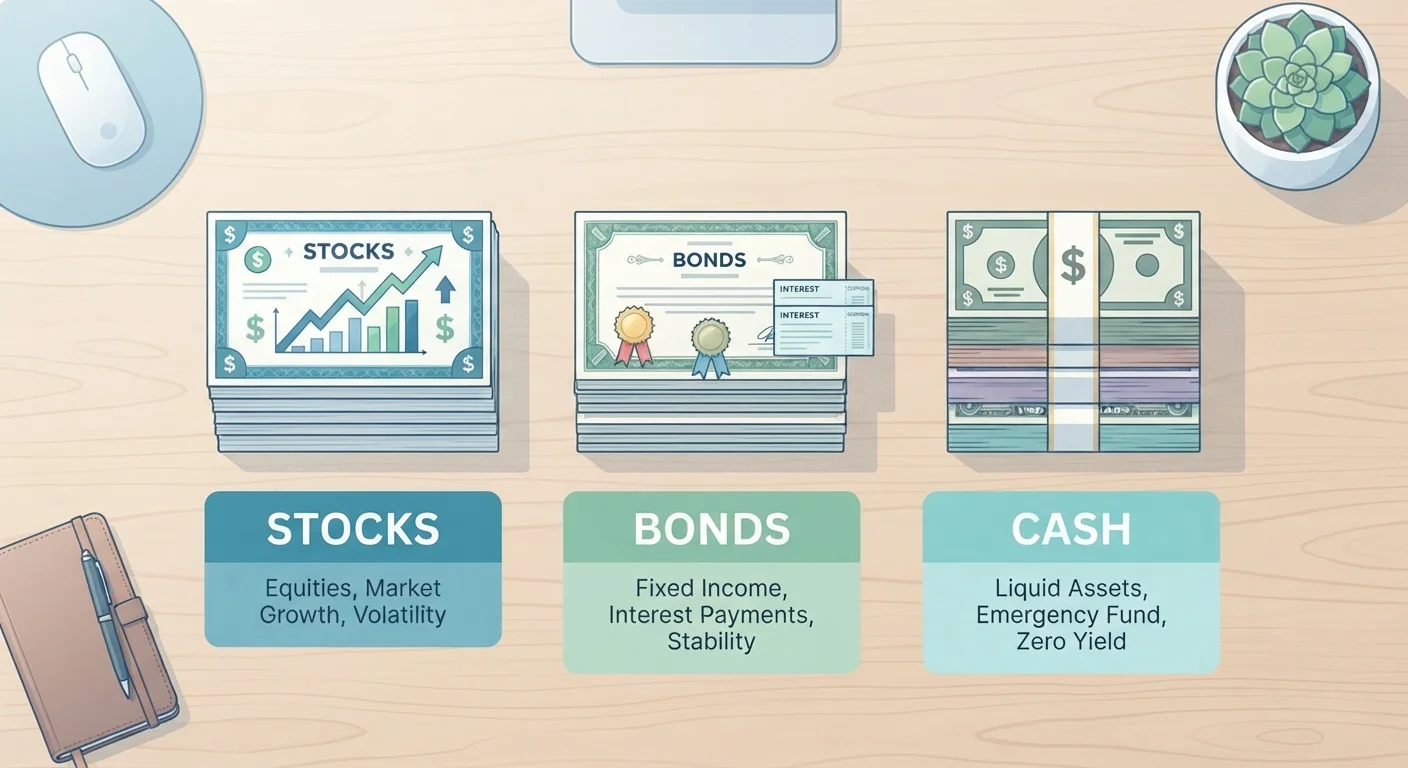
| Asset class: Stocks | Ownership stakes in companies; returns come from price appreciation and dividends |
| Asset class: Bonds | Loans to governments or corporations; returns come from interest payments (coupons) |
| Asset class: Cash | Savings accounts, money markets, short-term T-bills; highest liquidity, lowest return |
| Risk level (general) | Stocks > Bonds > Cash (in typical market conditions) (General financial education framework; individual securities vary significantly) |
| Return potential (general) | Stocks > Bonds > Cash over long horizons (Historical patterns; past performance does not guarantee future results) |
| Key concept | Asset allocation — the mix of these three classes in your portfolio — drives most of your overall risk and return profile |
Stocks: Ownership With Upside — and Downside
When you buy a stock (also called a share or equity), you're purchasing a small ownership stake in a company. If that company grows and becomes more profitable, your shares can increase in value. Some companies also distribute a portion of their profits as dividends — regular cash payments to shareholders.
The tradeoff: stocks are volatile. Their prices fluctuate daily based on earnings reports, economic data, investor sentiment, and countless other factors. In any given year, a stock market index can fall 20% or more. Over long periods, equities have historically outpaced inflation and other asset classes — but that long-run performance comes with short-term uncertainty. No specific outcome is guaranteed, and past performance does not predict future results.
Stocks are generally considered appropriate for money you won't need for several years, because short-term price swings are less likely to derail a long time horizon.
~10%
Average annual US stock market return (pre-inflation, long-run)
The S&P 500 has historically averaged roughly 10% per year before inflation over multi-decade periods — though individual years vary dramatically and past results don't predict future outcomes.
20%+
Typical peak-to-trough decline in major bear markets
A bear market is defined as a decline of 20% or more from recent highs; the US market has experienced several such downturns across modern market history.
3
Core asset classes in most portfolio frameworks
Most mainstream investment frameworks — from target-date funds to model portfolios — are built around stocks, bonds, and cash or cash equivalents.
Bonds: Lending Money in Exchange for Interest
A bond is essentially a loan you make to a government or corporation. In return, the borrower agrees to pay you a fixed interest rate (called the coupon) over a set period, then return your original principal at maturity.
Bonds are generally considered lower risk than stocks — especially government bonds issued by stable economies — but they're not risk-free. Key risks include:
- Interest rate risk: When interest rates rise, existing bond prices typically fall, because newer bonds offer better returns.
- Credit risk: If the issuer defaults, you may not get your money back. Corporate bonds, especially lower-rated ones, carry more credit risk than government bonds.
- Inflation risk: Fixed interest payments lose purchasing power if inflation rises faster than your coupon rate.
Bonds tend to provide more stability and predictable income than stocks, which is why they're often used to balance a portfolio. For a broader look at how these concepts connect to tax-efficient account structures, see our overview of tax-advantaged accounts.
Cash and Cash Equivalents: Stability at a Cost
"Cash" in portfolio terms includes physical cash, savings accounts, money market funds, and short-term Treasury bills — instruments that are highly liquid and carry very low risk of losing value in nominal terms.
Cash serves three roles in a portfolio: as an emergency buffer, as dry powder for future investment opportunities, and as a stabilizer during volatile markets. The downside is that cash typically earns a low return, and when inflation runs above interest rates, its real purchasing power erodes over time.
Holding too much cash long-term is a risk of its own — not the dramatic loss you'd see in a stock crash, but a slow, quiet erosion of what your money can actually buy. Understanding when cash is the right tool versus when it's holding you back connects directly to the distinction between saving and investing.
Asset class
A category of investment with similar characteristics, risk profile, and behavior. Stocks, bonds, and cash are the three primary asset classes.
Asset allocation
The percentage split of your portfolio across different asset classes. Your allocation reflects your risk tolerance, time horizon, and financial goals.
Dividend
A cash payment made by some companies to shareholders, typically from profits. Not all stocks pay dividends, and payments can be reduced or eliminated.
Coupon
The fixed interest rate a bond pays its holder periodically until maturity. For example, a 4% coupon on a $1,000 bond pays $40 per year.
Liquidity
How quickly and easily an asset can be converted to cash without significant loss in value. Cash is perfectly liquid; some bonds or real estate are less so.
Volatility
The degree to which an investment's price fluctuates over time. High volatility means larger and more frequent price swings, which increases short-term risk.
How These Three Work Together
No single asset class is universally superior. The right mix — called your asset allocation — depends on your time horizon, risk tolerance, and financial goals. A 30-year-old saving for retirement might hold a higher proportion of stocks. A retiree drawing income might lean more heavily on bonds and cash equivalents.
Diversifying across asset classes doesn't eliminate risk, but it can reduce the impact of any one investment falling sharply. When stocks decline, bonds often (though not always) hold steadier — providing a cushion. Cash gives you flexibility to rebalance or cover expenses without selling investments at a loss.
Before you settle on an allocation, it's worth working through key questions about your goals and circumstances. And for the vocabulary that tends to trip people up along the way, commonly googled investment terms explained plainly is a useful companion.
This article is for general informational and educational purposes only and does not constitute personalized financial, investment, tax, or legal advice. Consult a qualified financial professional before making decisions about your own circumstances.
The content on this site is for informational purposes only and is not a substitute for professional advice. Always consult a qualified professional for guidance specific to your situation.