

Our Verdict
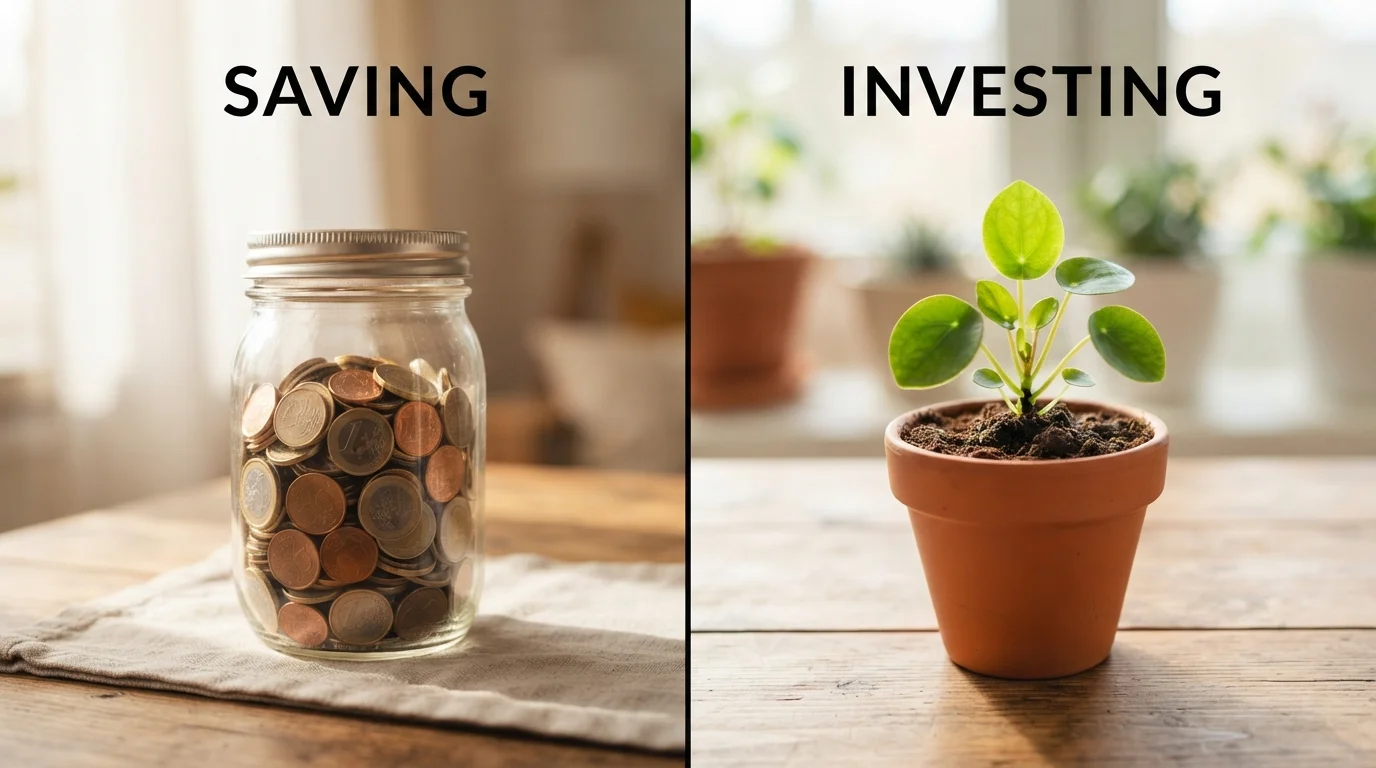
Saving and investing aren't rivals — they serve complementary roles in a healthy financial life. Saving protects you in the short term; investing builds wealth over the long term. Most people need both, and the right balance depends on your goals, timeline, and current financial cushion.
| Best for | Recommended |
|---|---|
| Those building or maintaining an emergency fund | Saving |
| Those with goals five or more years away | Investing |
| Those paying for a major purchase within one to three years | Saving |
| Those looking to grow wealth and outpace inflation over time | Investing |
What Each One Actually Means
Saving means setting money aside in a low-risk, accessible account — typically a savings account, money market account, or certificate of deposit (CD). The goal is to preserve your principal (the original amount) and keep funds available when you need them. Returns are modest but predictable.
Investing means putting money into assets — such as stocks, bonds, mutual funds, or real estate — with the expectation that they'll grow in value over time. Returns can be significantly higher than savings accounts, but your principal is not guaranteed. Markets fluctuate, and the value of investments can go down as well as up.
The core distinction is the trade-off between safety and access on one side, and growth potential and risk on the other. Neither is inherently better; each fills a different role in your financial life. To understand how different asset types behave within investing, see our overview of stocks, bonds, and cash.
| Saving | Investing | |
|---|---|---|
| Primary purpose | Preserve money, short-term access | Grow wealth over the long term |
| Risk level | Very low | Low to high depending on assets |
| Typical returns | Modest (often 1–5% APY) | Historically higher, but variable |
| Liquidity | High — funds accessible quickly | Varies; selling may take days or incur loss |
| Best time horizon | Under 3 years | 5 or more years |
| Inflation protection | Limited — may lose real value | Stronger potential over long periods |
| Principal protection | Yes (FDIC-insured up to limits) | No — value can decrease |
The Inflation Problem With Saving Alone
Keeping all your money in a savings account feels safe — and for short-term needs, it is. But over years or decades, inflation quietly erodes purchasing power. If your savings account yields 1% annually and inflation averages 3%, your money is effectively losing ground each year in real terms.
~3%
Average annual US inflation rate (long-run)
The Federal Reserve targets 2% inflation; long-run averages have often run slightly above that, quietly reducing purchasing power over time.
~44%
Americans with no retirement savings
A Federal Reserve report found a significant share of non-retired adults had no retirement savings or pension, highlighting the gap between saving and long-term investing.
This is why financial educators often describe long-term investing as a way to stay ahead of inflation, not just to get rich. Investing is less about chasing returns and more about not falling behind. For a clear explanation of how growth compounds over time, see what compound interest actually does to your money.
When Saving Makes More Sense
Saving is the right tool in several specific situations:
- Building an emergency fund: Most financial guidance suggests three to six months of essential living expenses kept in an accessible, stable account. This fund should not be invested, because you may need it on short notice and can't afford a market dip to cut it by 20% right when an emergency hits.
- Short-term goals (under three years): If you're saving for a down payment, a wedding, or a car, a savings account or CD protects that money from market swings.
- Reducing high-interest debt: Before investing, it often makes more financial sense to pay down high-interest debt, since guaranteed interest saved frequently outweighs uncertain investment returns.
Start Your Emergency Fund First
Before directing money into investments, aim to build at least a small cash cushion in a savings account. Even a few hundred dollars reduces the chance you'll need to sell investments at a loss during an emergency. Think of your emergency fund as the financial foundation that makes investing sustainable — not a detour away from it.
The timeline rule is simple: money you'll need soon belongs in savings; money you won't need for years is a candidate for investing.
When Investing Makes More Sense
Once your emergency fund is established and short-term needs are covered, investing becomes the more powerful tool for goals that are five or more years away — including retirement, long-term wealth building, or funding a child's education.
The key advantage of investing is time. Markets have historically experienced volatility in short periods but have trended upward over long ones, giving invested money the opportunity to recover from dips and compound growth over decades. That said, past performance doesn't guarantee future results, and all investing carries risk. Understanding your own risk tolerance is an essential first step before putting money into markets.
Tax-advantaged accounts — such as 401(k)s and IRAs — are also worth understanding early, since they can significantly reduce the tax drag on long-term investment growth. Our guide to tax-advantaged accounts explains how these vehicles work.
How to Start Doing Both
The good news: saving and investing aren't mutually exclusive. Most people can — and should — do both simultaneously, once the financial basics are in place. A reasonable starting sequence looks like this:
- Cover essential monthly expenses.
- Build a starter emergency fund (even $1,000 is a meaningful buffer).
- Contribute enough to any employer retirement plan to capture matching contributions, if available.
- Pay down high-interest debt aggressively.
- Expand your emergency fund to three to six months of expenses.
- Begin investing additional funds toward longer-term goals.
If you're ready to take the next step into investing, our beginner's guide to investing covers the core ideas you need before putting money to work. And if you want a comprehensive end-to-end framework, the complete roadmap for everyday savers walks through everything from foundational concepts to fees and long-term strategy.
This article is for general informational and educational purposes only and does not constitute personalized financial, investment, tax, or legal advice. Please consult a qualified financial professional before making decisions based on your individual circumstances.
The content on this site is for informational purposes only and is not a substitute for professional advice. Always consult a qualified professional for guidance specific to your situation.