

How Compounding Actually Works
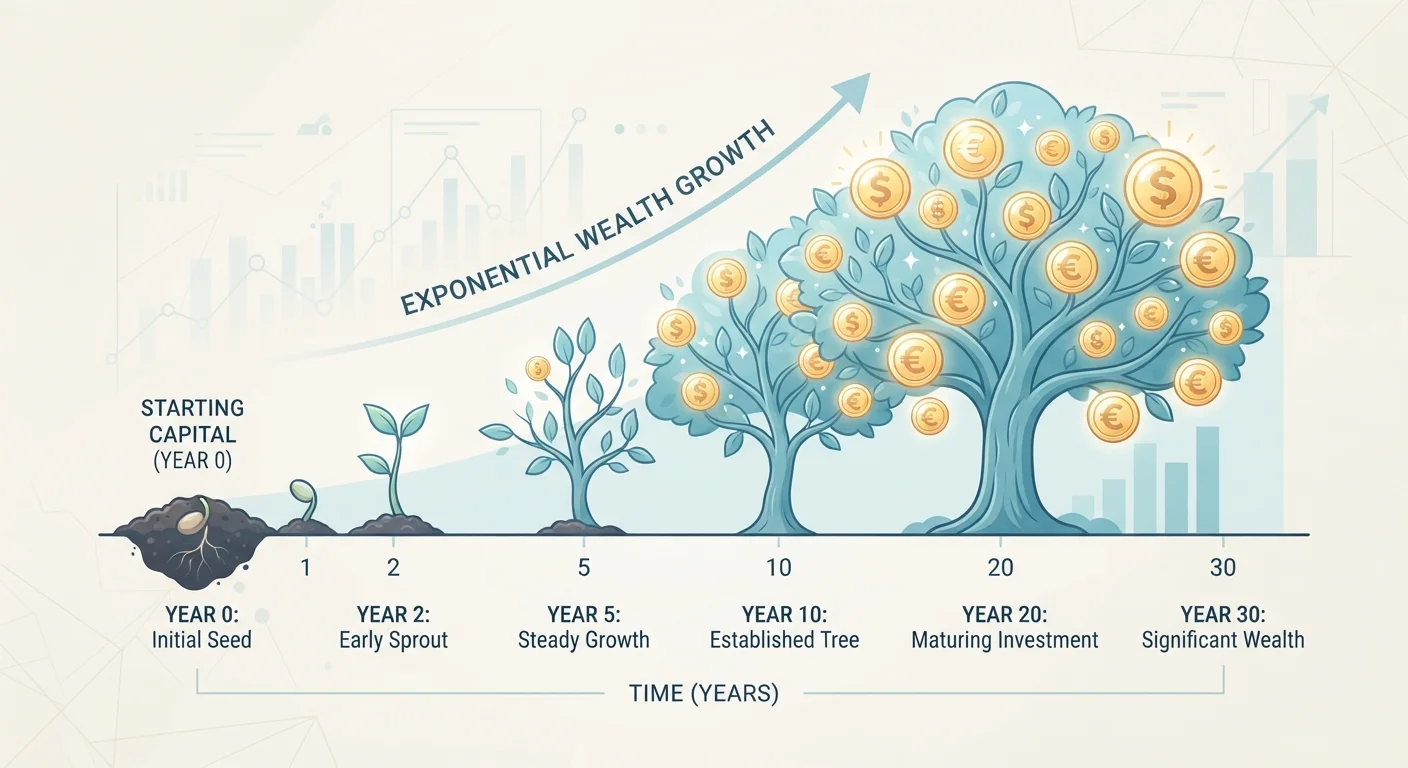
Here is the simplest way to understand compound interest: your earnings become part of the engine generating future earnings.
Start with $1,000 at a 5% annual interest rate. After year one, you earn $50 in interest, leaving you with $1,050. In year two, that 5% applies to $1,050 — not the original $1,000 — so you earn $52.50 instead. The year after, you earn more still. Each cycle, the base grows, and so does the interest generated.
Over 10 years, that $1,000 with no additional contributions grows to roughly $1,629. Over 30 years, it reaches approximately $4,322 — more than four times the original amount, without adding another dollar. That acceleration is compounding at work.
72
Years to double money (Rule of 72 at 6%)
Divide 72 by your annual return rate to estimate the years needed to double your balance — a widely used financial planning shorthand.
~4.3x
Growth of $1,000 over 30 years at 5%
With no additional contributions and annual compounding at 5%, $1,000 grows to approximately $4,322 — illustrating how exponential growth builds over decades.
10 years
Head start that significantly widens final balances
A decade of earlier compounding can produce a substantially larger retirement balance even with identical monthly contributions and return rates.
This is why the APY (Annual Percentage Yield) shown on savings accounts matters more than the stated rate. APY already accounts for the compounding frequency, giving you the true annual growth rate on your balance.
Why Time Is the Most Powerful Variable
No factor influences the outcome of compounding more than time. Starting earlier — even with a smaller amount — typically outperforms starting later with more money.
Consider two savers. One invests $200 per month starting at age 25, earning an average 6% annual return. Another waits until age 35 to start, contributing the same $200 monthly at the same return. By age 65, the early starter has contributed $96,000 and the later one $72,000 — a $24,000 difference in contributions. But the account balances diverge by far more, because the early starter's money had an extra decade to compound.
Start Now, Adjust Later
If the 'right amount' is keeping you from starting, set a small recurring contribution today and increase it when your income grows. Even $25 per month benefits from compounding over time. Automating the transfer removes the friction of deciding each month.
This does not mean late starters should give up. It means starting now — with whatever amount is realistic — matters far more than waiting until the amount feels significant. See our honest look at what smaller and larger contributions can achieve for a more detailed breakdown.
When Compounding Works Against You
Compound interest is mathematically neutral — it amplifies whatever direction your money is moving. When it is on your side, it builds wealth. When it is working against you, it deepens debt.
Credit card balances with high interest rates compound monthly, sometimes daily. If you carry a $3,000 balance at 22% APR and make only minimum payments, the interest accrued each month gets added to your principal — and the following month's interest is calculated on that larger figure. The debt grows faster than minimum payments can reduce it.
Compounding and Inflation
Nominal interest rates don't account for inflation. If your savings account earns 4% but inflation runs at 3%, your real purchasing power is growing at roughly 1%. When evaluating long-term growth, it helps to consider real (inflation-adjusted) returns alongside nominal ones. A financial adviser can help you think through this in the context of your goals.
Understanding how to use saving and investing in tandem — and when each is the right tool — connects directly to this dynamic. Our article on saving versus investing walks through how to deploy your money strategically.
Putting Compounding Into Practice
Compounding is most effective when paired with consistent contributions, minimal withdrawals, and account types that maximize tax efficiency — such as IRAs or 401(k)s, where growth is either tax-deferred or tax-free depending on the account type. Consult a qualified financial adviser to determine what approach fits your specific situation.
If you are newer to building a financial foundation, understanding asset classes is a logical next step. Our guide to stocks, bonds, and cash explains how each behaves and how they fit together in a portfolio designed to grow over time.
This article is for general informational and educational purposes only and does not constitute personalized financial, investment, or tax advice. Speak with a qualified financial professional before making decisions about your own finances.
Frequently Asked Questions
Simple interest is calculated only on the original principal. Compound interest is calculated on the principal plus any interest already earned, so the growth accelerates over time. For long-term savings or investments, this distinction becomes increasingly significant.
It depends on the account or investment. Savings accounts often compound daily or monthly, while bonds may compound semi-annually. More frequent compounding results in slightly more growth, captured by the APY figure.
Yes. Credit card and loan balances compound just like savings — meaning unpaid interest gets added to your balance and then itself earns interest. High-rate debt can compound rapidly, making it important to pay it down as aggressively as possible.
There is no minimum threshold — compounding works on any balance. Even small, consistent contributions benefit from compounding over a long enough time horizon. The key variable is time, not starting amount.
The Rule of 72 is a simple mental math shortcut: divide 72 by your annual interest rate to estimate how many years it takes to double your money. At a 6% annual return, your money doubles roughly every 12 years.
In FDIC-insured savings accounts, the stated APY is contractually paid, making the compounding predictable. In investment accounts, returns vary with market performance, so compounding projections are estimates, not guarantees. Past performance does not guarantee future results.
The content on this site is for informational purposes only and is not a substitute for professional advice. Always consult a qualified professional for guidance specific to your situation.