

Start here
What Consumer Rights Actually Are
Build knowledge
Warranties: Express vs. Implied
Core concept
Refunds and Returns: What the Law Requires
Critical distinction
When a Store Policy Can't Override the Law
Go deeper
Labels, Disclosures, and Deceptive Practices
Take action
How to Assert Your Rights Effectively
What Consumer Rights Actually Are
Consumer rights are legally enforceable protections that govern transactions between buyers and sellers. They exist at the federal level — primarily through the Federal Trade Commission Act and the Magnuson-Moss Warranty Act — and are layered with state-level statutes that often provide stronger protections. Together, these laws set a minimum standard that retailers must meet regardless of what their store policy says.
Most shoppers assume their rights begin and end with whatever return policy is posted at the register. In reality, that policy operates on top of a legal baseline. Understanding where the baseline sits — and where a retailer's policy is simply a discretionary business choice — is the foundation of informed shopping. The same logic applies in other consumer contexts: just as tenants have baseline rights that landlords cannot contractually waive, buyers have protections that no store sign can erase.
Warranties: Express vs. Implied
A warranty is a seller's commitment about what a product will do. There are two fundamental types every shopper should understand.
An express warranty is any explicit promise — written or spoken — about a product's quality, performance, or condition. If a salesperson tells you a blender motor is warranted for five years, that's an express warranty even without a document.
An implied warranty of merchantability is different: it exists automatically under the Uniform Commercial Code (UCC), adopted in some form by every US state. It means that when you buy a product, it is legally expected to function for its ordinary purpose. A toaster that won't toast is a breach of implied warranty — regardless of what the box says or whether any written warranty exists.
Sellers can disclaim implied warranties in writing (using language like "sold as-is"), but several states limit or prohibit this for consumer goods. Always check your state's rules before accepting an "as-is" term on a significant purchase. For a practical pre-purchase checklist, see what to verify before any major purchase.
Refunds and Returns: What the Law Requires
The US has no single federal law requiring retailers to accept returns or issue refunds for a product simply because you changed your mind. That is a business policy, not a legal mandate. However, several important exceptions apply.
- Defective goods: If a product fails to meet its implied or express warranty, you are generally entitled to a repair, replacement, or refund under the UCC and state consumer protection law.
- Misdescribed goods: If you received something materially different from what was advertised or described at sale, consumer fraud statutes in most states give you recourse.
- FTC Mail/Internet Order Rule: For online and phone purchases, sellers must ship within the stated timeframe or offer you the option to cancel for a full refund.
Understanding how return windows, restocking fees, and "final sale" terms interact with these rights matters enormously. Our deeper look at how return policies actually work explains the mechanics in detail.
When a Store Policy Can't Override the Law
This is where many shoppers — and even some retailers — get confused. A store policy is a contract term, not a law. When it conflicts with a statute, the statute wins.
Common scenarios where policy does not prevail:
- A "no refunds" sign does not protect a seller who knowingly sold a broken or unsafe product.
- A restocking fee policy cannot be applied to return a misdescribed item — you didn't get what you paid for.
- A warranty disclaimer cannot override state law if that state prohibits disclaiming implied warranties on consumer goods.
The phrase "all sales final" is particularly misunderstood. Retailers can use it to limit discretionary, change-of-mind returns. But as consumer protection law makes clear, it does not strip your right to a remedy when goods are faulty or fraudulently represented.
Labels, Disclosures, and Deceptive Practices
Consumer protection law also governs what retailers must — and cannot — say on labels and in advertising. The FTC's prohibition on unfair or deceptive acts applies broadly, covering pricing claims, country-of-origin labels, and environmental marketing terms like "natural" or "eco-friendly."
Key rules to know:
- Price comparisons: A "was $100, now $60" claim is only legal if the item was genuinely sold at the higher price for a meaningful period.
- Made in USA: The FTC sets specific standards for this claim; it cannot be used loosely for goods that are only partially assembled domestically.
- Shrinkflation disclosures: There is no federal law requiring disclosure when package size shrinks, but weight and volume on the label must be accurate.
When shopping, watch for return policy red flags that often signal other transparency problems at the retailer level.
How to Assert Your Rights Effectively
Knowing your rights matters only if you can act on them. Here's a practical approach that works across most retail disputes.
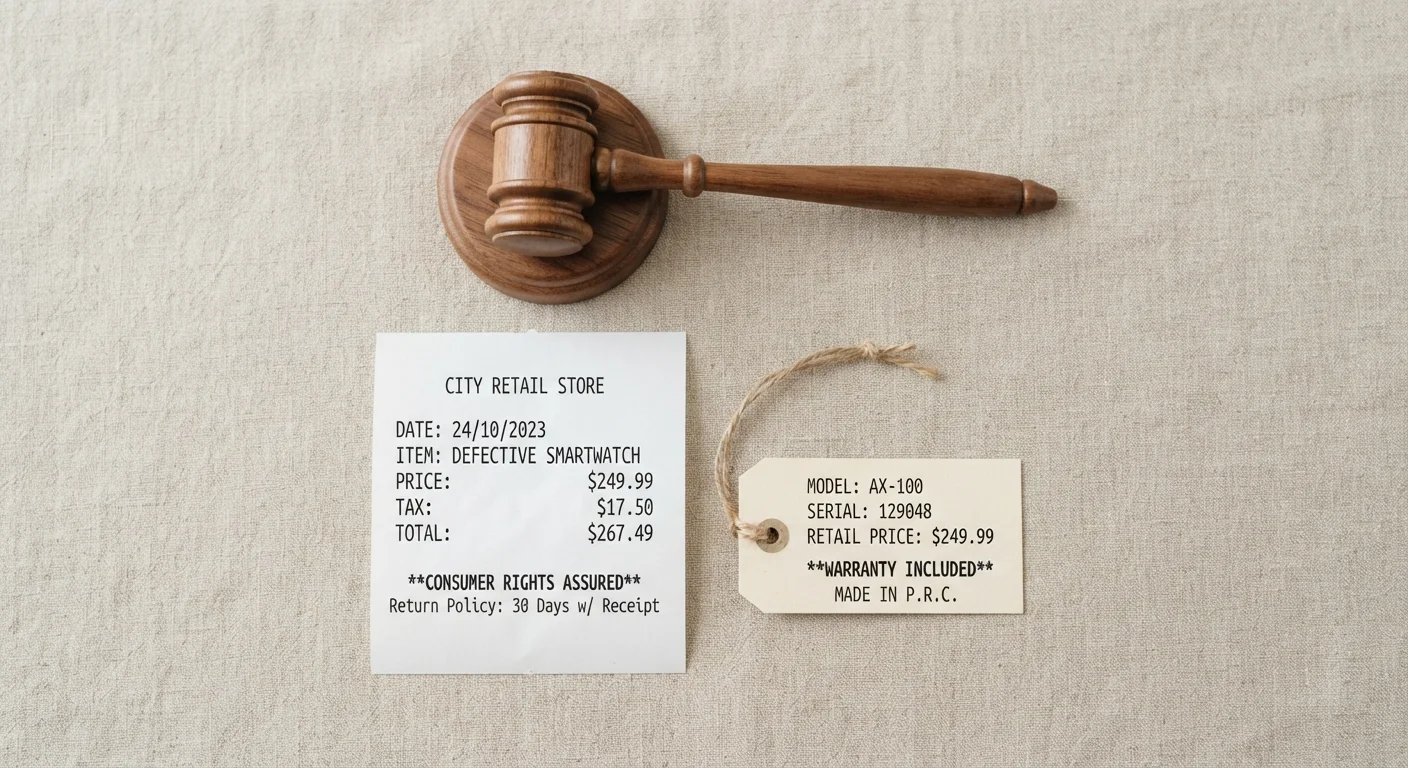
- Document everything. Keep receipts, screenshots of listings, order confirmations, and any written warranty documents. These are your evidence.
- Communicate in writing. Email or written letters create a paper trail; verbal complaints are easy for retailers to ignore or misrepresent.
- Cite the specific protection. Mentioning "implied warranty" or referencing your state's consumer protection statute signals to a retailer that you know your position.
- Escalate systematically. Start with the retailer, then the card issuer (chargebacks are powerful), then your state attorney general, then the FTC's complaint portal, and finally small claims court if the amount warrants it.
Consumer protection frameworks across shopping and housing often share the same structure: minimum legal floors, layered state protections, and enforcement options that most people never use simply because they don't know they exist. Explore the broader consumer guides for more on spending, labels, and rights across purchase categories.
This article provides general consumer information and education. It is not legal advice. Laws vary by state and situation — consult a qualified attorney or your state's consumer protection office for guidance specific to your circumstances.
Frequently Asked Questions
Stores can set strict return policies for change-of-mind returns, but they cannot refuse remedies when a product is defective, unsafe, or materially misdescribed. State lemon laws and implied warranty protections may apply regardless of posted policy.
An implied warranty of merchantability is an automatic legal protection that goods will work as reasonably expected. It applies to most retail purchases under the Uniform Commercial Code, even without any written warranty document.
"Final sale" limits discretionary returns but does not strip your rights to a remedy for faulty or misdescribed goods. Sellers cannot use that label to waive their statutory obligations under consumer protection law.
The Federal Trade Commission handles deceptive trade practices at the federal level. Your state attorney general's office, plus state-level consumer protection agencies, handle many retail disputes. Small claims court is also an accessible option.
Generally yes, plus additional FTC rules apply online, including the Mail, Internet, or Telephone Order Rule, which sets shipping deadlines and cancellation rights when sellers cannot fulfill orders on time.
Escalate in writing, citing the specific protection you believe applies. File a complaint with your state attorney general, the FTC, or the Consumer Financial Protection Bureau if payment is involved. Small claims court is another cost-effective option.
The content on this site is for informational purposes only and is not a substitute for professional advice. Always consult a qualified professional for guidance specific to your situation.