

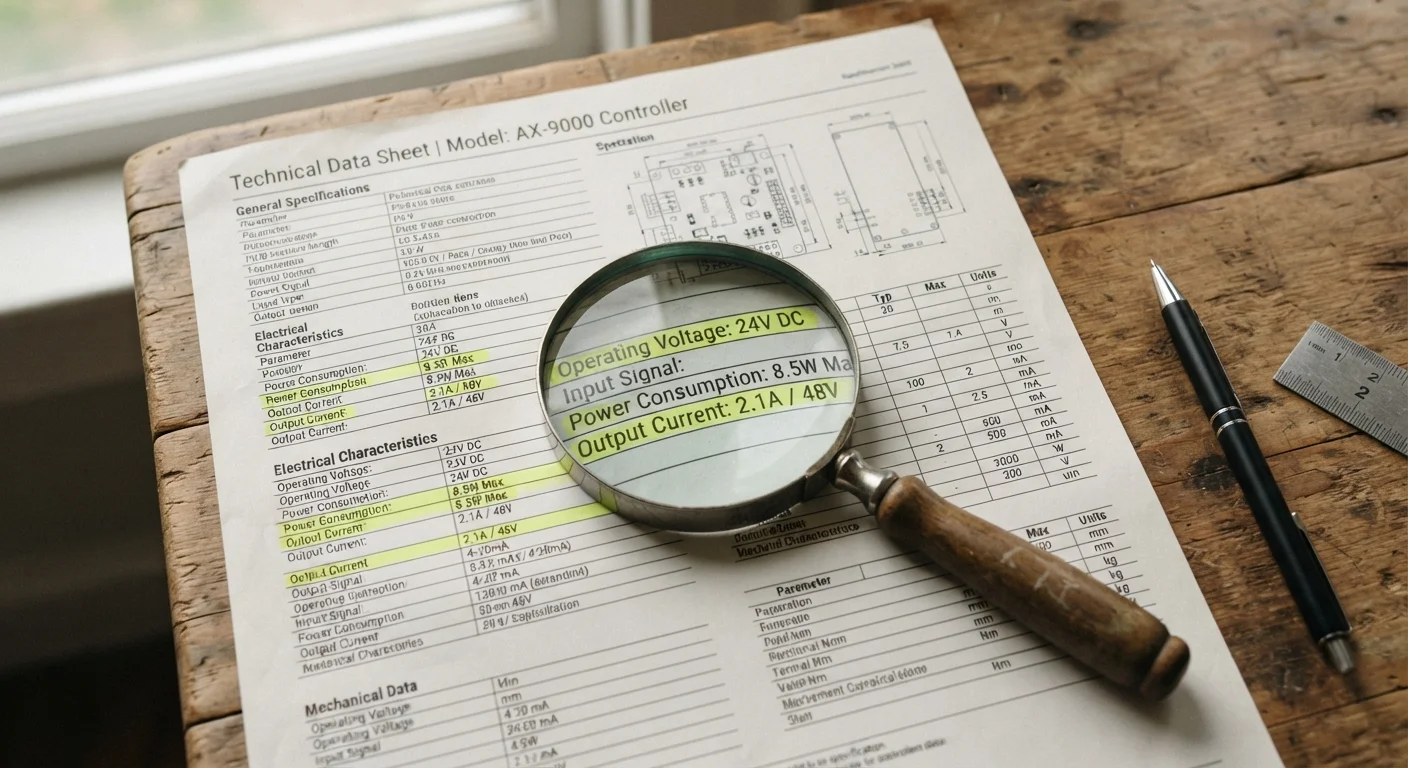
Why Spec Sheets Exist — and Who They're Written For
A spec sheet is a manufacturer's formal declaration of what a product can do under defined conditions. In theory, it's the most objective document available about a product. In practice, it's written by marketing and engineering teams working together — which means it's technically accurate but strategically framed.
Understanding that tension is the first step. The numbers on a spec sheet aren't lies, but they're often selected and presented to highlight strengths and downplay weaknesses. Your job as a reader is to translate what's there — and notice what isn't.
This same label-literacy skill applies across consumer decisions. The same logic you use to decode a product spec sheet mirrors what's needed to read product labels without getting lost in fine print or to interpret sunscreen protection ratings — numbers always need context.
What you will need
What You'll Need Before Starting
You don't need technical training to read a spec sheet critically. You need a clear sense of your use case, a willingness to look up unfamiliar units, and the habit of asking what a number is actually measuring. The steps below walk through exactly that process.
Manufacturer spec sheet or product listing
The primary document you'll be decoding — typically found on the brand's product page or inside the box.
Third-party test database or standards body reference
Organizations like ASTM, IEC, or ENERGY STAR publish the testing standards that underpin many consumer specs — useful for verifying what a number actually measures.
Unit conversion reference
Converting between units (lumens to watts, dB to perceived loudness) helps make abstract numbers feel concrete.
Identify what the product is supposed to do
Before reading a single number, write down the one or two things this product must do well for it to be worth buying. A portable speaker needs to be loud enough for outdoor use. A laptop for video editing needs fast storage and sufficient RAM. An air purifier needs to actually cycle enough air. Every other spec is secondary — often sharply secondary.
Learn the unit before you compare the number
Every spec has a unit of measurement that tells you what kind of thing is being quantified. Decibels measure sound pressure logarithmically, not linearly — a 3 dB difference sounds roughly twice as loud. Lumens measure total light output; nits measure brightness per unit area. Milliamp-hours measure stored charge, not battery life. Misreading units is the most common reason shoppers compare two products on different playing fields.
When a unit is unfamiliar, look it up before interpreting the number. A quick search for what a unit measures — not which product scores higher — will reframe the entire comparison.
Check for the testing condition or standard
Look for footnotes, asterisks, or parenthetical notes next to any headline number. Battery life rated at what screen brightness? Range measured indoors or outdoors? Noise reduction tested at what frequency? Without this context, even an accurate number is misleading.
Reputable manufacturers cite a testing standard by name — ENERGY STAR, MIL-STD-810, IEC 62301, or similar. When a standard is cited, you can look up exactly what conditions it requires. When no standard is cited, the manufacturer set their own conditions.
Separate peak specs from sustained or typical specs
Many specs describe peak performance — the best the product can achieve under optimal, brief conditions. Sustained performance is what the product delivers over continuous, real use. This distinction matters in processors (burst speed vs. sustained clock speed), storage devices (peak write speed vs. average write speed), and audio equipment (peak output vs. continuous output).
If a spec sheet only lists peak figures, ask whether the category is one where sustained performance matters to you. If it is, the missing number is worth investigating.
Note what's missing, not just what's listed
A spec sheet's silences are informative. Manufacturers highlight numbers they're proud of and quietly omit ones that compare unfavorably. A battery-powered tool that lists peak torque but not runtime is signaling something. A display that lists resolution but not color accuracy may be doing the same.
Cross-reference the specs listed against a standard feature checklist for the category — these are often published by consumer testing organizations or independent review outlets. Any spec that's standard in the category but absent from this sheet deserves a follow-up.
[tip_callout]For more on which features sound impressive but rarely translate to real value, see our guide to features that rarely get used.
Translate specs back into real-world scenarios
Once you've collected the relevant numbers, run them through your actual use case. A 5,000 mAh battery in a device with a power-hungry screen may deliver less runtime than a 4,000 mAh battery in an efficient one. A noise-canceling rating in decibels means little unless you know the frequency range — some headphones cancel engine hum well but struggle with speech frequencies.
The goal isn't to become an expert in every spec. It's to avoid being misled by a number that sounds impressive in isolation. Specs are tools for comparison, not guarantees of experience.
Common Pitfalls and How to Avoid Them
Marketing Conditions vs. Real-World Use
Many headline specs — battery life, range, noise reduction, peak brightness — are measured under controlled lab conditions that may differ significantly from typical use. Always look for notes on test methodology. If none are listed, treat the number as an upper bound, not a typical outcome.
Different Standards Mean Different Numbers
Two products can list the same spec using incompatible testing protocols. Audio products may cite frequency response measured at different decibel thresholds; displays may quote brightness under different white-level conditions. A number is only meaningful in comparison when both products used the same standard.
The most reliable approach is to anchor every spec you read to the question: does this number affect the thing I actually need the product to do? A refrigerator's ice-making capacity per day is irrelevant if you don't use the ice maker. A projector's peak lumen rating is irrelevant if you only use it in a darkened room. Specs only have weight when they connect to your real conditions.
When you're ready to move beyond specs and evaluate whether advertised features are worth paying for at all, this guide on features that rarely get used covers the most common examples across product categories.
The content on this site is for informational purposes only and is not a substitute for professional advice. Always consult a qualified professional for guidance specific to your situation.