

Our Verdict
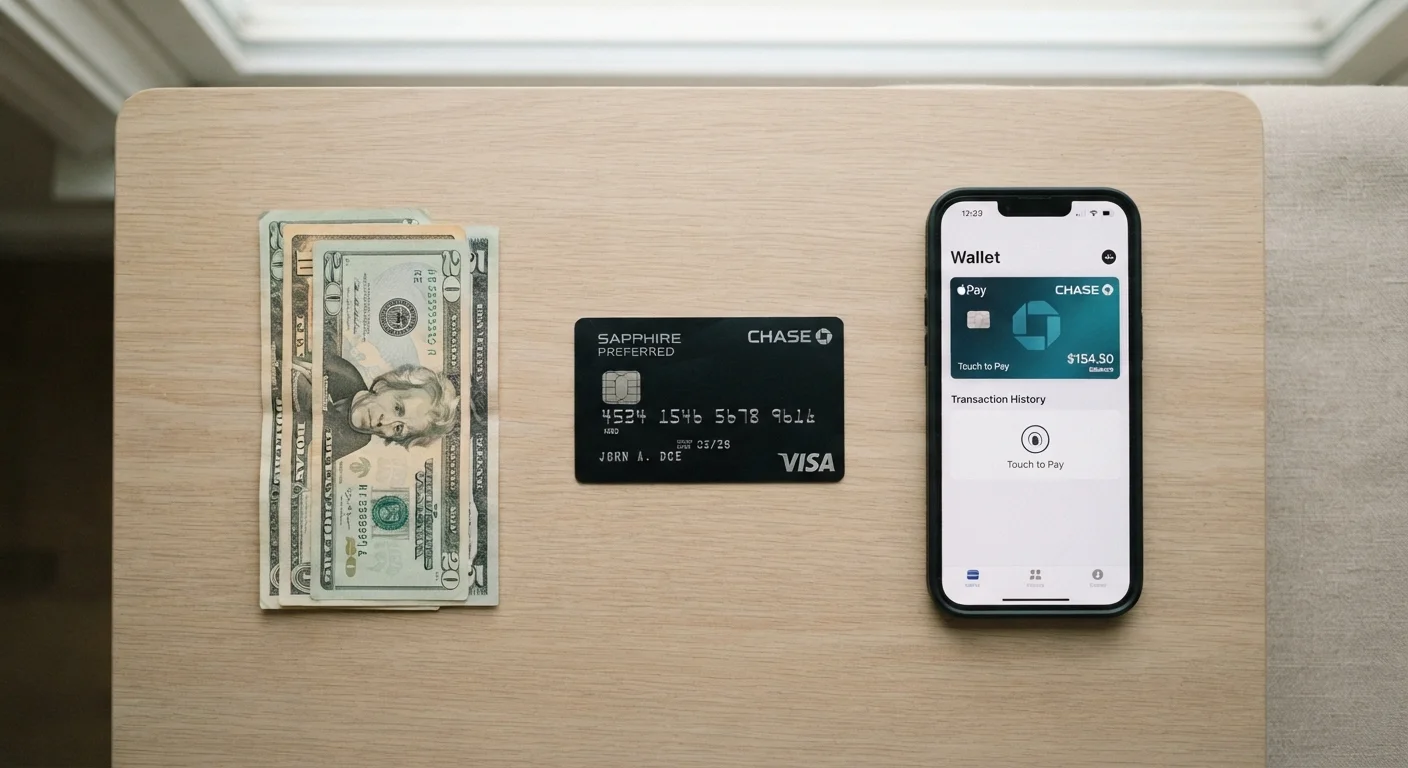
Each payment method carries its own psychological footprint. Cash creates deliberate friction that supports tighter spending control; cards offer convenience and consumer protections but lower spending awareness; digital wallets are fastest but most divorced from the physical reality of money leaving your account. The evidence consistently shows that the more abstract the payment, the easier it is to underestimate what you've spent.
| Best for | Recommended |
|---|---|
| Readers who regularly overspend on everyday discretionary items | Cash |
| Those who prioritize purchase protections and tracking features | Card |
| Frequent small transactions where convenience outweighs spending risk | Digital Wallet |
| People building conscious spending habits over time | A deliberate mix of all three |
Why Payment Method Isn't Just a Logistics Choice
Most people choose how to pay based on convenience — what's in their pocket or what the merchant accepts. But behavioral economists have spent decades studying whether the payment method itself changes how much we spend, and the findings are consistent enough to be worth understanding.
The core concept is called the "pain of paying" — a term used in behavioral finance to describe the discomfort we experience when money leaves our hands. The more tangible and immediate that experience, the more we tend to restrain spending. The more abstract it becomes, the less that internal brake engages.
This isn't about willpower. It's about how the brain processes different types of transactions. Understanding that mechanism puts you in a better position to use payment formats strategically rather than just habitually. For more on the cognitive patterns at work, see why we overspend and what to do about it.
Comparing Cash, Card, and Digital Wallet
Each payment method has a distinct profile when it comes to spending awareness, consumer protections, and practical usability. The table below summarizes where they differ across the criteria that most affect everyday spending decisions.
| Cash | Debit Card | Credit Card | Digital Wallet | |
|---|---|---|---|---|
| Pain of paying (spending awareness) | High — physical loss is tangible | Moderate — account deducted immediately | Low — payment deferred | Very low — fastest, most frictionless |
| Fraud and purchase protections | None if lost or stolen | Limited federal protections apply | Strong protections under federal law | Varies by linked card type |
| Spending tracking ease | Manual only; no automatic record | Automatic via bank statements | Automatic; detailed statements | Automatic via app or linked account |
| Accepted everywhere? | Widely accepted; some gaps | Near-universal | Near-universal | Growing but not yet universal |
| Risk of overspending | Low — capped by what you carry | Moderate — full account available | Higher — credit limit may be large | Similar to linked card; very easy to spend |
| Budgeting suitability | Strong for cash-envelope methods | Good with active monitoring | Requires disciplined review | Requires deliberate tracking habit |
One important nuance: debit cards and credit cards, while often grouped together, behave differently in practice. Credit cards decouple the purchase from immediate account impact entirely — you're spending future money, which research suggests produces even less spending inhibition than a debit card drawing on current funds.
What the Research Actually Shows
Studies in consumer behavior — including work published in journals covering marketing and decision science — consistently find that people spend more when using cards versus cash for equivalent purchases. One frequently cited line of research found that willingness to pay for the same item was measurably higher when subjects paid by card rather than cash.
~83%
US transactions now cashless
Federal Reserve payment studies indicate cash's share of US consumer transactions has declined steadily, with electronic payments now representing the clear majority.
12–18%
Typical spending increase with cards vs. cash
Multiple behavioral economics studies suggest card users tend to spend meaningfully more on identical purchases compared to cash payers, though figures vary by study design.
1 in 3
Americans rarely or never use cash
Pew Research Center surveys have found a substantial and growing share of US adults report going cashless in most or all of their weekly transactions.
Digital wallets appear to extend this pattern further. Tapping a phone or smartwatch introduces even less deliberate pause than swiping a card. The transaction is over before the brain registers it as a financial event in any meaningful way.
It's worth noting that most research in this area involves controlled or observed settings, and real-world behavior is always more complex. Individual habits, financial literacy, and how closely someone monitors their accounts all moderate these effects. The evidence points to tendencies, not inevitabilities.
To understand how these patterns connect to broader impulse-spending behavior, the distinction between impulse and considered purchases is worth examining.
Using This Knowledge Practically
Try the Envelope Method for One Category
If there's one area of your budget that consistently runs over — groceries, dining, entertainment — try allocating a fixed cash amount for it each week. This isn't about restricting yourself; it's about making the budget limit tangible rather than abstract. Many people find that even one or two weeks of cash-only spending in a problem category recalibrates their sense of what things actually cost.
The most useful application of this research isn't switching exclusively to cash — it's matching your payment method to the spending context deliberately.
- High-risk discretionary categories (dining out, entertainment, impulse retail): cash or a prepaid debit with a fixed balance can act as a natural ceiling.
- Recurring bills and planned purchases: cards offer superior fraud protection, automated records, and sometimes purchase protection — advantages that outweigh the spending-awareness trade-off when you're not at risk of going over budget anyway.
- High-volume low-value transactions (transit, coffee, small purchases): digital wallets are efficient, but consider reviewing these transactions weekly so the convenience doesn't become a blind spot.
Building a simple review habit — checking what you spent and how you paid each week — is often more effective than any single payment method rule. Spending habits worth building into any budget covers what consistent financial review actually looks like in practice.
For a more complete picture of your own spending patterns and how payment method fits into that, the complete guide to understanding your spending patterns is a useful next step.
This article is for general informational and educational purposes only and does not constitute personalized financial advice. Readers should consult a qualified financial professional for guidance specific to their circumstances.
The content on this site is for informational purposes only and is not a substitute for professional advice. Always consult a qualified professional for guidance specific to your situation.