

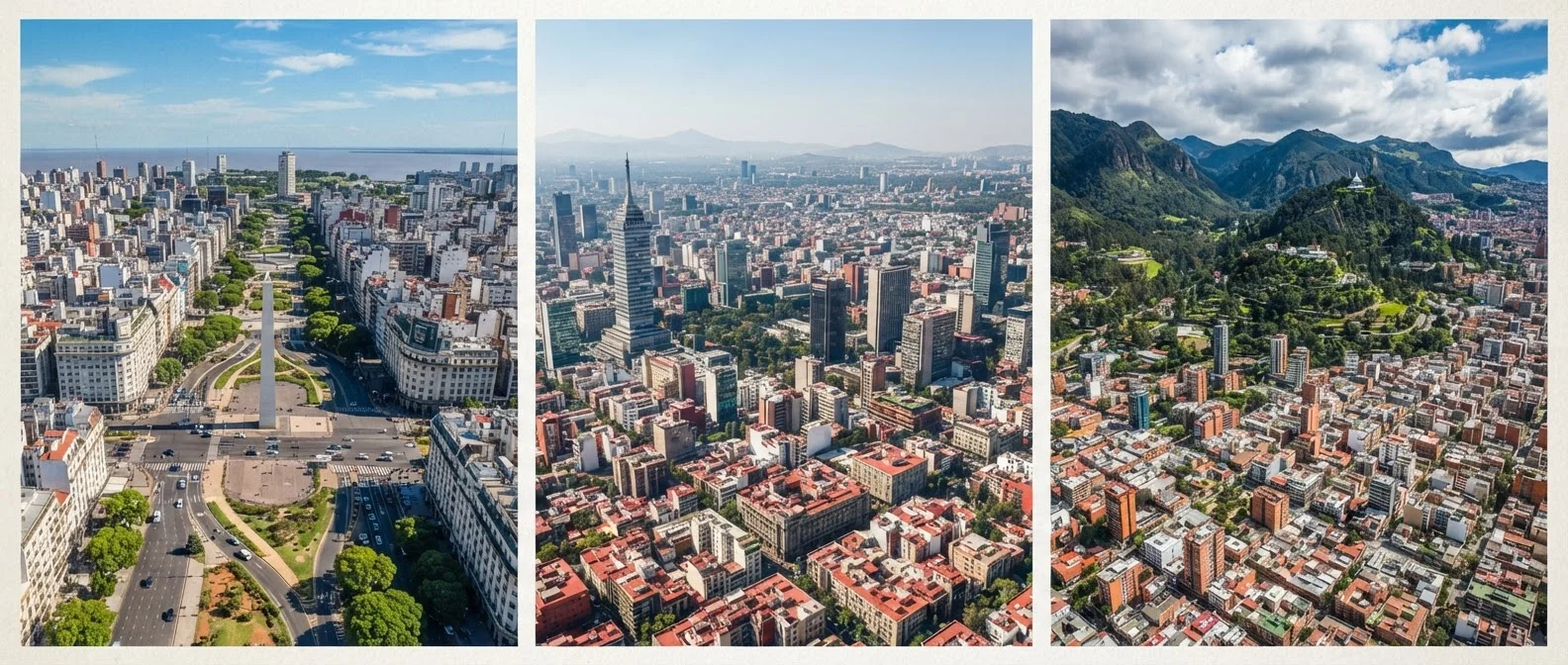
Our Verdict
Buenos Aires, Mexico City, and Bogotá each reward visitors differently. The right choice depends on what kind of urban experience you're after — not on which city is objectively 'better.' All three offer genuine cultural depth that short itineraries can only scratch the surface of.
| Best for | Recommended |
|---|---|
| Travelers who want a walkable, café-and-culture city with a slower evening rhythm | Buenos Aires |
| Those who want maximum variety — food, history, art, and neighborhoods — in one destination | Mexico City |
| Visitors seeking an emerging city with strong food and nightlife and impressive mountain scenery | Bogotá |
Three Cities, Three Very Different Urban Experiences
Latin America covers more geographic and cultural ground than most travelers anticipate. Buenos Aires, Mexico City, and Bogotá are among the region's most visited urban destinations, but comparing them head-to-head reveals just how distinct each really is. Altitude, language cadence, urban layout, food culture, history, and even the daily rhythm of street life differ meaningfully across all three.
This breakdown is designed to set accurate expectations rather than rank the cities. Each has real strengths and real trade-offs depending on your travel style, itinerary length, and what you're hoping to get out of a city break.
| Buenos Aires | Mexico City | Bogotá | |
|---|---|---|---|
| Altitude | Sea level | ~7,300 ft | ~8,660 ft |
| City scale | Large (3M city proper) | Massive (9M+ city proper) | Large (8M+ city proper) |
| Primary language cadence | Rioplatense Spanish | Mexican Spanish | Colombian Spanish |
| Walkability | High in key neighborhoods | Moderate, neighborhood-dependent | Moderate in tourist areas |
| Food culture highlight | Beef, wine, Italian-influenced | Street food to fine dining depth | Bandeja paisa, coffee, emerging scene |
| Key cultural draw | Tango, architecture, café culture | Pre-Columbian history, museums | Street art, colonial district, coffee |
| Best itinerary length | 3–5 days minimum | 5–7 days minimum | 3–5 days minimum |
Buenos Aires: European Rhythm, South American Soul
Buenos Aires is often described as the most European city in Latin America — an oversimplification, but one that captures something real. Wide Haussmann-style boulevards, Italian and Spanish immigrant architecture, and a deeply café-centric culture give the city a familiar visual grammar for North American and European visitors. What that framing misses is how distinctly Argentine it is: the passion around football, the particular cadence of Rioplatense Spanish, the tradition of the milonga (a tango social dance event), and the extended dinner culture where restaurants don't fill until 9 p.m.
Palermo, San Telmo, and Recoleta are walkable neighborhoods with distinct characters — and that walkability is a genuine advantage for short stays. The city's public transit system (subte) is functional if aging. Dining out is a central social ritual, not just a convenience, and the quality of local beef is not exaggerated. Travelers planning a broader Argentina trip should note that Patagonia is a natural extension — see our Patagonia logistics guide for what that overland or air journey actually involves.
Plan Dinner Late in Buenos Aires
Porteños (Buenos Aires residents) typically eat dinner between 9 and 11 p.m. Restaurants before 8 p.m. will often be nearly empty. Adjusting to this rhythm — rather than fighting it — makes the dining experience significantly more authentic and enjoyable. Lunch is the more flexible meal for those on an earlier schedule.
Mexico City: Scale, Depth, and Constant Motion
Mexico City (CDMX) is one of the largest cities on Earth by population, and that scale is immediately felt. The metro area holds over 20 million people and the urban fabric is vast — neighborhoods like Roma, Condesa, Coyoacán, and Centro Histórico each feel like distinct villages within the city. First-time visitors routinely underestimate how much ground the city covers and overload their itineraries accordingly.
The cultural depth here is arguably unmatched in the region. Pre-Columbian history sits alongside colonial architecture, world-class contemporary art, and a food scene that ranges from street tacos to internationally recognized fine dining. The Museo Nacional de Antropología alone merits a full half-day. Air quality and traffic can be significant on some days, and navigating the metro efficiently takes a brief learning curve — but both are manageable with basic orientation. Altitude is mild here (about 7,300 feet) compared to Bogotá, so most visitors adapt quickly.
20M+
Mexico City metro area population
Mexico City is among the five largest metropolitan areas in the world by population, according to UN urban data.
8,660 ft
Bogotá's elevation above sea level
Bogotá ranks among the highest major capital cities globally, making altitude a concrete logistical consideration for visitors.
Bogotá: Altitude, Ambition, and Rapid Transformation
Bogotá sits at approximately 8,660 feet above sea level, making it one of the highest major capitals in the world. That altitude is the single most important logistical fact for first-time visitors: plan a light first day, avoid heavy exercise, limit alcohol initially, and don't be surprised if a headache appears. Most healthy adults adjust within 24–48 hours, but it's worth building that buffer into any itinerary.
Beyond the altitude, Bogotá has changed substantially over the past two decades. The Candelaria historic district, the Zona Rosa, and the Usaquén neighborhood each offer distinct textures. The city's street art scene — particularly in La Candelaria — is internationally recognized. Colombia's coffee culture is present and accessible in a way that doesn't feel performative. Medellín gets frequent attention as Colombia's transformed city, but Bogotá's scale and cultural infrastructure make it a richer base for a city-focused break. That said, as with all three cities, neighborhood selection and situational awareness matter — consult current travel advisories from your government's official travel authority before departing.
Check Official Travel Advisories Before Booking
Safety conditions, entry requirements, and health advisories for all three countries can shift. Before finalizing travel plans, check the U.S. Department of State's travel advisory pages for Argentina, Mexico, and Colombia. These pages are updated regularly and provide specific, current guidance that no editorial article can replicate.
Practical Logistics Worth Knowing Before You Go
A few structural differences shape the on-the-ground experience in each city. Entry requirements, currency conditions, and health considerations vary — and all can change. Always verify requirements through official government travel portals before booking.
- Currency: Argentina's exchange environment has been volatile; understand the current official and informal rate landscape through reliable sources before travel. Mexico and Colombia use more stable, straightforward currency exchange systems.
- Flight access: All three cities have major international airports with direct US routes. Mexico City typically offers the broadest range of direct connections from US cities.
- Language: All three are Spanish-speaking, though vocabulary and accent differ noticeably. Basic Spanish goes a long way in all three; English fluency among service staff varies considerably by neighborhood.
- Safety: Each city has areas that are well-suited for visitors and areas that are not. Blanket characterizations — positive or negative — are generally inaccurate. Research neighborhood-level conditions and stay aware of your surroundings.
A long weekend realistically covers one neighborhood cluster in any of these cities. A week begins to do justice to the depth available. All three reward return visits more than single-trip attempts at comprehensiveness.
The content on this site is for informational purposes only and is not a substitute for professional advice. Always consult a qualified professional for guidance specific to your situation.