

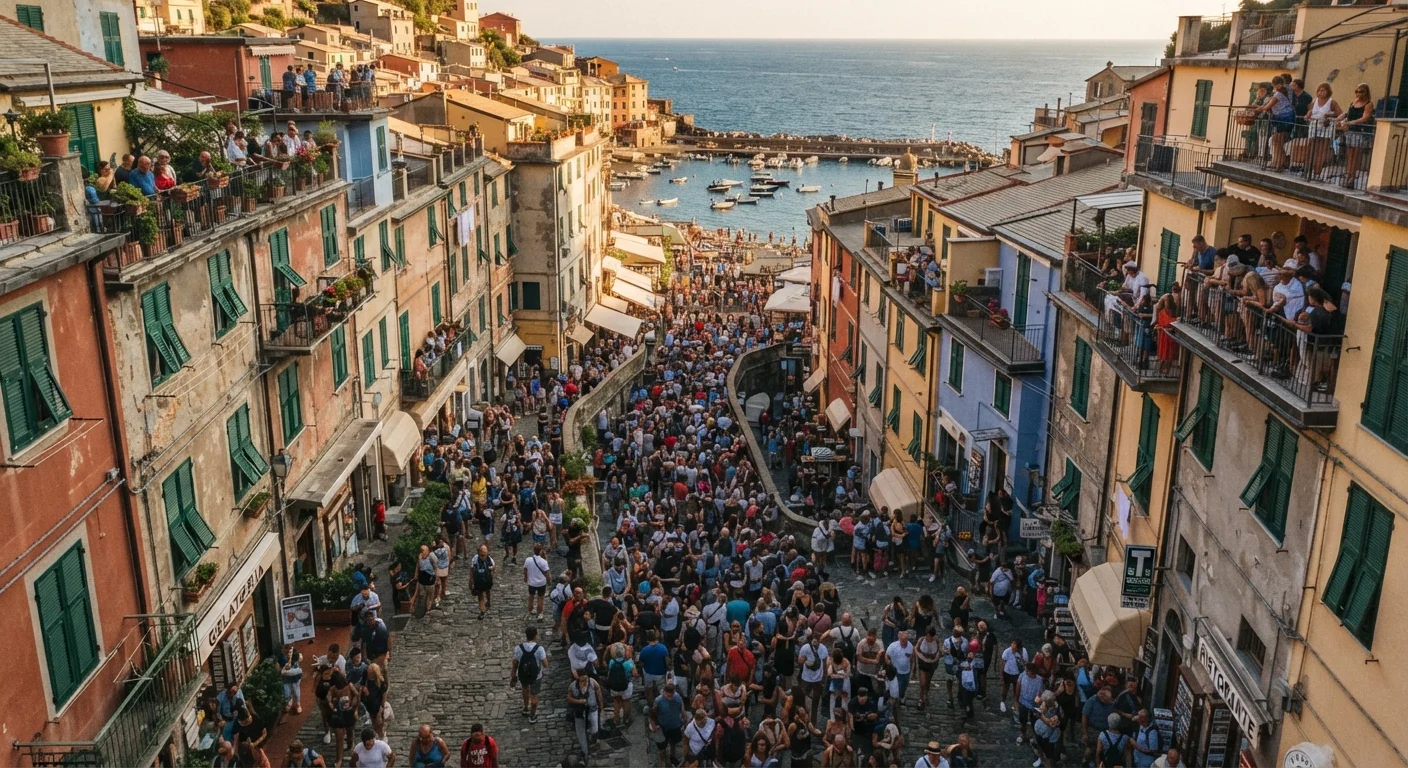
What Overtourism Actually Does to a Place
The postcard version of a destination rarely includes the reality: cruise ship passengers six deep on a narrow bridge, locals unable to afford rent in their own neighborhoods, coral reefs bleached by sunscreen runoff, or ancient stone steps worn smooth by millions of footfalls. These aren't isolated complaints — they're the documented outputs of tourism that exceeds a place's absorptive capacity.
Overtourism operates on several levels simultaneously. Physically, it degrades the very features that made a place worth visiting: trail erosion at natural sites, damage to historical monuments from sheer foot traffic, and water and waste systems pushed beyond design limits. Economically, it can hollow out local commerce — replacing butchers and pharmacies with souvenir shops and gelato stands, and converting residential apartments into short-term rentals that price out the families who once lived there.
Culturally, the effects are subtler but no less real. When a neighborhood's primary function shifts from housing a community to servicing visitors, the authentic character that attracted tourists in the first place gradually erodes. Venice, Amsterdam's canal district, and Dubrovnik's old town are often cited as places where this cycle is already advanced.
“Tourism can be a force for good, but only if we manage it in a way that respects both people and the planet. Growth without governance is just pressure.”
— Zurab Pololikashvili, Former Secretary-General, UN Tourism (UNWTO)
Why Certain Destinations Get Hit Hardest
Not all popular destinations face overtourism equally. A few structural factors determine vulnerability: geographic constraint, infrastructure limits, and the self-reinforcing nature of viral exposure.
Island destinations and historic walled cities are physically bounded — there's only so much space, and no amount of investment expands it meaningfully. When a TikTok or Instagram post sends hundreds of thousands of visitors to a site that previously saw a fraction of that traffic, the mismatch between demand and capacity can become acute within a single season.
Social media's role here is significant but often mischaracterized. The problem isn't that beautiful places get photographed — it's that algorithmic amplification concentrates attention on the same handful of spots, often a single viewpoint or a particular staircase, while virtually identical experiences nearby go unvisited. This creates artificial bottlenecks in places that could otherwise distribute visitors more evenly.
1.4B
International tourist arrivals globally in 2023
According to the UN Tourism (formerly UNWTO) 2024 Barometer, international arrivals reached approximately 1.4 billion in 2023, approaching pre-pandemic levels.
80%
Tourism concentrated in 10% of destinations
Industry analyses consistently find that the vast majority of international tourist volume concentrates in a small fraction of global destinations, intensifying pressure on those hotspots.
~$0
Net local benefit from all-inclusive resort stays
Studies on tourism economics note that all-inclusive and cruise-based tourism often results in minimal local spending, with most revenue leaving the destination economy entirely.
For travelers planning trips to coastal Europe, understanding this dynamic is directly relevant. Our comparison of coastal Europe versus Mediterranean interior destinations illustrates how dramatically different the visitor experience — and the impact — can be within the same region.
What Individual Travelers Can Realistically Do
It's worth being honest here: no single traveler is responsible for overtourism, and no individual can solve it. The structural drivers — airline route economics, destination marketing budgets, platform algorithms — operate well above the level of personal choice. That said, individual decisions do aggregate into collective outcomes, and there are genuinely practical adjustments that reduce pressure without requiring travelers to sacrifice meaningful experiences.
Research the Area Around the Headline Attraction
Before finalizing an itinerary, spend fifteen minutes searching for neighborhoods, towns, or natural sites within an hour of your main destination. These secondary spots frequently offer comparable scenery or history at a fraction of the crowd density — and your visit directly supports communities that benefit far less from tourism revenue.
Timing matters more than destination. Traveling in shoulder season — not necessarily off-season, which carries its own trade-offs — often means visiting the same place with significantly reduced crowds. Our guide to seasonal travel myths separates the genuine advantages of shoulder travel from the oversimplified version.
Where money goes matters. Spending at locally owned restaurants, staying in family-run accommodations, and hiring local guides channels tourism revenue into community hands rather than extracting it. This doesn't require significant extra cost — it mostly requires intention.
Geographic distribution helps. Most overtourism is hyperlocal: concentrated at a single landmark or neighborhood while nearby alternatives go unvisited. Taking an hour to research a less-photographed alternative — a different bay, a smaller hill town, a museum a few blocks from the famous one — can meaningfully shift your personal footprint. The planning resources here can help you think through itinerary structure in more depth.
Budget planning also intersects with this: travelers who underestimate costs often end up making choices — like eating only at tourist-trap restaurants — that concentrate spending in ways that worsen rather than help the local economy. See our overview of common budget blind spots for practical context.
Frequently Asked Questions
Overtourism is driven by a combination of cheaper air travel, viral social media exposure, concentrated marketing around a handful of iconic sites, and the natural human tendency to visit the same places everyone else is talking about. It's a structural issue, not simply a matter of too many people wanting to travel.
Visiting lesser-known destinations or spreading visits across a broader region does help redistribute economic and environmental pressure. However, it only works at scale — individual choices matter most when they reflect broader shifts in traveler behavior. The goal isn't to punish popular places but to spread the benefits of tourism more evenly.
Not always. Shoulder season reduces crowds at many destinations but not all — some places see year-round saturation, and others have compressed shoulder seasons due to climate or school calendars. See our <a href="/travel-smart/planning/seasonal-travel-myths-that-lead-planners-astray">breakdown of seasonal travel myths</a> for a more nuanced view.
Residents often experience rising housing costs as landlords convert long-term rentals to short-term vacation properties, increased noise and congestion, loss of neighborhood character, and displacement from central areas. In some cases, essential services like grocery stores are replaced by tourist-facing shops, making daily life harder for locals.
Absolutely. Tourism funds conservation, preserves cultural heritage, and supports local livelihoods — often substantially. The issue isn't tourism itself but volume and concentration. Well-managed tourism with distributed visitor flows can be genuinely beneficial for communities and ecosystems alike.
Peak season refers to a predictable seasonal surge in visitors that a destination has adapted to handle. Overtourism describes a chronic condition where visitor volume consistently exceeds what the destination can recover from, regardless of season. A place can experience overtourism even in its off-peak months if baseline demand is high enough.
The content on this site is for informational purposes only and is not a substitute for professional advice. Always consult a qualified professional for guidance specific to your situation.