

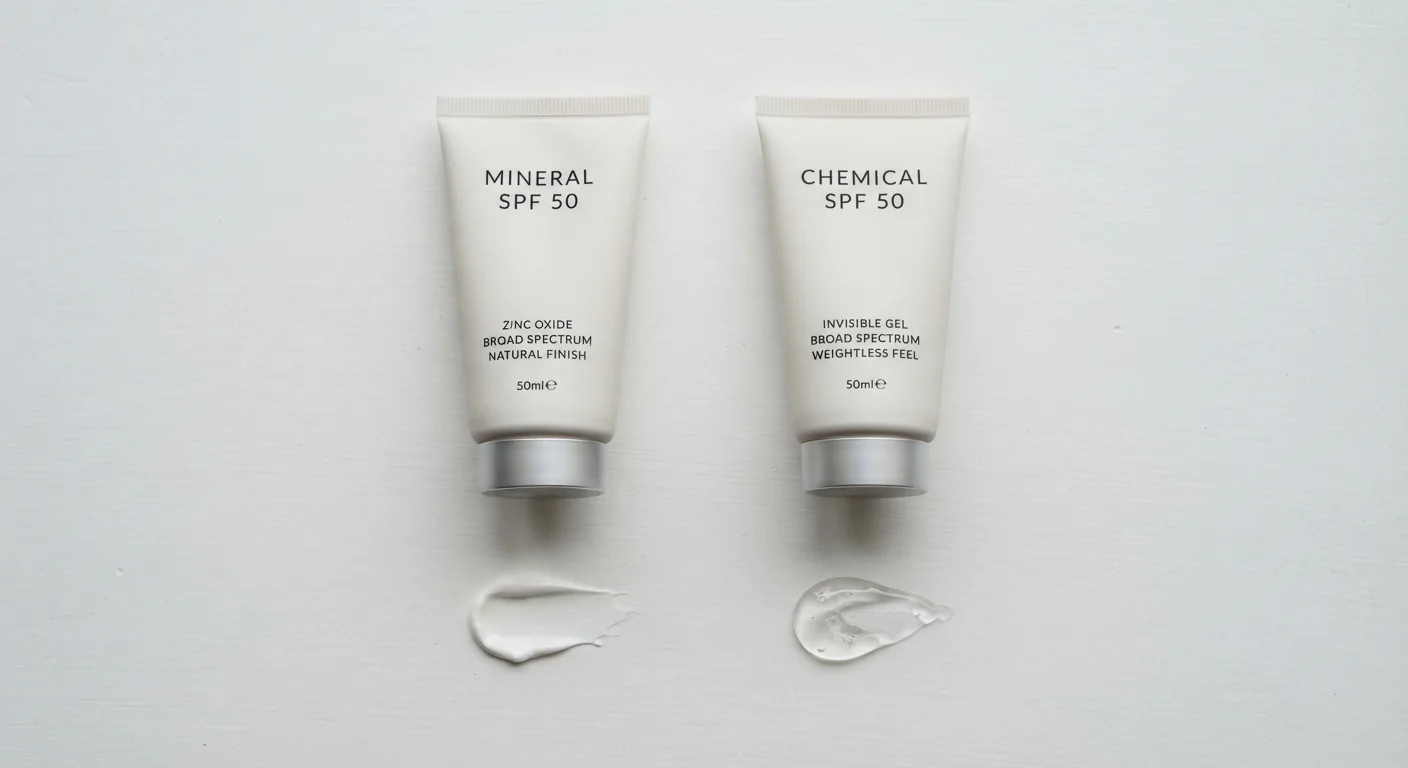
Option A
Chemical Sunscreen
The lightweight, invisible daily workhorse.
Best for: Those who want a barely-there finish for everyday wear, especially under makeup.
Option B
Mineral Sunscreen
The skin-sitting, broad-spectrum physical shield.
Best for: Those with sensitive or reactive skin who want immediate, stable UV protection.
How Each Type Actually Works
The core difference between chemical and mineral sunscreens comes down to the mechanism of UV protection - and understanding that mechanism makes every other trade-off easier to evaluate.
Chemical sunscreens use organic (carbon-based) filter molecules such as avobenzone, octinoxate, octocrylene, and homosalate. These molecules absorb UV photons and convert that energy into a small amount of heat, which dissipates harmlessly. Because the reaction is chemical, the filters need time - typically 20 to 30 minutes after application - to bind with skin proteins before full protection is active.
Mineral sunscreens rely on inorganic compounds, primarily zinc oxide and titanium dioxide. These particles sit on the skin's surface and work by scattering and reflecting UV radiation before it can penetrate. They are effective immediately upon application and are photostable - meaning they do not degrade significantly when exposed to light.
For a deeper look at how protection levels are measured and labelled, see our guide to SPF numbers, PA ratings, and broad-spectrum claims.
| Criterion | Chemical Sunscreen | Mineral Sunscreen |
|---|---|---|
| Mechanism | Absorbs UV, converts to heat | Scatters and reflects UV rays |
| Key ingredients | Avobenzone, octinoxate, octocrylene | Zinc oxide, titanium dioxide |
| Activation time | 20-30 minutes after application | Immediate upon application |
| Texture and finish | Lightweight, invisible, no cast | Thicker; may leave white cast |
| Sensitive skin tolerance | Variable; some filters may irritate | Generally well-tolerated |
| Photostability | Some filters degrade under UV | Stable; does not degrade in light |
| Environmental concerns | Some filters restricted in marine zones | Lower aquatic impact (non-nano) |
| Broad-spectrum coverage | Possible with correct formula | Zinc oxide covers UVA + UVB well |
Skin Compatibility and Sensitivities
Skin type is often the deciding factor when choosing between filter categories. Neither type is universally superior - it depends on your skin's baseline and concerns.
Sensitive and reactive skin tends to respond better to mineral formulas. Zinc oxide in particular has a long safety record and is used in products designed for infants and post-procedure skin. Some chemical filter molecules - oxybenzone being the most studied example - have been associated with contact sensitization in a subset of users, though reactions are not universal.
Acne-prone skin can go either way. Some find chemical sunscreens lightweight enough not to clog pores; others find certain formulations, especially those heavy in emollients, problematic. Mineral options with a matte or gel base are often well-tolerated, but formulation - not just filter type - is what ultimately determines comedogenicity.
Darker skin tones may find traditional mineral sunscreens leave a chalky or ashy white cast. This is a formulation issue: newer micronized zinc oxide particles and tinted mineral products address this, but not all mineral sunscreens have caught up. Chemical sunscreens remain cast-free across all skin tones.
Hybrid Formulas Are Increasingly Common
Many contemporary sunscreens combine both chemical and mineral filters in a single product. This approach can deliver the cosmetic elegance of chemical filters while boosting stability and broad-spectrum coverage with mineral ingredients. If you find the trade-offs of each type limiting, a hybrid formula may offer a practical middle ground. Check the active ingredients list to understand exactly what you are applying.
See how sunscreen fits into the bigger picture of your daily routine in our article on layering skincare products in the right order.
Environmental and Stability Considerations
Environmental impact has become an increasingly discussed factor in sunscreen choice. Certain chemical UV filters - most notably oxybenzone and octinoxate - have been identified in research as potentially harmful to coral reef ecosystems and have been banned in locations including Hawaii and some U.S. territories. The science is ongoing, but awareness is reasonable if you swim in marine environments.
Mineral filters, particularly non-nano zinc oxide, are generally considered lower-risk for aquatic ecosystems, which is why they dominate reef-safe labeling - though it is worth noting that "reef-safe" is not a regulated term in the U.S.
On the stability side, mineral filters are photostable under UV exposure. Some chemical filters - avobenzone in particular - can degrade when exposed to UV light, which is one reason formulators pair it with photostabilizers like octocrylene or Tinosorb. A well-formulated chemical sunscreen accounts for this; a poorly formulated one may not maintain full protection throughout the day.
To understand more about the active ingredient landscape sunscreen fits into, our practical reference on active ingredients worth knowing provides useful broader context.
20-30 min
Activation time for chemical sunscreens
Dermatologists consistently recommend applying chemical sunscreen at least 20-30 minutes before sun exposure to allow UV filters to bind properly with skin.
~27%
Adults who report skipping sunscreen due to texture
A survey published in the Journal of the American Academy of Dermatology found that cosmetic concerns, including texture and white cast, are among the leading reasons people skip or under-apply sunscreen.
2 hrs
Maximum reapplication interval recommended
Both the FDA and major dermatology bodies recommend reapplying any sunscreen - chemical or mineral - every two hours during outdoor activity, or after swimming and sweating.
The content on this site is for informational purposes only and is not a substitute for professional advice. Always consult a qualified professional for guidance specific to your situation.