

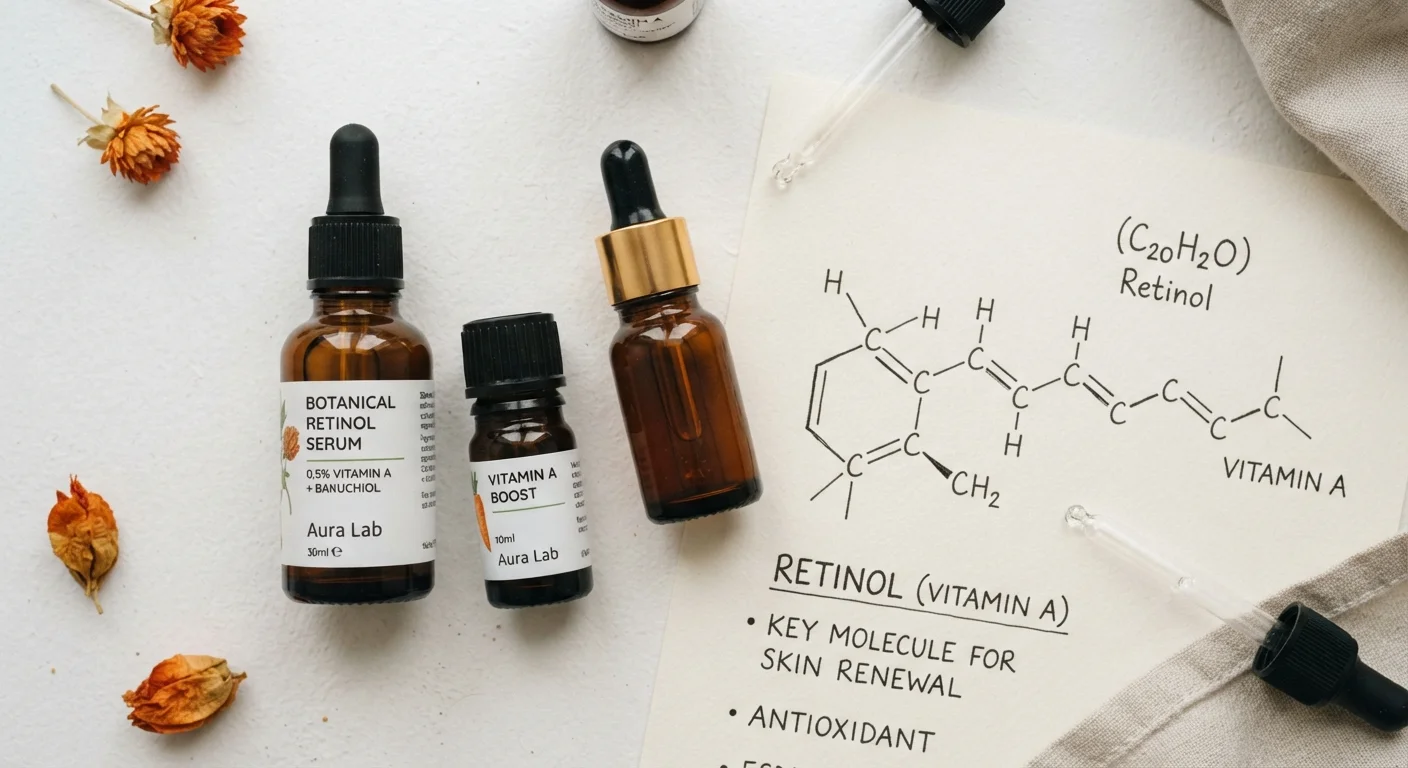
Option A
Retinol
The widely available, well-studied over-the-counter standard.
Best for: Best for those new to vitamin A who want gradual, steady results with a lower risk of irritation.
Option B
Retinal (Retinaldehyde)
The faster-converting, still-accessible middle ground.
Best for: Best for those who've tolerated retinol and want closer-to-prescription results without a prescription.
The Same Family, Very Different Speeds
When you see retinol, retinoid, and retinal on labels and ingredient lists, you're looking at members of the same vitamin A family - not different ingredients entirely. What separates them is how many conversion steps each requires before your skin can actually use them.
Your skin uses retinoic acid to communicate with skin cells, influence cell turnover, and support collagen production. None of the over-the-counter forms deliver retinoic acid directly. Instead, they're precursors that your skin enzymes convert once absorbed. The number of steps required determines how quickly you see results - and how much potential for irritation you're working with.
Think of it as a relay race: prescription retinoids hand off the baton at the finish line, while retinol has to pass it through two teammates first. As decoding an ingredient label gets easier with practice, so does understanding where each form sits in this chain.
| Criterion | Retinol | Retinal (Retinaldehyde) |
|---|---|---|
| Conversion steps to retinoic acid | Two steps | One step |
| Relative speed of action | Slower, gradual | Faster than retinol |
| Irritation potential | Lower | Moderate |
| Prescription required (US) | No | No |
| Typical starting concentration | 0.025%-0.1% | 0.025%-0.1% |
| Best suited for | Beginners, sensitive skin | Retinol-tolerant skin |
| Clinical evidence base | Extensive | Growing, promising |
How Each Form Works - Step by Step
Retinol is converted first to retinaldehyde (retinal), then to retinoic acid - two enzymatic steps. This built-in delay is precisely why it's the standard entry point: lower peak concentrations of active retinoic acid mean a lower immediate burden on the skin barrier.
Retinal (retinaldehyde) skips the first step. It converts directly to retinoic acid in a single enzymatic reaction. Research suggests it may work roughly 11 times faster than retinol at the cellular level, though real-world results depend heavily on formulation, concentration, and individual skin biology. It's more potent than retinol but still available without a prescription in most US formulations.
Prescription retinoids - tretinoin being the most widely prescribed - are retinoic acid itself. No conversion needed. This is why prescription retinoids have the most robust clinical evidence behind them and also why the adjustment period, sometimes called retinization, tends to involve more noticeable dryness and sensitivity. A dermatologist's guidance matters here.
The umbrella term retinoid refers to the entire vitamin A derivative family, including all three above. When a product claims to contain a retinoid without specifying which one, checking the full ingredient list is essential - something our guide to active skincare ingredients can help with.
2 steps
Conversions retinol needs to become active
Retinol must be converted to retinaldehyde, then to retinoic acid - each step reducing the total concentration reaching skin cells.
~11×
Faster conversion rate of retinal vs. retinol
Published cell-level research suggests retinaldehyde converts to retinoic acid roughly 11 times faster than retinol, though formulation and skin biology affect real-world outcomes.
0
Conversion steps for prescription tretinoin
Prescription tretinoin delivers retinoic acid directly to skin cells, which is why it has the most robust clinical track record - and the steepest adjustment curve.
Choosing the Right Form for Your Skin
Potency isn't automatically better. A form your skin can't tolerate won't produce the results you're after - it'll just produce irritation. The goal is to find the strongest form your skin barrier can handle comfortably over time.
If you have dry, sensitive, or barrier-compromised skin, starting with a low-concentration retinol and building frequency slowly is a well-supported approach. If you've used retinol for several months without significant issues and want to step up, retinal is a logical next consideration. Prescription retinoids are best pursued with a dermatologist who can assess your skin's baseline and guide the introduction.
Regardless of which form you use, a few practical rules apply across the board: use it at night (retinoic acid degrades in UV light), follow with a moisturizer to support the barrier, and always apply SPF the following morning. How you layer it with other actives matters too - see our guidance on layering skincare products for the right sequence. If you have a skin condition, are pregnant, or are nursing, consult a healthcare professional before starting any vitamin A product.
A Note on Labels and Terminology
Marketing language doesn't always match scientific terminology. A product labeled "retinoid complex" may contain retinol, retinal, a synthetic retinoid like adapalene, or a blend. The only way to know exactly what you're getting is to check the INCI ingredient name on the label. Our article on reading product labels explains what those listings legally have to disclose.
This article is for general informational and educational purposes only and does not constitute medical or dermatological advice. Consult a qualified healthcare professional for guidance specific to your skin or health situation.
The content on this site is for informational purposes only and is not a substitute for professional advice. Always consult a qualified professional for guidance specific to your situation.