

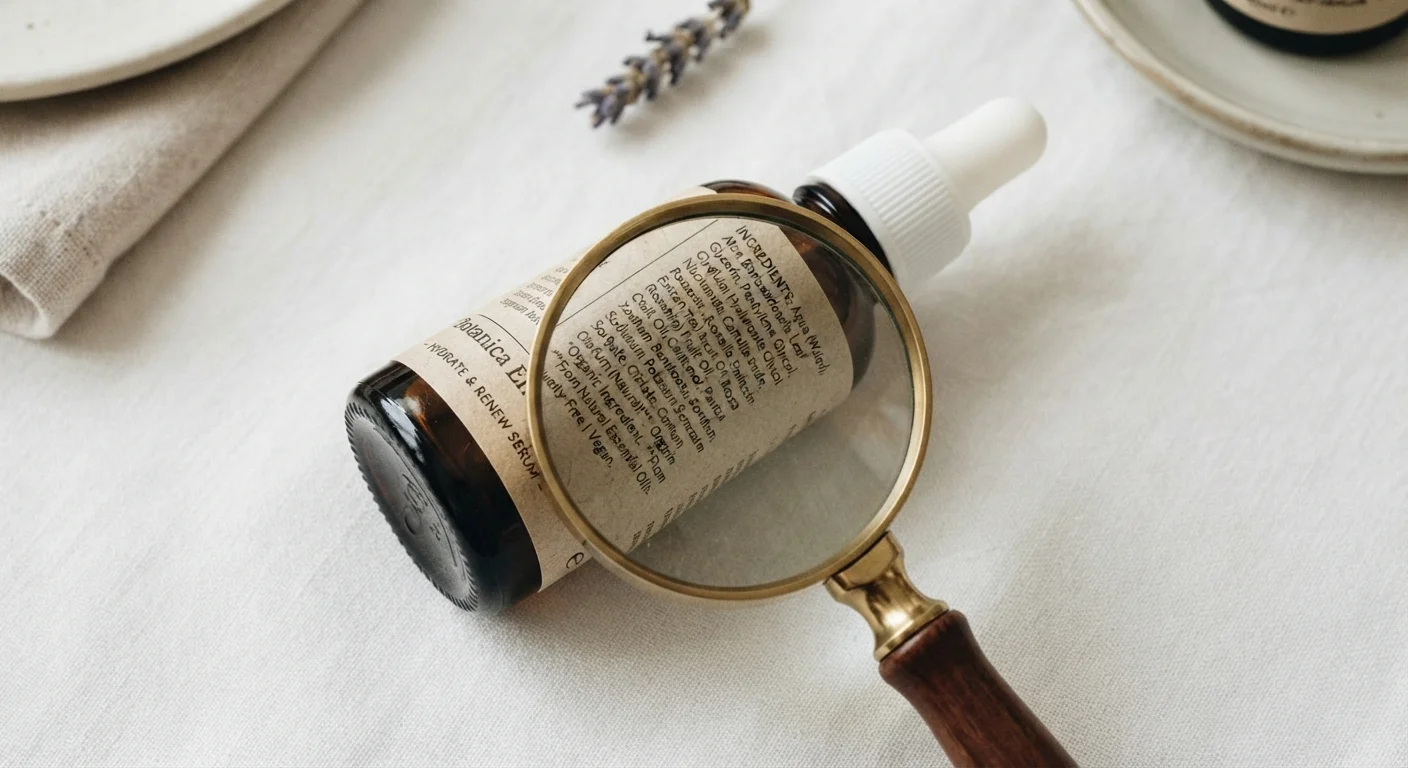
Why Skincare Labels Look So Intimidating
Flip over almost any moisturizer or serum and you'll find a wall of unfamiliar names: Butyrospermum parkii, niacinamide, phenoxyethanol. It reads like a chemistry exam — but there's a clear system behind it, and understanding that system is genuinely useful.
In the United States, the FDA requires cosmetic manufacturers to list ingredients using INCI names (International Nomenclature of Cosmetic Ingredients) — a standardized global naming system. That's why shea butter appears as Butyrospermum parkii and vitamin E as tocopherol. The names are scientific, but they're consistent across every brand and country, which actually makes cross-product comparison easier once you recognize them.
For a broader look at how ingredient list conventions work across product categories, see our guide to ingredient list conventions.
| Labeling system used in the US | INCI (International Nomenclature of Cosmetic Ingredients) (US FDA cosmetic labeling regulations) |
| Listing order rule | Descending by weight percentage (FDA 21 CFR Part 701) |
| Below this concentration, any order is permitted | 1% by weight (FDA cosmetic ingredient labeling guidelines) |
| Water's typical share in water-based formulas | 60–80% by weight (General cosmetic formulation reference) |
| Ingredient exempt from INCI naming on US labels | Fragrance (listed simply as "fragrance" or "parfum") (FDA trade secret exemption for cosmetics) |
| Actives required to show concentration on US labels | OTC drug actives (e.g., sunscreen UV filters, acne treatments) (FDA OTC drug monograph rules) |
The Order Rule: What Position Actually Signals
The single most important rule on any skincare label: ingredients are listed in descending order by weight. Whatever appears first makes up the largest proportion of the formula. Water (aqua) leads most water-based products because it typically constitutes 60–80% of the formula by weight.
Ingredients present at 1% or less can be listed in any order after that threshold — which is why you'll often see a cluster of exotic botanical extracts and active compounds near the bottom of a list. They may be genuinely effective at low concentrations (niacinamide, for instance, has a well-studied track record at 2–5%), or they may be present in such small amounts that their impact is negligible. Position alone doesn't tell you which — but it does tell you where to focus your attention.
To dig deeper into specific actives and what concentrations matter, our practical reference on active ingredients is a useful companion.
INCI Name
International Nomenclature of Cosmetic Ingredients — the globally standardized naming system used on cosmetic labels. It uses Latin or scientific names to ensure consistency across brands and countries.
1% Threshold
Under US and EU labeling conventions, ingredients present at 1% or less by weight can be listed in any order after those above 1%. This means the final cluster of ingredients may include anything from trace botanicals to key actives.
Preservative
An ingredient that prevents microbial growth (bacteria, mold, yeast) in a formula. Preservatives are essential in any water-containing product and are regulated for safe concentration limits.
pH Adjuster
An ingredient — such as citric acid or sodium hydroxide — used in tiny amounts to calibrate a formula's acidity or alkalinity. The right pH ensures both skin compatibility and the stability of active ingredients.
Emollient
An ingredient that softens and smooths the skin by filling gaps in the outer skin barrier. Common emollients include plant oils, fatty alcohols, and esters.
Humectant
An ingredient that draws moisture to the skin, typically from the air or deeper skin layers. Glycerin and hyaluronic acid are well-known examples.
Preservatives, pH Adjusters, and the Ingredients Nobody Talks About
Near the end of most ingredient lists, you'll find a cluster of names that often get unfairly maligned: preservatives, stabilizers, and pH adjusters. These ingredients keep a product safe, stable, and effective — without them, water-based formulas would grow bacteria within days.
Common preservatives like phenoxyethanol and the parabens family (methylparaben, propylparaben) appear at very low concentrations — typically well under 1%. Regulatory bodies including the FDA and the EU's Scientific Committee on Consumer Safety have established concentration limits for cosmetic use; well-formulated products stay well within those thresholds.
pH adjusters such as citric acid or sodium hydroxide appear in tiny amounts to bring a formula to the right acidity for both skin compatibility and ingredient stability. Their presence near the bottom of a list doesn't mean they're unimportant — it means they're doing a precise, low-concentration job.
"Fragrance" Is a Legal Catch-All
Under US FDA rules, fragrance ingredients can be grouped under the single term "fragrance" or "parfum" as a trade secret exemption. This means a product could contain dozens of individual fragrance compounds without disclosing them individually. If you have fragrance sensitivities, looking for "fragrance-free" labeling (not just "unscented," which may still contain masking fragrances) is a reasonable starting point — though consulting a dermatologist for personalized guidance is always advisable.
If you're curious how this label-reading approach applies to haircare products, our guide to haircare label claims covers that territory, including what words like "strengthening" and "nourishing" actually mean in a formula context.
What Labels Cannot Tell You — and What to Do Instead
Ingredient lists have real limits. They don't disclose exact percentages (except for certain regulated actives like sunscreen filters, which must be listed with their concentration under FDA monograph rules — see our sunscreen label guide for details). They also don't reveal a formula's pH, the delivery system used, or whether botanical extracts are standardized to active compounds.
The practical takeaway: use the ingredient list as a filter, not a verdict. Look for actives you're targeting in the top half of the list. Check that preservatives are present (their absence in a water-based formula is a red flag, not a selling point). And cross-reference ingredients you're uncertain about with reliable, evidence-grounded sources rather than marketing copy.
For a grounded look at one of the most confusing ingredient families, our explainer on retinol versus retinoids shows how naming conventions within a single ingredient family can create genuine confusion worth untangling.
This article is for general informational purposes only and does not constitute medical or dermatological advice. Consult a qualified healthcare professional for concerns about skin conditions or reactions.
The content on this site is for informational purposes only and is not a substitute for professional advice. Always consult a qualified professional for guidance specific to your situation.