

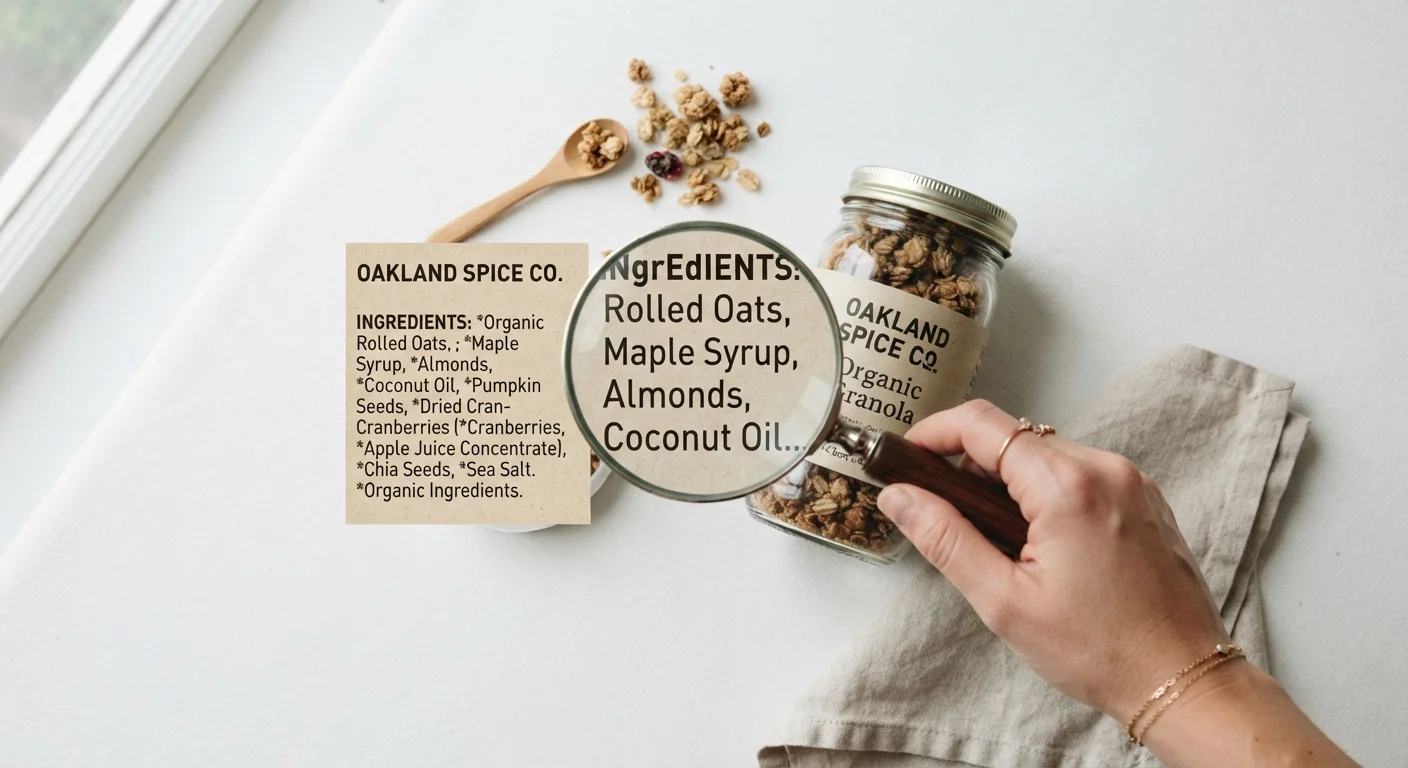
The Descending Weight Rule — and What It Actually Reveals
US federal regulations require that every ingredient on a food or cosmetic label appear in descending order of predominance by weight. In practice, this means the ingredient your product contains the most of comes first. For most foods, that's water. For many shampoos and lotions, it's also water — or a similarly inert carrier.
The implication: the first three to five ingredients typically make up the bulk of what you're putting in or on your body. If a product advertises a botanical extract as a key feature but that extract appears near the bottom of a long list, it's likely present in a very small amount. This doesn't automatically make the product ineffective — some compounds work at low concentrations — but it does temper marketing claims worth scrutinizing.
For a broader look at how label rules connect across product categories, see Reading a Product Label Without Getting Lost in the Fine Print.
60+
Names added sugar can legally appear under
The FDA recognizes more than 60 terms that qualify as added sugars under current labeling regulations, according to publicly available FDA guidance.
1%
Concentration threshold for flexible ingredient ordering
Under 21 CFR 101.4, ingredients present at 1% or less may be listed in any order after higher-concentration ingredients are ranked — a rule that affects how the bottom of most ingredient lists should be interpreted.
~10,500
Cosmetic ingredients in the INCI database
The International Nomenclature of Cosmetic Ingredients dictionary, maintained by the Personal Care Products Council, contains roughly 10,500 standardized ingredient entries.
The 1% Threshold and the Gray Zone at the Bottom
Here's where the ordering rule gets more nuanced. FDA regulations allow ingredients present at 1% or less to be listed in any order after those above 1% are properly ranked. Manufacturers can place a desirable-sounding ingredient just above a preservative, even if both are at trace levels, as long as everything above 1% is correctly sequenced.
This is why a long tail of ingredients at the end of a list can't be reliably ranked by the consumer. If the list has 25 ingredients and the top 10 are clearly above 1%, the remaining 15 could appear in any sequence the manufacturer chose.
Allergen Declarations Are a Separate Rule
The FDA requires that major food allergens — including milk, eggs, fish, shellfish, tree nuts, peanuts, wheat, and soybeans — be declared plainly, regardless of how small the amount. This disclosure may appear within the ingredient list or in a separate "Contains:" statement below it. Allergen labeling rules operate independently from the descending-weight ordering convention.
For food products specifically, the Nutrition Facts panel's "Added Sugars" line is a more reliable indicator of total sugar content than parsing the ingredient list alone — because ingredient splitting (see the next section) can obscure the true cumulative amount.
Ingredient Splitting: How One Substance Becomes Many
One of the most consequential labeling conventions — and the one most likely to mislead a quick reader — is ingredient splitting. Because each ingredient is listed individually by its own weight, a manufacturer can use several forms of the same substance and list each one separately. The result: each form ranks lower than it would if they were combined.
Sugar is the most documented example. A product might list cane sugar, brown rice syrup, dextrose, and molasses as four separate entries. Individually, none may rank in the top three. Combined, they could represent the single largest ingredient by weight. This is why Sugar by Any Other Name is a genuinely useful skill — not just nutritional trivia.
The practice isn't exclusive to sugars. Oils, starches, and fiber sources can be split similarly. It's legal, and it's worth knowing when you're evaluating a product's actual composition versus its label presentation.
Naming Conventions: Why the Same Ingredient Can Look Different
Food labels use common or usual names — "salt," "flour," "ascorbic acid" — while cosmetic labels must use INCI (International Nomenclature of Cosmetic Ingredients) names, which are standardized scientific terms. This is why a skincare label might read "Tocopherol" instead of "Vitamin E," or "Aqua" instead of "Water."
The INCI system exists for global consistency, not consumer friendliness. It means the same database of ingredient names applies whether a product was formulated in the US, Europe, or Japan — useful for safety regulators, less intuitive for shoppers. The Skincare Ingredient Label, Decoded walks through the most common INCI names and what they actually do.
One practical note: "fragrance" or "parfum" on a cosmetic label is a legally permitted catchall term that can represent a blend of dozens of undisclosed compounds. For readers with sensitivities, this single word warrants extra attention. Before adding any new product to your routine, run through this pre-use checklist to catch potential reactions early.
Cross-Reference the Nutrition Facts Panel
For food products, don't rely solely on the ingredient list to gauge sugar, sodium, or fat content. The Nutrition Facts panel aggregates these totals regardless of how many separate ingredient entries contribute to them. Use both together for the most complete picture. Reading a Nutrition Label Without Getting Lost explains each line in plain terms.
This article is for informational purposes only. For personal health, dietary, or skincare concerns, consult a qualified healthcare or dermatology professional.
Frequently Asked Questions
Not exactly — it means it's present in the greatest quantity by weight. A product may list water first, which is often just a carrier. What matters more is what follows water in meaningful concentrations.
Naming conventions vary by product category. Foods use common or usual names; cosmetics use standardized INCI names; supplements follow their own labeling rules. The same compound might appear under a different name depending on the category.
They can legally split sugar across multiple ingredient names — for example, listing corn syrup, dextrose, and maltose separately — which pushes each lower on the list. The total added sugars figure on the Nutrition Facts panel is the more reliable number to check.
Parenthetical disclosures typically identify sub-ingredients within a compound ingredient. For example, 'chocolate chips (sugar, cocoa butter, chocolate, vanilla extract)' breaks down what's inside that one component.
Yes, for two reasons. Allergens must be declared regardless of quantity, so even trace amounts appear. And some active ingredients — like retinol in skincare — are effective at very low concentrations, so a late-list placement doesn't mean ineffective.
The FDA's food and cosmetic ingredient databases, the EWG Skin Deep database for cosmetics, and the USDA's FoodData Central are publicly available, non-commercial resources for looking up ingredient function and safety data.
The content on this site is for informational purposes only and is not a substitute for professional advice. Always consult a qualified professional for guidance specific to your situation.