

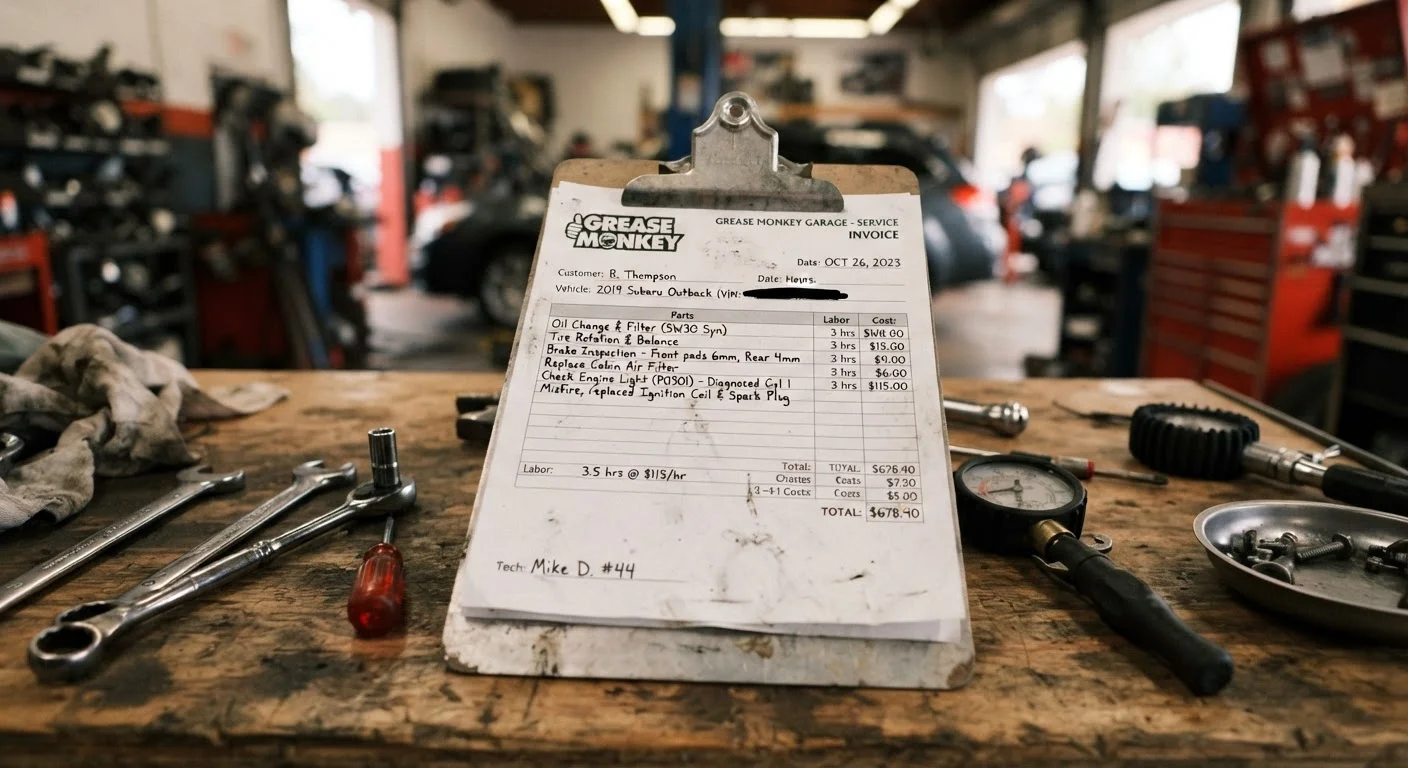
Why Service Reports Confuse Most Drivers
A mechanic's service report is one of the few documents most drivers sign without fully understanding — often because the terminology is technical, the time pressure is real, and declining feels awkward. The result is that many people either approve everything reflexively or feel suspicious of all recommendations without a clear way to tell the difference.
The good news: service reports follow a consistent structure, and the language on them is learnable. Once you understand what each section represents, you can evaluate charges the same way you'd review any itemized bill. That's not cynicism — it's informed decision-making.
Tyre condition is one area where reports often generate confusion. If a shop flags tyre wear, it helps to already understand tyre pressure and tread depth thresholds so you can assess whether the concern is legitimate or premature.
What you will need
How to Read and Respond to the Report
The steps below walk you through each stage of the process — from receiving the initial estimate to reviewing the final invoice. Having your owner's manual on hand and knowing your current mileage will make every step more concrete.
Owner's Manual
Provides manufacturer-specified maintenance intervals to cross-reference against any recommended services on the report.
Smartphone or Notepad
Used to note questions, photograph the service report, and look up unfamiliar terminology on the spot.
Personal Maintenance Log
A record of past services that lets you verify whether a suggested job is genuinely due.
Request the Itemized Estimate Before Work Begins
Ask for a written estimate that separates every charge: parts, labor, and any diagnostic or shop fees. A legitimate shop will provide this without hesitation. Review each line — a bundled "service package" price makes it nearly impossible to evaluate individual items fairly.
Decode the Core Terminology
Service reports use language that carries specific meaning:
- Labor rate: The hourly charge for technician time, applied to a standardized time estimate per job — not the actual clock time it took.
- OEM vs. aftermarket parts: OEM (Original Equipment Manufacturer) parts come from the vehicle's maker; aftermarket parts come from third parties. Both can be legitimate depending on the repair.
- Diagnostic fee: The charge for identifying a problem, often applied toward repair cost if you proceed.
- Required vs. recommended: "Required" typically signals a safety or legal issue; "recommended" is elective, however beneficial it may be.
Cross-Reference Against Your Maintenance Schedule
Open your owner's manual or check your vehicle's full maintenance schedule to verify whether each suggested service aligns with the manufacturer's mileage or time intervals. If a shop recommends a transmission fluid flush at 40,000 miles but your manual specifies 60,000, you have a factual basis to decline — politely and confidently.
Ask Three Questions for Every Unfamiliar Line Item
For each item you don't recognize, ask:
- What is this, and why does my vehicle need it now?
- What happens if I defer it?
- How was this identified — visually, by measurement, or by a warning code?
The answers reveal whether the recommendation is evidence-based or speculative. A well-run shop will welcome the questions; evasive or impatient responses are themselves informative.
Approve, Decline, or Defer Each Item in Writing
You are not obligated to approve every item on a service report at once. Mark each line as approved, declined, or deferred and ask the shop to note declined items on the final invoice. This protects you legally and creates a record for your next visit. For context on what a standard service genuinely covers, see what routine servicing actually covers.
Review the Final Invoice Before Paying
Compare the final invoice line-by-line against the original estimate. Confirm that only approved work appears, part numbers match what was quoted (OEM vs. aftermarket), and the labor hours align with the estimate. Discrepancies — even small ones — should be resolved before you hand over payment, since disputes become significantly harder once the vehicle leaves the lot.
Verbal Approval Can Be Binding
In most U.S. states, authorizing repair work verbally — even informally — can legally commit you to paying for it. Always confirm the scope and estimated cost in writing before any technician touches your vehicle. If a shop adds unapproved work, you generally have the right to dispute that charge, but prevention is far simpler than after-the-fact disputes.
"Recommended" Does Not Mean "Urgent"
Shops are required to disclose safety-critical issues, but they may also list elective services that are genuinely helpful — or simply revenue-generating. Cross-reference every "recommended" item against your owner's manual mileage intervals. If it isn't due yet according to the manufacturer, it is reasonable to decline and revisit at the appropriate service interval.
Keep a Personal Maintenance Log
File each service report — physical or digital — in a simple folder organized by date and mileage. When a shop claims a service is overdue, your own records let you verify that instantly. A documented history also adds tangible value if you sell the vehicle privately.
Common Report Sections and What They Mean
Most service reports share a standard layout worth recognizing:
- Vehicle information header: Confirms VIN, mileage logged at drop-off, and the technician's name. Verify these are accurate before anything else.
- Concern / Complaint: What you reported when you brought the car in. Confirm this matches your actual complaint.
- Cause: The technician's diagnosis. This should be specific — "worn brake pads at 2mm" is verifiable; "brakes checked" is not.
- Correction: The proposed or completed fix. Each correction should map to a line-item charge.
- Multi-point inspection results: Often color-coded (green / yellow / red) to indicate condition. Yellow items are typically the source of upsell recommendations — treat them with the cross-referencing approach described in Step 3.
If you're also evaluating a used vehicle purchase, applying similar critical reading skills to vehicle history reports will serve you well in that process too.
The content on this site is for informational purposes only and is not a substitute for professional advice. Always consult a qualified professional for guidance specific to your situation.