

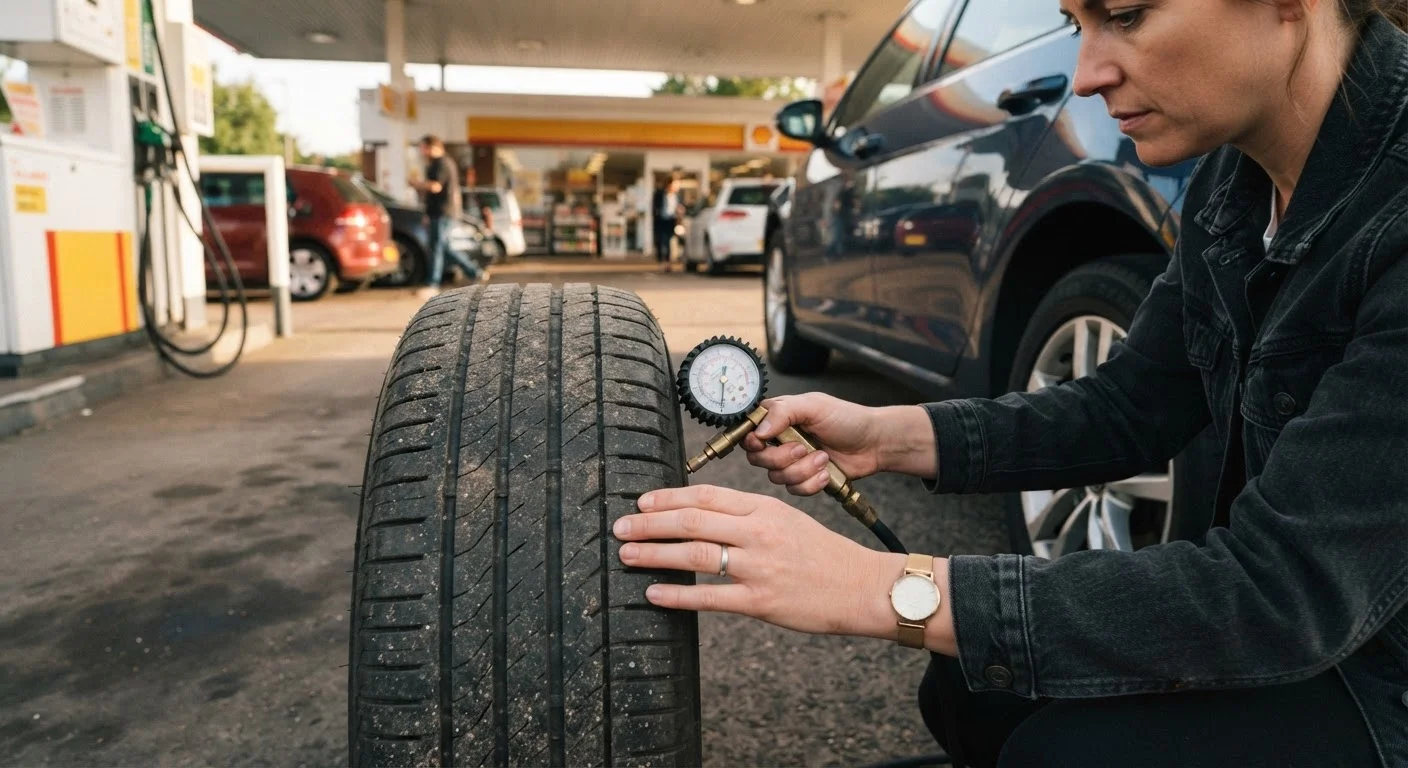
What Tyre Pressure Actually Measures — and Why It Shifts
Tyre pressure describes how much compressed air is inside the tyre, expressed in PSI (pounds per square inch). The right pressure keeps the tyre's contact patch — the small area touching the road — at its optimal shape and size. Too little pressure and the tyre's edges bear more load than they should; too much and the centre of the tread shoulders all the stress.
The correct figure for your vehicle is found on the driver's door jamb sticker or in the owner's manual. Front and rear tyres sometimes carry different recommended values, so check both. The number moulded into the tyre sidewall is the tyre's maximum rated pressure — not a target.
Always Check Pressure Cold
Heat from driving raises air pressure temporarily, so a reading taken after a warm-up drive will be higher than the true cold pressure. For accurate results, check before driving or at least three hours after the vehicle has been parked. This is especially important when diagnosing whether a tyre is truly overinflated or simply warm from use.
Pressure changes with temperature. For every 10°F drop in ambient temperature, expect to lose approximately 1 PSI. This makes autumn and early winter the most common seasons for drivers to unknowingly operate on underinflated tyres. See the seasonal maintenance checklist for a broader set of weather-driven checks.
Tread Depth: What the Numbers Mean in Practice
Tyre grooves serve a specific engineering purpose: they displace water from beneath the tyre during wet braking, allowing the rubber to maintain contact with the road surface. As tread wears down, that displacement capacity shrinks. The practical consequence is longer stopping distances and a sharply increased risk of hydroplaning — where the tyre rides on a film of water instead of gripping the road.
1 PSI
Pressure lost per 10°F temperature drop
This is a widely cited engineering relationship used by tyre manufacturers and vehicle safety educators to explain seasonal pressure loss.
2/32"
US legal minimum tread depth
This threshold is the statutory replacement point in most US states; tyres at or below this depth should be removed from service.
4/32"
Practical wet-weather replacement threshold
Safety researchers and tyre engineers widely recommend this depth as the point at which wet braking performance begins to degrade meaningfully.
The US legal minimum tread depth is 2/32 of an inch. A common field check is the penny test: insert a penny head-down into a tread groove. If Abraham Lincoln's head is fully visible, the tread is at or below that legal threshold. Many tyre and safety engineers, however, use 4/32 as a practical wet-weather replacement benchmark — at that depth, wet stopping distances begin to increase meaningfully.
Uneven tread wear is also informative. Wear concentrated on the tyre's edges typically indicates chronic underinflation; wear down the centre suggests overinflation. Either pattern warrants attention before the tyre reaches minimum depth. For a broader view of what these signs might mean on a service document, reading a mechanic's service report can help decode the terminology.
When Each Reading Becomes a Safety Issue
Pressure and tread depth don't carry equal urgency in every situation. Here's how to think about when each truly matters:
- Underinflation: Increases rolling resistance, raises fuel consumption, generates sidewall heat, and can accelerate structural tyre failure. Particularly dangerous at highway speeds. Tyre blowouts and brake failures become significantly more likely with chronic underinflation.
- Overinflation: Reduces the contact patch, decreasing grip, and causes the centre of the tread to wear faster. Over-pressurised tyres are also more vulnerable to impact damage from potholes.
- Tread below 4/32: A meaningful wet-weather concern. Braking distances in rain can increase substantially. At 2/32, the tyre meets the legal replacement threshold regardless of conditions.
- Tread below 2/32: The tyre is legally worn out in most US states and should not remain in service. This is a compliance issue as well as a safety one.
If you're building these habits from scratch, vehicle maintenance from the very beginning provides a structured foundation for new vehicle owners.
TPMS Sensors Are Not a Substitute for Manual Checks
Tyre Pressure Monitoring Systems (TPMS) are federally required on US vehicles manufactured after 2007 and alert drivers when pressure drops roughly 25% below the recommended level. However, a tyre can be meaningfully underinflated — and tread can wear to dangerous levels — without triggering any dashboard warning. Manual monthly checks remain the most reliable safety habit.
Checking Both Correctly: A Practical Approach
Consistent checks are more valuable than occasional ones. Monthly pressure checks, combined with a visual tread inspection at the same time, take under five minutes and establish a baseline that makes wear patterns and slow leaks obvious over time.
For pressure: Use a quality gauge — digital or dial-type — with the tyre cold. Remove the valve cap, press the gauge firmly onto the valve stem, read the value, and compare it to your door jamb specification. Add or release air as needed, then refit the cap. Check all four tyres, including the spare if your vehicle has one.
For tread: A tread depth gauge costs a few dollars and gives a precise reading in seconds. The penny test is reliable for identifying tyres already at the legal limit. For the 4/32 threshold, use a quarter instead — if Washington's head is fully visible, tread is at or below 4/32. Rotate your inspection around the tyre's circumference, since wear is rarely perfectly uniform.
These two checks are foundational to safe vehicle operation. For context on how tyre failure can unfold and what to do if it occurs, see what actually happens during a tyre blowout.
Frequently Asked Questions
Check the sticker inside the driver's door jamb or the owner's manual. The number printed on the tyre sidewall is the tyre's maximum pressure, not the recommended pressure for your vehicle — using that figure can overinflate your tyres.
Once a month is the standard guidance, and always before a long road trip. Temperature changes affect pressure significantly, so recheck after any major weather shift. Always measure cold, before driving more than a mile.
Most US states set the legal minimum at 2/32 of an inch. You can check this with a penny — if Lincoln's head is fully visible when inserted head-down into a groove, the tread is at or below 2/32 and the tyre should be replaced.
Yes. Severely underinflated tyres flex more than designed, generating excess heat in the sidewall. Over time this can cause structural failure and a sudden blowout, particularly at highway speeds. Maintaining correct pressure is one of the most effective blowout-prevention steps available.
Less so than in wet conditions, but worn tyres still reduce braking grip on dry roads and are more vulnerable to punctures. Wet-weather performance degrades dramatically as tread depth falls below 4/32, which is why many safety engineers treat that as the practical replacement threshold.
Cold air is denser, so tyre pressure drops as temperatures fall — roughly 1 PSI per 10°F. This means tyres that were correctly inflated in summer may be noticeably underinflated by winter. Check and adjust pressure whenever there is a significant temperature change.
The content on this site is for informational purposes only and is not a substitute for professional advice. Always consult a qualified professional for guidance specific to your situation.