

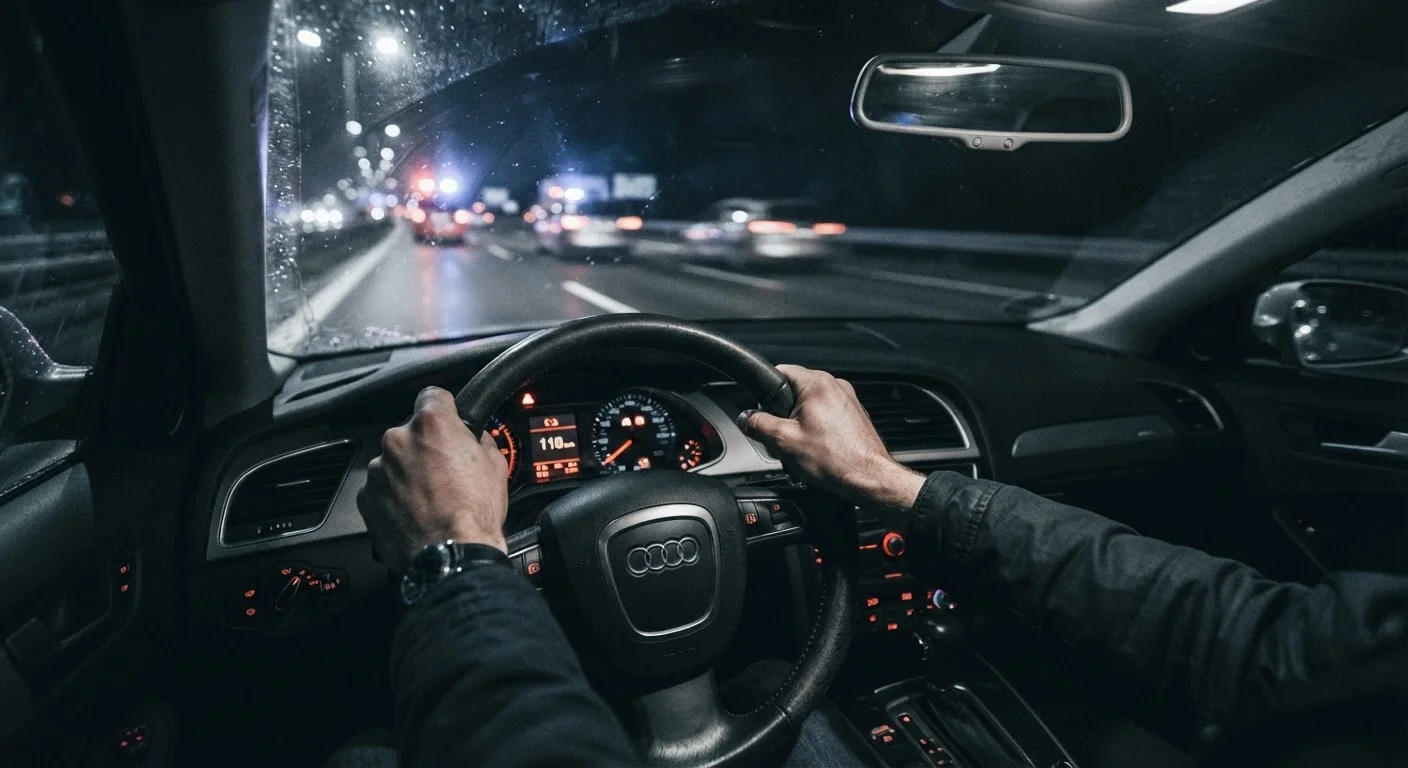
Why Instinct Often Works Against You
In a driving emergency, the human stress response drives us toward sharp, forceful reactions — brake hard, steer sharply, overcorrect. In most vehicle emergencies, these instincts make outcomes worse, not better. A tyre blowout, a sudden skid, or unresponsive brakes each demand a counterintuitive response: smooth inputs, maintained grip, and deliberate deceleration rather than panic.
Understanding why these responses work is what makes them accessible under pressure. Physics doesn't change in a crisis — weight transfer, friction limits, and momentum still govern what your car can and cannot do. Drivers who have internalized the correct responses, even just conceptually, perform significantly better when seconds matter.
Adverse conditions compound these risks considerably. If you regularly drive in challenging weather, adjusting your approach for rain, fog, and snow is an essential complement to the emergency techniques covered here.
Do Not Slam the Brakes During a Blowout
Hard braking after a tyre failure is one of the most dangerous instinctive reactions a driver can make. It transfers weight abruptly to the damaged corner, increasing the risk of rollover or loss of directional control. Resist the urge — keep a firm, steady grip and allow the car to slow naturally before applying gradual brake pressure.
Step-by-Step: Handling Each Emergency
The following steps address the three most common in-motion vehicle emergencies: a tyre blowout, brake fade or failure, and a skid. Each scenario requires a distinct sequence of actions. Read through all steps before you need them — familiarity is itself a form of preparation.
What you will need
Responding to a Tyre Blowout
The moment a tyre fails, you will hear a loud bang or feel a sudden pull to one side. Your instinct may be to brake hard — resist it. Instead, grip the steering wheel firmly with both hands and maintain your current direction of travel. Ease your foot off the accelerator smoothly; do not lift suddenly. Allow aerodynamic drag and rolling resistance to slow the vehicle gradually.
Once speed has dropped below roughly 30 mph, steer toward the shoulder or a safe stopping area and apply the brakes gently. Activate your hazard lights as soon as it is safe to do so.
Handling Brake Fade or Failure
Brake fade occurs when brake components overheat, reducing stopping power — most often on sustained downhill grades. If the pedal feels soft or unresponsive, pump the brake pedal rapidly several times to build hydraulic pressure. In a manual transmission vehicle, downshifting through the gears uses engine braking to assist in slowing the car.
If brakes remain unresponsive, steer toward a safe area such as a runaway truck ramp, open field, or uphill incline. As a last resort on a level surface, applying the handbrake (parking brake) gradually — not abruptly — can slow the vehicle without inducing a spin.
Correcting an Oversteer Skid (Rear Slides Out)
An oversteer skid — where the rear of the car swings outward — is common in rear-wheel-drive vehicles or when turning too fast on a slippery surface. The correction is to steer in the same direction the rear is sliding (commonly called 'steering into the skid'). If the rear swings left, turn the wheel left.
Ease off the accelerator but do not brake. Once the rear realigns with the front, straighten the wheel promptly to prevent the car from swinging back the other way (counter-skid).
Correcting an Understeer Skid (Front Slides Wide)
Understeer happens when the front wheels lose grip and the car continues straight despite steering input — typical in front-wheel-drive vehicles entering a corner too fast. Ease off the accelerator to transfer weight back to the front axle, which can help restore front-wheel grip. Avoid braking sharply, as this shifts weight further forward and can worsen the situation.
Reduce steering lock slightly — holding excessive steering input while wheels are sliding often makes recovery harder. As speed drops and grip returns, the car will begin to follow your intended path.
Securing and Signaling After Any Emergency
Once the vehicle has come to a controlled stop in a safe location, activate hazard lights immediately if not already done. If you are on a highway or motorway, stay inside the vehicle with your seatbelt fastened unless there is an immediate fire or safety hazard — exiting onto a live roadway carries serious risk. For guidance on what to do next, see our motorway breakdown safety steps.
Call emergency services or roadside assistance, describe your location precisely, and remain visible to rescuers.
Brake Fade Can Return Without Warning
If your brakes have faded due to heat — common on long mountain descents — they may seem to recover briefly before failing again. Do not assume the problem is resolved. Pull over safely as soon as possible, allow the brakes to cool completely, and have the system inspected by a qualified mechanic before continuing.
Prevention Is Your Best Emergency Plan
Check tyre pressure monthly and inspect tread depth regularly — worn tyres are far more vulnerable to blowouts. Brake fluid condition and pad thickness should be assessed as part of routine servicing. Staying current with vehicle maintenance dramatically reduces the likelihood of facing these emergencies on the road.
For a deeper look at what physically occurs during a high-speed tyre failure, the highway tyre blowout explainer covers the mechanics in detail. And if your vehicle stops moving altogether, our roadside breakdown response guide walks through the next steps.
This article provides general driver education and is not a substitute for professional driver training. Techniques described are general guidance; vehicle behavior varies by make, model, and road conditions. Always drive within your ability and the posted limits.
The content on this site is for informational purposes only and is not a substitute for professional advice. Always consult a qualified professional for guidance specific to your situation.