

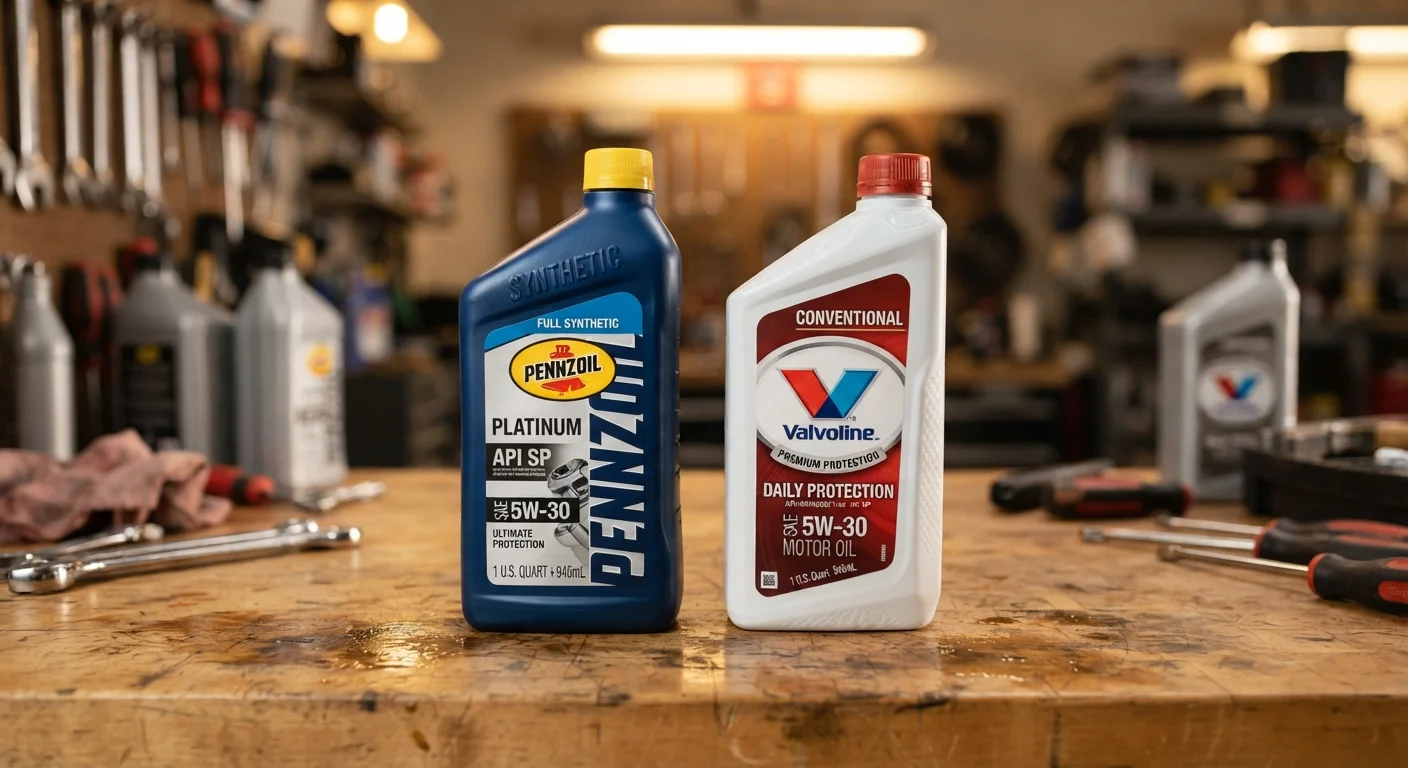
Option A
Synthetic Motor Oil
The engineered, high-performance option.
Best for: Drivers with newer vehicles, turbocharged engines, or those operating in extreme temperature ranges.
Option B
Conventional Motor Oil
The time-tested, widely available standard.
Best for: Owners of older vehicles with low-mileage, simple engine designs and moderate driving conditions.
What Sets Them Apart at the Molecular Level
The core difference between synthetic and conventional oil isn't marketing — it's chemistry. Conventional motor oil is refined from crude petroleum. That refining process removes many impurities, but the resulting molecules are still irregular in size and shape, which can affect how consistently the oil performs under pressure and heat.
Synthetic motor oil, by contrast, is built molecule by molecule through a chemical process. That engineering produces a lubricant with uniform molecular structure, fewer contaminants, and more predictable behavior across a wide range of temperatures and operating conditions. Most full synthetics start from a petroleum or chemical base, but the synthesis step distinguishes their performance profile considerably.
There are also synthetic blends — mixtures of both types — that occupy a middle ground in both performance and price. These are worth knowing about, but the meaningful comparison for most drivers is still full synthetic versus conventional.
API and ILSAC Certification Labels Matter
When selecting any motor oil, look for certification marks from the American Petroleum Institute (API) and the International Lubricant Standardization and Approval Committee (ILSAC). These marks — such as the API donut or the starburst symbol — indicate the oil meets established performance and protection standards. Your owner's manual will specify which certification category is required for your engine.
Head-to-Head: Key Differences That Matter to Drivers
Understanding how these oils differ in practice helps you make a more informed decision at service time. Here's how they compare across criteria that actually affect your engine and your costs.
| Criterion | Synthetic Oil | Conventional Oil |
|---|---|---|
| Molecular consistency | Engineered, uniform structure | Naturally variable from crude |
| Temperature performance | Stable across wide extremes | More susceptible to breakdown |
| Typical change interval | Often 7,500–10,000+ miles | Typically 3,000–5,000 miles |
| Cost per quart | Higher upfront cost | Lower upfront cost |
| Engine protection under stress | Superior in demanding conditions | Adequate in standard conditions |
| Compatibility with older engines | Use with caution; consult mechanic | Well-suited for many older designs |
One important nuance: a longer change interval for synthetic oil doesn't mean skipping maintenance is fine. Oil degrades from contamination and combustion byproducts regardless of its base chemistry. As our editorial team explains in detail, delayed oil changes carry real engine costs that accumulate quietly over time.
When the Choice Is Already Made for You
For a growing number of vehicles — particularly those with turbocharged engines, direct injection systems, or tight manufacturing tolerances — the manufacturer specifies synthetic oil. This isn't upselling; it's an engineering requirement. Running conventional oil in an engine designed for synthetic can void warranty provisions or accelerate wear.
Your owner's manual is the single most authoritative source for what your specific engine requires. If it specifies a particular viscosity grade (such as 0W-20 or 5W-30) and a full synthetic, that specification should be followed. If it allows conventional or either type, you have genuine flexibility. You might also find our breakdown of common car maintenance myths useful — including several that surround oil change decisions specifically.
~75%
U.S. motor oil market share: synthetic
Industry estimates suggest synthetic and synthetic-blend oils now account for the majority of motor oil sold in the U.S., reflecting a significant shift from a decade ago.
2–3×
Longer change intervals vs. conventional
Synthetic oil change intervals are commonly double or triple those of conventional oil, though manufacturer guidelines always take precedence.
High-Mileage Vehicles: A Special Consideration
If your vehicle has significant mileage on it — typically above 75,000 miles — the conventional-to-synthetic switch deserves some care. Over time, seals and gaskets in older engines can adapt to the specific characteristics of the oil they've been running. A sudden switch to full synthetic, which has different detergent properties and viscosity behavior, can occasionally surface pre-existing leaks or seal wear that conventional oil was effectively masking.
This isn't a reason to fear synthetic oil in older engines, but it is a reason to have a conversation with a qualified mechanic before switching if your vehicle is high-mileage. Many mechanics recommend high-mileage-specific formulations — which may be conventional, synthetic, or blend — for engines with significant wear. Whether you handle this yourself or leave it to a professional is a decision with its own tradeoffs; see our guide on DIY maintenance versus taking your car to a mechanic for a practical breakdown.
The content on this site is for informational purposes only and is not a substitute for professional advice. Always consult a qualified professional for guidance specific to your situation.