

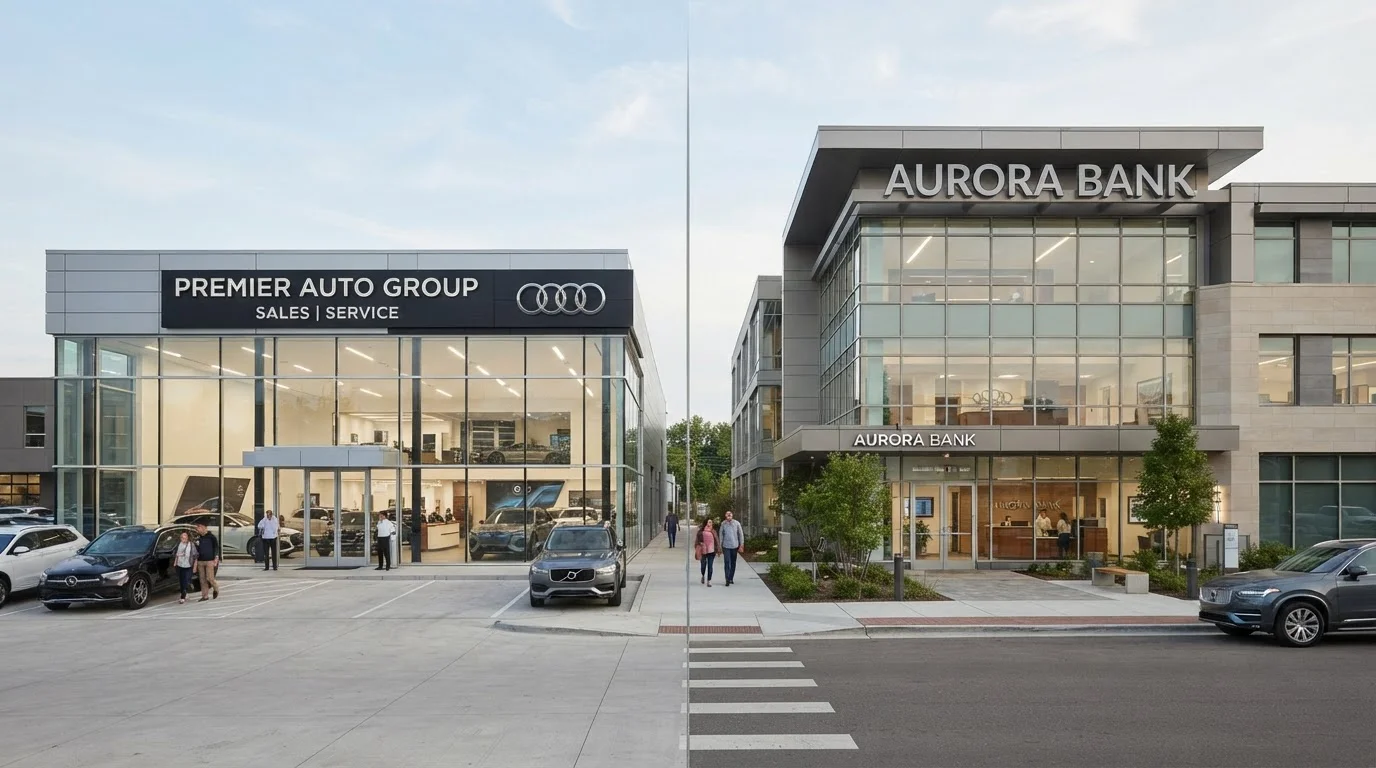
Option A
Dealer Financing
The convenient, one-stop financing option at the point of sale.
Best for: Buyers who want to bundle vehicle selection and financing into a single dealership visit, or who qualify for manufacturer-backed promotional rates.
Option B
Bank or Credit Union Financing
The independent, pre-arranged lending route before you set foot on the lot.
Best for: Buyers who want a firm rate in hand before negotiating, or who prefer working with a lender they already have a relationship with.
How Each Financing Path Works
When you finance a vehicle, you're borrowing money to pay the seller while agreeing to repay the lender — with interest — over a set term. The core question is: who is that lender?
Dealer financing (also called indirect lending) means the dealership acts as an intermediary. You complete a credit application on-site, the dealer submits it to one or more lenders in its network, and the dealer presents you with an offer. The underlying loan is typically held by a bank, a manufacturer's captive finance company, or another financial institution — not the dealer itself.
Direct lending means you approach a bank, credit union, or online lender independently, before or during your vehicle search. If approved, you receive a pre-approval for a specific loan amount at a stated rate. You then use those funds (or a check) at the dealership like a cash buyer. For a plain-language breakdown of the terms you'll encounter in any loan offer, see Auto Loan Terms Decoded.
| Criterion | Dealer Financing | Bank / Credit Union |
|---|---|---|
| Where you apply | At the dealership | Bank branch, online, or credit union |
| Timing | At point of sale | Before or during vehicle search |
| Rate transparency | Markup possible (dealer reserve) | Rate stated directly to borrower |
| Promotional rates | Manufacturer 0% APR available | Not available |
| Lender relationship | Indirect — dealer submits to lenders | Direct with the lending institution |
| Negotiating leverage | Lower — financing bundled with sale | Higher — separates price and financing |
| Credit spectrum served | Broad, including subprime lenders | Varies by institution |
The Rate Markup Factor and Promotional Deals
One critical dynamic in dealer financing is the dealer reserve — a markup the dealer may add to the rate it receives from the lender. For example, if a lender approves your loan at 6.5% APR, the dealer might present it to you at 7.9%, keeping the difference as compensation. Regulations in this area have evolved, and some lenders cap markups, but the practice exists and is worth understanding.
On the other hand, dealer financing is the only route to manufacturer-sponsored promotional rates. These are subsidized by automakers to move inventory and can include 0% APR for well-qualified buyers — rates no independent lender can match. Always compare the promotional rate against the market rate you could obtain independently to determine which genuinely costs less over your loan term.
~80%
New vehicle buyers who use dealership financing
Industry estimates from the Consumer Financial Protection Bureau indicate the majority of new vehicle purchases are financed through the dealership, reflecting its convenience.
0.25–0.5%
Typical rate advantage for credit union auto loans
National Credit Union Administration data consistently shows credit union auto loan rates running below the average rate at commercial banks for comparable credit tiers.
Credit unions deserve particular attention. As member-owned, not-for-profit institutions, they return earnings to members in the form of lower rates and fees. If you're not yet a member of a credit union, eligibility requirements vary — some are open to anyone in a geographic area. Understanding how your credit profile affects any loan offer is also worthwhile; our credit resource hub covers the fundamentals.
Negotiating Strategy: Why Keeping Costs Separate Matters
A common dealership tactic is to anchor the conversation around your monthly payment rather than the vehicle's total price or interest rate. This framing can obscure how much you're actually paying. Extending a loan term by 12 months, for instance, lowers the monthly figure while increasing the total cost substantially.
Arriving with a bank or credit union pre-approval shifts the dynamic. You've already locked in a rate ceiling — if the dealer can beat it, great; if not, you have a ready alternative. This separation allows you to negotiate the vehicle price first, then discuss financing independently.
Applying to Multiple Lenders and Your Credit Score
Rate-shopping with multiple lenders within a short window — typically 14 to 45 days depending on the credit scoring model — is generally treated as a single inquiry by major credit bureaus. This means pre-shopping at your bank or credit union before visiting a dealership is unlikely to meaningfully affect your credit score, as long as applications are clustered in that window.
Whether you're buying new, used, or certified pre-owned also shapes which financing routes are available and at what rates. For context on how vehicle type affects the broader purchase, see New Car, Used Car, or Certified Pre-Owned. For a complete view of how financing fits into the overall process, The Full Vehicle Purchase Journey walks through every stage.
This article provides general financial education about auto loan options and is not personalized financial or legal advice. Loan availability, rates, and terms vary based on individual credit profiles, lender policies, and market conditions. Consult a qualified financial professional for guidance tailored to your situation.
The content on this site is for informational purposes only and is not a substitute for professional advice. Always consult a qualified professional for guidance specific to your situation.