

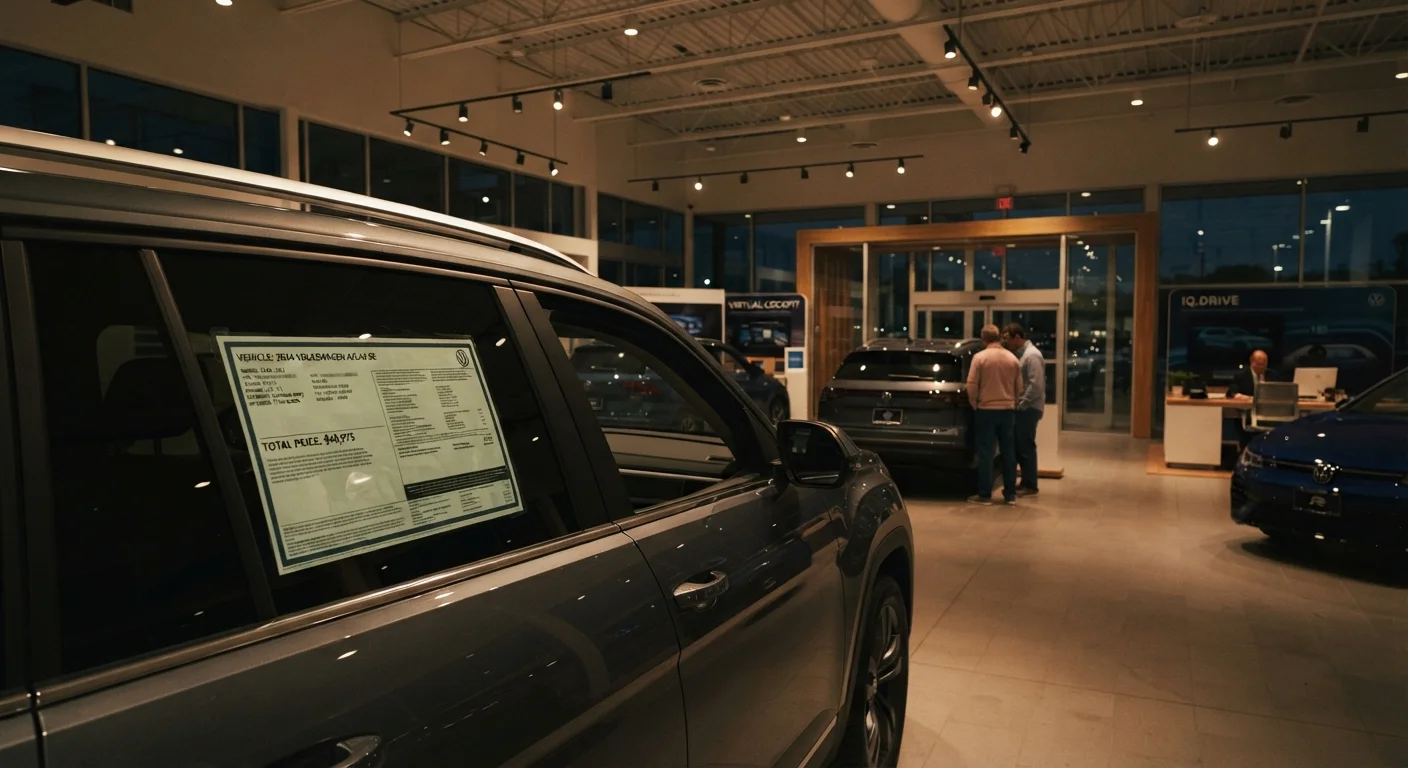
Why the Sticker Is Just the Opening Act
Walk into any dealership and you'll spot the Monroney sticker — a detailed label covering the vehicle's base price, factory-installed options, fuel economy estimates, and destination charge. It's a useful snapshot, but treating it as your final cost is one of the most common and costly assumptions a car buyer can make.
Between the sticker price and the amount you sign for, a series of additional charges accumulate. Some are legitimate and standard; others are discretionary, inflated, or avoidable entirely. Knowing which is which gives you real negotiating leverage. For a broader look at what comes after the purchase, see our guide on understanding total cost of ownership before you commit.
$1,000–$2,000+
Typical range of fees added above MSRP
Consumer advocacy organizations estimate that taxes, title, documentation, and destination charges commonly add this range to the advertised price on a new vehicle purchase.
Varies by state
Documentation fee cap enforcement
Only some U.S. states cap the documentation fee dealers may charge; in uncapped states, doc fees can range from under $100 to over $900 depending on the dealership.
~$300–$600
Average destination charge on new vehicles
Manufacturer-set destination charges on new cars and trucks typically fall in this range, though they can be higher for larger vehicles or longer shipping distances.
Fees You'll Almost Always Encounter
Certain charges appear on nearly every vehicle purchase contract regardless of dealer or state. Understanding them in advance prevents sticker shock at the finance office.
- Destination charge: The cost to ship the vehicle from the factory to the dealership. This is set by the manufacturer and is non-negotiable — it also already appears on the Monroney sticker. Dealers cannot legally charge it twice, but it's worth confirming.
- Documentation fee: Covers the dealer's cost of preparing title, registration, and loan documents. Amounts range widely — from under $100 in some states to several hundred dollars in others — and some states cap the amount by statute.
- Sales tax: Calculated on the vehicle's purchase price and varies by state and sometimes by county or municipality. This is a genuine government-mandated cost with no room for negotiation.
- Title and registration: State fees to legally transfer ownership and register the vehicle in your name. These amounts are fixed by your state's DMV schedule.
None of these fees signal bad faith — they are real costs. The problem arises when less transparent charges get bundled alongside them.
Always Ask for the Out-the-Door Price
Before discussing monthly payments or trade-in values, request a complete itemised breakdown of every charge included in the final purchase price. This single step prevents the most common sources of surprise at contract signing. A reputable dealer will provide this without hesitation.
The Charges Worth Scrutinising Closely
Beyond standard fees lies a category of charges that are either dealer-generated or heavily marked up. These are the line items that quietly inflate the final number and deserve a careful second look.
- Dealer-installed accessories: Items like all-weather mats, window tinting, or paint sealant added by the dealer after factory delivery. Markups on these packages can be substantial, and many buyers never specifically requested them.
- Market adjustment or ADM (Additional Dealer Markup): A surcharge added above MSRP, typically during periods of high demand or limited supply. Unlike a standard fee, this is pure dealer discretion and is worth questioning or shopping around to avoid.
- Extended warranties and add-on products: Service contracts, gap insurance, and credit insurance are commonly pitched in the finance office. These can have legitimate value, but prices and terms vary enormously. Never feel pressured to decide on the spot.
- Advertising fees: Some dealers pass regional advertising costs on to the buyer as a line item. Whether this is negotiable depends on the dealer and market.
These charges are a key reason why the hidden costs consumers routinely overlook extend well beyond the window sticker.
How to Protect Yourself Before You Sign
The most effective strategy is simple: always ask for the out-the-door price — the complete, itemised total — before any discussion of monthly payments. Monthly payment framing is a common tactic that obscures total cost by stretching a high price across more months.
Request the purchase worksheet as an itemised document. Review every line. For each unfamiliar charge, ask for a plain explanation. Items you did not request — particularly dealer-installed accessories — can often be removed or reduced. Items set by the government or manufacturer generally cannot.
Comparing out-the-door quotes from multiple dealerships is one of the most effective ways to identify outlier fees. If one dealer's doc fee is $895 and another's is $199 for the same vehicle, that gap is real money — and worth knowing before you commit. For a deeper perspective on evaluating what you're actually getting for your money, our piece on price vs. value applies directly here.
This article is for general informational purposes only. Fees, taxes, and regulations vary by state and locality. Always verify current costs and requirements with your dealership and state DMV before completing a vehicle purchase.
Frequently Asked Questions
No. The invoice price is what the dealer pays the manufacturer, while the MSRP is the suggested selling price to consumers. The gap between the two is sometimes called the dealer margin, though incentives and holdbacks further complicate the actual dealer cost.
In most market conditions, yes. The MSRP is a starting point for negotiation, not a fixed floor. However, in high-demand situations — such as limited inventory or newly launched models — dealers may sell at or above MSRP.
A documentation fee (doc fee) covers the dealer's administrative costs for processing paperwork. It is charged by virtually all dealers, but the amount varies widely by state. Some states cap the fee by law; others do not.
The out-the-door price is the total you'll pay to drive away, including all taxes, fees, and dealer charges. Always ask for this number in writing before agreeing to any deal — it's the only figure that truly tells you what the car costs.
No. Dealers often add accessories — such as paint protection film, cargo mats, or wheel locks — after the vehicle arrives and mark them up significantly. These are separate from the manufacturer's sticker and are frequently negotiable.
The content on this site is for informational purposes only and is not a substitute for professional advice. Always consult a qualified professional for guidance specific to your situation.