

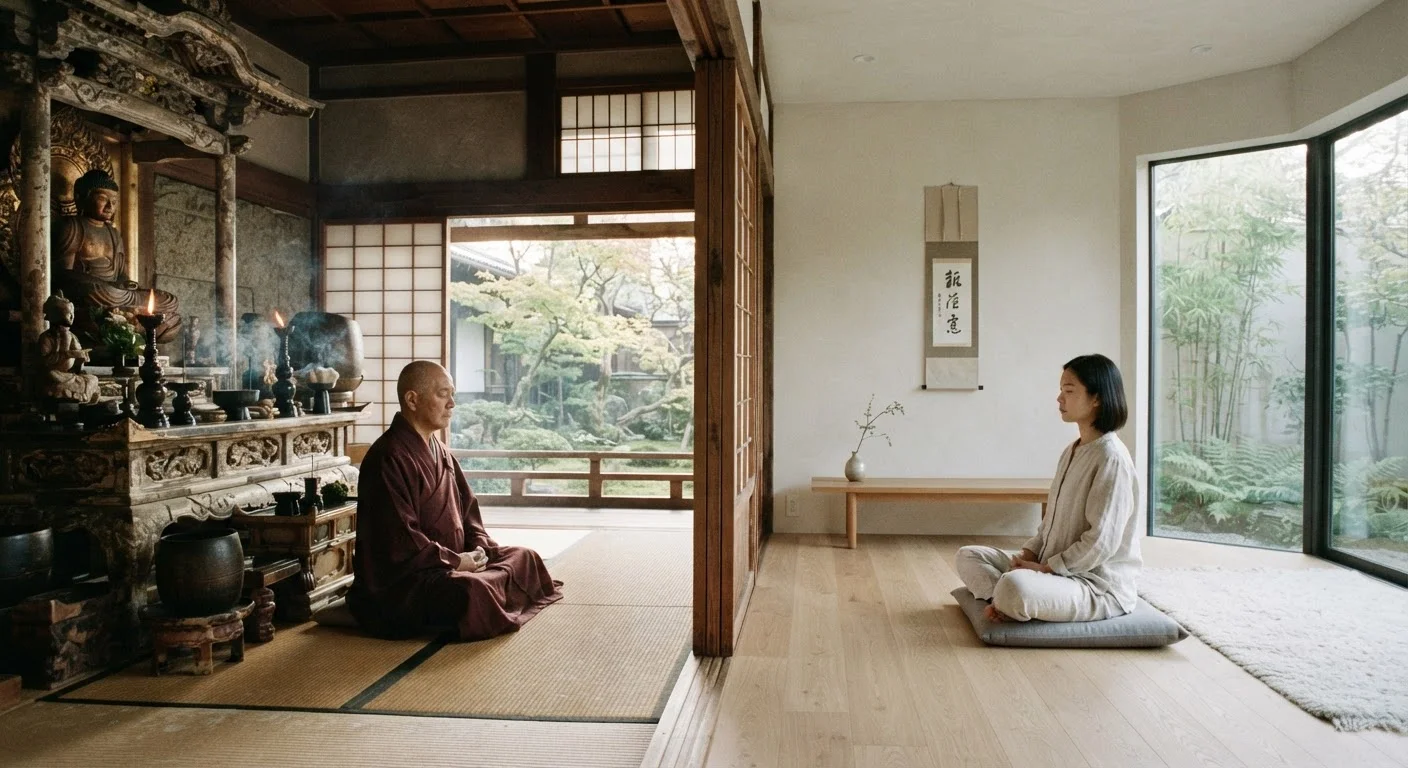
The Buddhist Roots of Mindfulness
The word mindfulness is an English translation of sati, a Pali term found in early Buddhist texts including the Satipatthana Sutta. Pali was the liturgical language of the Theravada Buddhist tradition, and sati carried a meaning closer to "clear awareness" or "recollection" than the passive, present-moment attention the word evokes today.
In its original context, sati was one component of the Buddha's Noble Eightfold Path — a structured ethical and meditative framework aimed at reducing suffering and cultivating liberation. Mindfulness was never a standalone wellness tool; it was embedded within a broader system that included right intention, right speech, and right action. Practitioners trained attention not simply to feel calmer, but to see the nature of experience clearly enough to loosen habitual, suffering-producing reactions.
The Satipatthana Sutta outlines four foundations of mindfulness: awareness of the body, feelings (as pleasant, unpleasant, or neutral), mental states, and phenomena. This is a far more structured framework than most modern definitions suggest. See our honest look at what mindfulness really means for how these definitions shifted over time.
2,500+
Years of mindfulness practice history
Early Buddhist texts referencing sati and the Satipatthana Sutta date to approximately the 5th century BCE.
1979
Year MBSR was developed
Jon Kabat-Zinn launched Mindfulness-Based Stress Reduction at the University of Massachusetts Medical School.
8 weeks
Standard MBSR program length
The core secular mindfulness curriculum involves structured weekly sessions and daily home practice over eight weeks.
How Mindfulness Traveled West
Serious Western scholarly engagement with Buddhist meditation began in the 19th century through the work of translators and comparative religion scholars. However, it was the mid-20th century that saw contemplative practice move from academic study into lived experience for Western audiences.
Teachers including Thich Nhat Hanh, who introduced "engaged Buddhism" to Western audiences in the 1960s, and S.N. Goenka, who taught Vipassana (insight meditation) intensives globally from the 1970s onward, made sustained practice accessible outside monasteries. Their approaches preserved much of the original ethical framework while adapting language for general audiences.
Simultaneously, psychologists and psychiatrists in the US and Europe were developing an interest in contemplative practices as potential clinical tools — a convergence that would soon reshape how mindfulness was defined and delivered.
“The most fundamental teaching of the Buddha is that the mind can be trained. What we call mindfulness is, at its heart, that training — the deliberate cultivation of a different relationship to experience.”
— Bhikkhu Bodhi, Buddhist scholar and translator of the Pali Canon
The Secularization of Mindfulness
The most influential moment in mindfulness's secular translation came in 1979, when molecular biologist Jon Kabat-Zinn developed Mindfulness-Based Stress Reduction (MBSR) at the University of Massachusetts Medical School. Kabat-Zinn deliberately reframed mindfulness in universal, non-religious terms — defining it as "paying attention in a particular way: on purpose, in the present moment, and non-judgmentally." This definition enabled clinical research and widened access significantly.
MBSR's eight-week structured program drew on Vipassana and Zen techniques — breath awareness, body scanning, mindful movement — while grounding outcomes in measurable psychological and physiological terms. Subsequent programs including Mindfulness-Based Cognitive Therapy (MBCT) built on MBSR's framework, and a substantial body of peer-reviewed research followed. For a clear-eyed view of what that research does and doesn't show, see what peer-reviewed research has established about mindfulness.
Know What Your Program Is Teaching
Before beginning a structured mindfulness course, ask whether it is rooted in a secular clinical model (like MBSR or MBCT), a Buddhist teaching lineage, or a hybrid. Each has a distinct framework and set of goals. Knowing this up front helps you evaluate what you experience and set realistic expectations.
What Was Kept — and What Was Left Behind
Secular mindfulness programs successfully preserved the attentional dimension of Buddhist practice: the deliberate training of awareness on present-moment experience without automatic judgment. This is genuine and valuable.
What was largely set aside is equally significant. Buddhist mindfulness was inseparable from sila (ethical conduct) and prajna (wisdom) — an understanding that clear attention is meant to reveal the constructed, impermanent nature of self and experience, not merely to reduce cortisol. The goal of liberation from suffering through insight is distinct from stress reduction or cognitive flexibility, even if those outcomes overlap.
Some scholars and practitioners — including those within Buddhist communities — have raised concerns that "McMindfulness" (a term sometimes used critically) risks becoming a productivity optimization tool disconnected from its humane ethical roots. This isn't a reason to dismiss secular mindfulness, but it is a reason to understand what any particular program is and isn't offering.
Secular Mindfulness Is Not Buddhist Meditation
Programs like MBSR are designed as evidence-informed psychological interventions, not as introductions to Buddhism. They draw on Buddhist techniques but explicitly remove the religious and philosophical context. If you are drawn to the fuller traditional system — including its ethical framework and philosophy of mind — seek out teachers trained within an established Buddhist lineage rather than assuming a clinical program covers the same ground.
Mindfulness Across Other Traditions
Sustained, non-reactive present-moment awareness is not exclusive to Buddhism. Recognizing this context helps practitioners see mindfulness as a human capacity that different wisdom traditions have cultivated independently.
- Stoicism: The Stoic practice of prosoche — self-attention and continuous awareness of one's thoughts, impulses, and judgments — parallels mindfulness in significant ways. Practitioners were asked to observe mental events without being automatically swept along by them.
- Christian contemplative traditions: Practices such as lectio divina, centering prayer, and the apophatic tradition of "the cloud of unknowing" cultivate a receptive, non-grasping awareness that shares structural features with meditation-based mindfulness.
- Taoism: The concept of wu wei (non-striving or effortless action) reflects an orientation toward experience that emphasizes observation over intervention — a resonance with mindful non-reactivity.
- Yoga traditions: Dharana (concentration) and dhyana (meditation) from the Yoga Sutras of Patanjali describe attentional training that precedes and overlaps with Buddhist approaches.
Our article on common mindfulness vocabulary provides plain-language definitions of many of the terms these traditions share.
When evaluating a mindfulness teacher or program, ask about their training lineage and what tradition, if any, their approach draws from. Transparency here is a sign of integrity.
The field includes a wide range of instructors with highly varied training. Understanding the source of a teacher's method helps you assess both its depth and its fit for your goals.
If you find secular mindfulness feels thin or unsatisfying, exploring one of its source traditions — even just through reading — often restores a sense of purpose and context to the practice.
Many practitioners report that understanding the philosophical underpinnings of attention training makes the techniques more meaningful and sustainable over time.
Making Sense of It for Your Own Practice
You don't need to adopt a religious framework to practice mindfulness effectively, and you don't need to abandon one to benefit from secular programs. What matters is knowing what you're engaging with.
If you pursue a secular MBSR-style program, you're training attention and developing skill at recognizing and pausing habitual mental reactions — genuine and well-studied capacities. If you study mindfulness within a Buddhist context, you're entering a more comprehensive system with ethical commitments and a specific philosophy of mind. Both are coherent. They simply aren't identical.
Understanding the differences between meditation, mindfulness, and relaxation is a useful next step before committing to any structured practice. And if you're new to all of this, a beginner's guide to where to actually start offers practical first steps grounded in realistic expectations.
The historical lineage of mindfulness is not a burden to carry into your practice — but it is a source of depth worth knowing about. Awareness of where a concept came from tends to improve how clearly we understand what we're actually doing with it.
This article is for informational and educational purposes only and is not a substitute for advice from a qualified mental health professional. If you are experiencing significant psychological distress, please consult a licensed healthcare provider.
The content on this site is for informational purposes only and is not a substitute for professional advice. Always consult a qualified professional for guidance specific to your situation.