

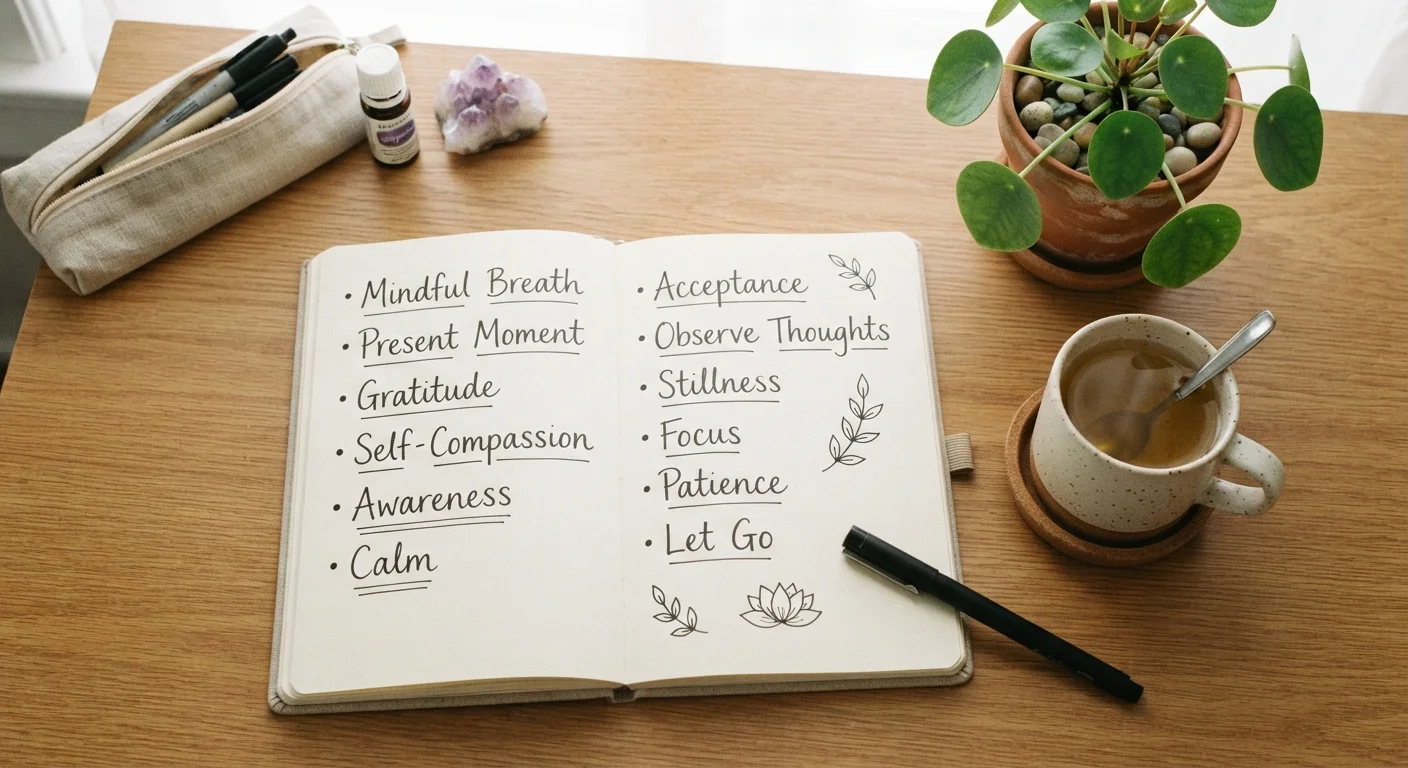
Why Mindfulness Vocabulary Can Feel Like a Foreign Language
Pick up any mindfulness guide or meditation app and you'll quickly run into words like equanimity, non-attachment, or interoception. For newcomers, the terminology can feel like a barrier rather than a bridge. Some terms come from Pali or Sanskrit Buddhist traditions; others are clinical labels from psychology research; still others are loose, popular shorthand that means different things in different contexts.
This reference cuts through the confusion. Each definition below reflects how the term is most commonly used in contemporary, secular mindfulness settings—though many have richer histories worth exploring. For a deeper look at where these ideas originated, see our guide to mindfulness across traditions.
Present-moment awareness
The deliberate act of directing attention to what is happening right now—sensations, thoughts, and surroundings—rather than replaying the past or anticipating the future. It is the foundational skill underlying most mindfulness practices.
Body scan
A guided practice in which attention moves systematically through different regions of the body, noticing physical sensations without trying to change them. It is commonly used to develop interoceptive awareness and reduce physical tension.
Non-judgmental observation
The practice of noticing thoughts, feelings, and sensations without labeling them as good or bad. The goal is to witness experience with curiosity rather than evaluation.
Equanimity
A stable, balanced mental state that neither clings to pleasant experiences nor resists unpleasant ones. In mindfulness contexts, it describes an evenness of mind that allows full engagement with experience without being overwhelmed by it.
Non-attachment
An orientation of not grasping at experiences, outcomes, or identities. It does not mean emotional coldness, but rather holding experiences lightly rather than depending on them for wellbeing.
Interoception
The perception of signals arising from inside the body—heartbeat, breath, muscle tension, hunger. Mindfulness practices often strengthen interoceptive awareness, which research associates with better emotion regulation.
Beginner's mind (Shoshin)
A concept from Zen Buddhism referring to approaching experience with openness and curiosity, as if encountering it for the first time. It counteracts the tendency to filter experience through habit and assumption.
MBSR
Mindfulness-Based Stress Reduction—an eight-week, structured program developed by Jon Kabat-Zinn at the University of Massachusetts in the late 1970s. It is one of the most extensively researched mindfulness interventions in clinical settings.
Rumination
Repetitive, often negative thinking that circles back on itself without resolution. Mindfulness practices are frequently contrasted with rumination, as they emphasize observing thoughts without dwelling on them.
Acceptance
In mindfulness and acceptance-based therapies, acknowledging the reality of a thought, feeling, or situation without fighting or denying it. Acceptance is an active stance, not resignation.
Loving-kindness (Metta)
A meditation practice that involves cultivating feelings of warmth and goodwill—first toward oneself, then toward others in expanding circles. Research suggests it may support positive emotion and social connection.
Cognitive defusion
A technique from Acceptance and Commitment Therapy (ACT) that involves observing thoughts as mental events rather than facts. It overlaps with mindfulness by encouraging distance from automatic thinking patterns.
Core Concepts at a Glance
The quick-reference card below summarizes the most essential facts about mindfulness as a field—useful context before diving into individual term definitions.
| Origin of secular mindfulness | Adapted from Buddhist contemplative traditions in the late 1970s (MBSR program, University of Massachusetts) |
| Most studied intervention | Mindfulness-Based Stress Reduction (MBSR) (Extensive peer-reviewed literature since the 1980s) |
| Standard MBSR program length | 8 weeks |
| Core skill | Sustained, non-judgmental present-moment attention |
| Related clinical approaches | MBCT, ACT, DBT (all incorporate mindfulness elements) (Established evidence-based therapies) |
| Formal vs. informal practice | Formal = scheduled sitting; Informal = awareness during daily tasks |
Understanding these basics helps anchor the vocabulary that follows. If you're still building a foundation, our article on what mindfulness actually means clarifies the concept itself before you start working through the terminology.
Common Confusions Worth Clearing Up
Several mindfulness terms are routinely used interchangeably in popular media even though they describe distinct things. Two of the most frequent mix-ups:
- Mindfulness vs. meditation: Mindfulness is a quality of attention—an awareness you can bring to any moment. Meditation is a structured practice used to cultivate that quality. You can be mindful while washing dishes; you're meditating when you sit formally to train attention. Our breakdown of meditation, mindfulness, and relaxation explores the full distinction.
- Non-attachment vs. detachment: Non-attachment means not clinging to outcomes or experiences; it doesn't mean emotional withdrawal or indifference. Detachment implies disconnection. The difference is subtle but meaningful in practice.
- Acceptance vs. approval: Accepting a thought or feeling means acknowledging it without resistance—not endorsing or liking it. This distinction is central to many evidence-based therapies built on mindfulness principles.
Terms Differ Across Traditions and Contexts
The definitions in this glossary reflect mainstream secular and clinical usage in the United States. If you encounter the same term in a Buddhist, therapeutic, or app-based context, the meaning may carry additional nuance or differ slightly. When a specific teacher or program uses a term in a specialized way, their working definition takes precedence within that context. Checking the source material is always worthwhile.
Ready to put these terms into practice? Our beginner's starting guide walks through first steps in plain language, and eight everyday moments for mindfulness shows how awareness fits into ordinary routines.
This article is for general informational purposes only and is not a substitute for advice from a qualified mental health professional. If you are experiencing significant psychological distress, please consult a licensed clinician.
The content on this site is for informational purposes only and is not a substitute for professional advice. Always consult a qualified professional for guidance specific to your situation.