

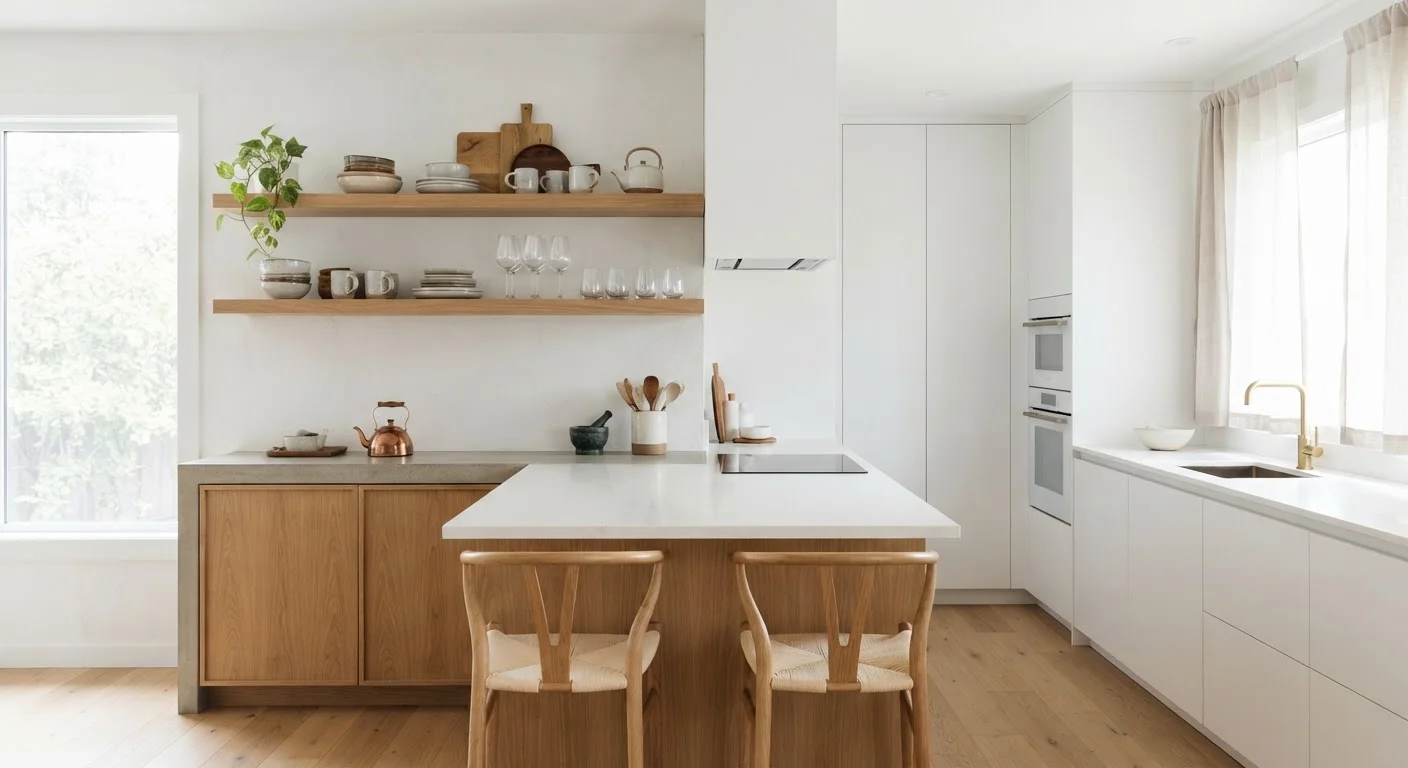
Option A
Open Shelving
The visually expressive, high-maintenance option.
Best for: People who enjoy curation, keep clutter naturally in check, and want their storage to double as décor.
Option B
Closed Cabinets
The forgiving, hide-it-away workhorse.
Best for: Households that prioritise function, have varied storage needs, or simply want a kitchen that looks tidy without daily effort.
What Open Shelving Actually Requires
Open shelving has dominated interior inspiration feeds for years, and it's easy to see why. A row of uniform white bowls, some stacked cutting boards, a few trailing plants — it photographs beautifully. The honest caveat is that the photo exists in a moment. You live in the aftermath.
The core demand of open shelving is visibility maintenance. Every item stored is on permanent display, which means mismatched mugs, bulky cereal boxes, and random appliances become visual noise unless actively managed. In practice, many households find themselves doing a quick tidy before guests arrive — except with open shelves, every day is that day.
Beyond tidiness, open shelves accumulate dust and kitchen grease faster than most people anticipate. Shelves positioned near a hob or cooktop will develop a tacky film on stored items within weeks. This isn't a dealbreaker, but it does mean dishes and glassware need washing before use more often, and the shelves themselves require regular wiping.
Open Shelving Outside the Kitchen
Open shelving in living rooms, hallways, or home offices operates under different conditions than in a kitchen. Without cooking grease and steam, dust accumulation is slower and the maintenance burden is considerably lighter. If you want to experiment with the aesthetic, a non-kitchen location is a lower-stakes starting point. See how display-focused choices can easily tip into clutter in our piece on gallery wall common mistakes.
Open shelving can also work well in non-kitchen contexts — living rooms, hallways, home offices — where cooking residue isn't a factor and the display pressure is lower. The maintenance reality is significantly easier outside cooking zones.
What Closed Cabinets Actually Require
Closed cabinets are the default for good reason. A door solves a remarkable number of domestic problems: mismatched storage containers, rarely-used appliances, bulky cleaning supplies, items you own out of necessity rather than affection. None of it needs to be curated — it just needs to fit.
The maintenance demand of closed cabinets is internal organisation. Without visibility, it's easy for cabinet interiors to become chaotic over time. Items migrate to the back, duplicates accumulate, and the cabinet that looked tidy when you moved in becomes a source of low-grade frustration six months later. The discipline required is periodic rather than daily, which suits most households better — but it still exists.
From a spatial perspective, closed cabinets can make a kitchen feel more enclosed, particularly in smaller rooms. Upper cabinets that run to the ceiling are efficient but can visually compress a space. This is worth considering in galley kitchens or rooms with limited natural light. Our piece on small-space design principles covers how layout choices interact with storage approaches in compact rooms.
| Criterion | Open Shelving | Closed Cabinets |
|---|---|---|
| Daily tidiness demand | High — everything visible | Low — doors conceal clutter |
| Dust and grease buildup | Faster, especially near hob | Slower, contained inside |
| Visual spaciousness | Opens up a room | Can feel heavier or enclosed |
| Storage flexibility | Limited — items must look good | High — anything fits |
| Periodic deep-clean effort | Items need washing more often | Interior reorganisation needed |
| Renter suitability | Varies — check lease before drilling | Already installed in most rentals |
| Aesthetic payoff | High when curated well | Neutral — clean and functional |
Matching the Style to Your Actual Life
The mistake most people make when choosing between these styles is selecting based on what looks good in photos rather than what suits their habits. Open shelving rewards a specific kind of household — one where tidiness is maintained naturally, where the items stored are genuinely attractive, and where the person living there finds curation enjoyable rather than exhausting.
If that describes you, open shelving can be a meaningful upgrade. If it doesn't — if the kitchen is a functional workhorse, if aesthetics rank below ease, if the household includes anyone who doesn't share your storage philosophy — closed cabinets will serve you far better on a Tuesday evening after work.
A hybrid approach is worth considering seriously. Many kitchens benefit from a single stretch of open shelving for frequently used, visually consistent items (everyday plates, glassware, a plant or two) while keeping everything else behind doors. This gives you the aesthetic payoff at a fraction of the ongoing effort. Similar trade-off thinking applies to other design choices — our look at common decorating myths explores how rigid style rules often create more problems than they solve.
~30 min
Typical weekly open-shelf tidy time
Home organisation experts commonly estimate that open-shelf households spend significantly more time on surface tidying than those with closed storage, though exact figures vary by household size and cooking frequency.
2–4×
Faster grease accumulation on open shelves near cooktops
Kitchen ventilation studies note that airborne grease particles settle on all nearby surfaces, but open shelves near active cooking zones accumulate residue considerably faster than enclosed cabinets.
Whatever you choose, the most important variable isn't the style — it's whether the style matches how you actually use your home.
The content on this site is for informational purposes only and is not a substitute for professional advice. Always consult a qualified professional for guidance specific to your situation.