

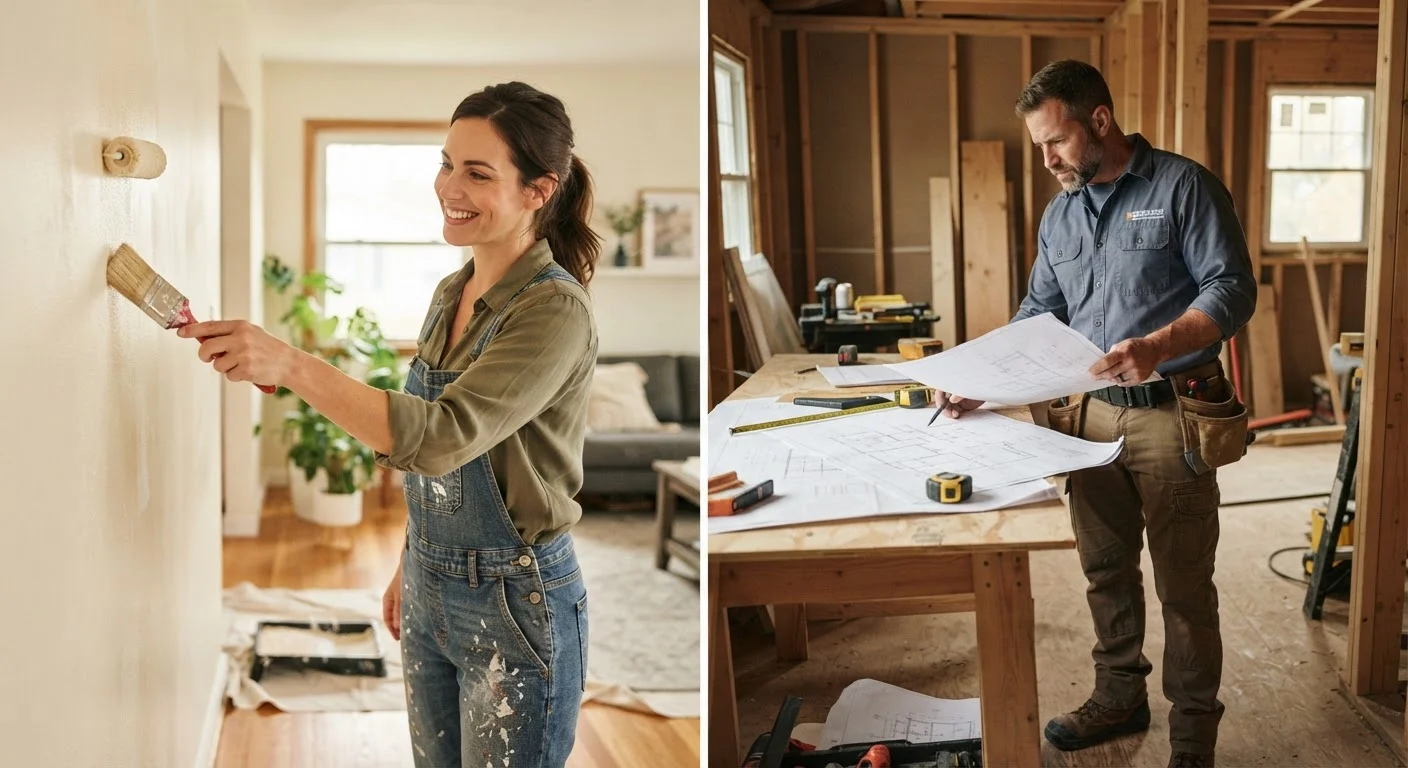
Option A
DIY
The hands-on, cost-conscious approach.
Best for: Lower-stakes tasks where mistakes are recoverable, permits aren't required, and the homeowner has relevant skills and time.
Option B
Hiring a Contractor
The professional, liability-managed option.
Best for: Structural, electrical, plumbing, or code-regulated work where errors carry safety, legal, or resale consequences.
The Real Question Isn't Cost — It's Consequence
Most homeowners frame the DIY-vs-contractor debate as a budget question. That's understandable, but it's the wrong starting point. The more useful question is: what happens if this goes wrong?
A badly painted accent wall costs you a weekend and a few gallons of paint to fix. A DIY electrical panel modification done incorrectly can cause a house fire, void your homeowner's insurance, and expose you to liability. The consequence gap between those two scenarios is enormous — and it should drive the decision more than sticker price does.
Think about any home project along two axes: technical complexity and consequence of failure. Tasks that are low on both axes are strong DIY candidates. Tasks that are high on either axis deserve serious consideration of professional help. This framework applies well beyond home improvement — see how the same logic plays out in our DIY vs. mechanic guide for vehicle upkeep.
| Criterion | DIY | Hiring a Contractor |
|---|---|---|
| Upfront cost | Lower labor cost; tool costs vary | Higher; includes labor and markup |
| Skill requirement | Depends entirely on the task | Provided by the professional |
| Time investment | Significant — research, execution, cleanup | Minimal for homeowner |
| Permit handling | Homeowner's responsibility | Typically managed by contractor |
| Liability if something goes wrong | Falls on homeowner | Contractor's insurance covers their work |
| Code compliance | Homeowner must research and ensure | Licensed trades required to comply |
| Resale documentation | May be difficult to verify | Permits and licenses provide a paper trail |
When DIY Is a Genuinely Smart Choice
There's a wide category of home tasks where a reasonably careful, patient homeowner can produce professional-quality results without specialized training. Painting interiors, replacing light switch covers, installing peel-and-stick backsplash, patching small drywall holes, sealing grout, swapping out cabinet hardware, and basic landscaping all fall here.
What these share: they're well-documented, the materials are forgiving, mistakes are reversible, and no permits are involved. YouTube tutorials and manufacturer instructions are genuinely sufficient guides for most of these jobs.
~35%
DIY projects that exceed initial budget estimates
Industry surveys consistently find that material overruns and unexpected complications push DIY costs higher than homeowners anticipate.
1 in 3
DIY home repairs later corrected by a professional
Home improvement research suggests a significant share of amateur repairs require professional remediation, often at greater total cost than hiring out originally.
DIY makes practical sense when you can honestly answer yes to all three of these questions:
- Do I have — or can I safely acquire — the skills this task requires?
- Do I have the time to do it properly, including research and cleanup?
- If I make a mistake, can it be corrected without professional help or serious cost?
If you're also weighing renovation decisions around materials and long-term upkeep, our outdoor decking material guide shows how the DIY/contractor question intersects with material choice.
When a Licensed Professional Is the Right Call
Several categories of home work carry risks that make DIY inadvisable for most homeowners — and illegal without a license in many jurisdictions.
Electrical work: Anything beyond swapping a light fixture typically requires a licensed electrician and a permit. Incorrect wiring is a leading cause of residential fires and can void homeowner's insurance.
Gas lines: Installation, extension, or repair of gas supply lines should always be handled by a licensed professional. A leak that goes undetected can be fatal.
Structural work: Removing or modifying load-bearing walls, beams, or foundations requires engineering knowledge and almost always a permit. Errors can compromise the structural integrity of the entire home. Our roof vs. foundation repair guide covers how to prioritize when multiple systems need attention.
Roofing: Beyond safety hazards from working at height, improper installation can void manufacturer warranties and lead to water intrusion that causes widespread damage.
Permits Are Not Optional
Many homeowners skip permits to save time or money, but unpermitted work can surface during a home sale inspection and may need to be disclosed, corrected, or even demolished. Some jurisdictions also require licensed tradespeople for specific categories of work regardless of the homeowner's skill level. Always check your local building department's requirements before starting any significant project.
Before hiring anyone, use our contractor preparation checklist to scope the job, gather the right documentation, and ask the questions that protect you.
The Hidden Costs That Blur the Comparison
The math on DIY savings is often more complicated than it appears. Consider the full cost picture before committing either way.
For DIY: Tool purchase or rental, materials (often bought in larger quantities than needed), disposal of waste, and — critically — your time. A job quoted at $400 by a contractor might take a novice 12 hours across two weekends, require $200 in tools they'll rarely reuse, and still need a professional fix if something goes wrong.
For contractors: Labor markups are real, but so is efficiency. A licensed plumber replaces a water heater in two hours; the same job might take an inexperienced homeowner an entire day with a risk of error. Contractors also carry their own liability insurance, which matters if something goes wrong during the job.
The most balanced approach: get a professional quote first, then honestly assess whether your DIY savings — after tools, materials, and time — are substantial enough to justify the risk and effort. If you're thinking through similar trade-offs in other areas of your finances, the DIY investing vs. robo-adviser comparison uses a similar evaluative framework.
The content on this site is for informational purposes only and is not a substitute for professional advice. Always consult a qualified professional for guidance specific to your situation.