

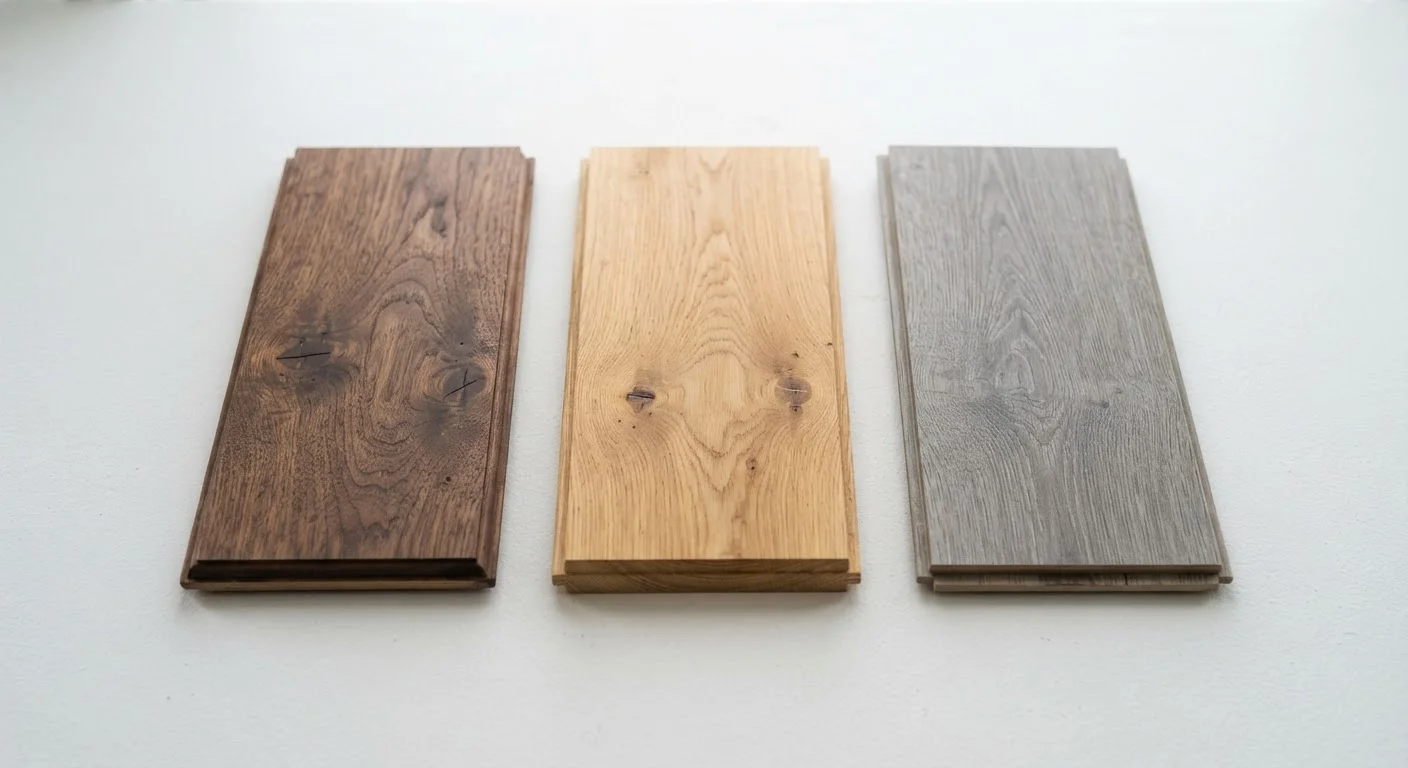
Our Verdict
No single flooring type wins across every situation. Solid hardwood offers unmatched longevity and refinishability for dry, stable environments, while engineered wood threads a practical middle ground for moisture-prone spaces. Laminate suits tight budgets and temporary living arrangements well, though it trades lifespan for affordability.
| Best for | Recommended |
|---|---|
| Homeowners prioritising longevity and resale value | Solid Hardwood |
| Rooms with variable humidity such as basements or kitchens | Engineered Wood |
| Renters or those working within a strict budget | Laminate |
| Those wanting a balance of natural look and moisture resistance | Engineered Wood |
How Each Flooring Type Is Constructed
Understanding what's inside each plank explains almost every performance difference you'll encounter.
Solid hardwood is milled from a single piece of wood — typically oak, maple, hickory, or walnut — and runs uniformly thick, usually ¾ inch. That thickness is what allows it to be sanded and refinished multiple times over decades.
Engineered wood uses a real hardwood veneer on top — anywhere from 2mm to 6mm thick — bonded over several layers of plywood or high-density fiberboard. This cross-ply construction resists expansion and contraction caused by humidity swings far better than solid wood.
Laminate contains no real wood at all. A photographic image layer mimics wood grain under a hard, clear wear layer, sitting atop a dense fiberboard core. The result looks convincingly like wood at a distance but behaves very differently underfoot and over time.
For homeowners considering how flooring contributes to a room's overall feel, see our guide on how texture shapes a room's warmth.
Durability, Moisture, and Maintenance Compared
| Solid Hardwood | Engineered Wood | Laminate | |
|---|---|---|---|
| Material composition | Single solid wood plank | Hardwood veneer over plywood core | Photo layer over fiberboard core |
| Moisture resistance | Low — avoid wet rooms | Moderate — handles humidity well | Low to moderate — vulnerable to water |
| Refinishable | Yes — many times | Yes — limited by veneer depth | No |
| Typical lifespan | 50–100 years | 25–50 years | 15–25 years |
| Installation complexity | Higher — usually professional | Moderate — DIY-friendly options | Low — floating click-lock |
| Relative material cost | Highest | Mid-range | Lowest |
| Basement suitability | Not recommended | Generally suitable | Limited — moisture risk |
Durability: Solid hardwood is extremely durable, but its Achilles heel is moisture. Excess humidity causes it to swell; too little causes it to gap and crack. It's generally not recommended for below-grade installations (basements) or rooms with frequent water exposure.
Engineered wood handles moderate moisture much better, making it a practical choice for kitchens, finished basements, and regions with high seasonal humidity. However, its refinishability depends on the veneer thickness — thinner veneers may allow only one or two light sandings, while thicker ones can match solid hardwood's longevity.
Laminate's fiberboard core is particularly vulnerable to water damage. Standing water or persistent humidity can cause swelling, warping, and delamination that cannot be repaired — planks must be replaced. Some newer water-resistant laminate products exist, but even those carry limitations compared to engineered wood.
Laminate and Moisture Don't Mix Well
Even water-resistant laminate products are not waterproof. Prolonged exposure to moisture — whether from a slow plumbing leak, humid air, or repeated spills not quickly cleaned — can cause the fiberboard core to swell irreversibly. In rooms with consistent moisture exposure, engineered wood or a tile alternative is a more reliable long-term choice.
Cost, Installation, and Lifespan
Cost differences across these three materials are significant enough to drive many purchase decisions on their own.
Solid hardwood carries the highest material cost per square foot, plus installation typically requires professional nail-down or glue-down methods and acclimatisation time before installation begins. However, when properly maintained, solid hardwood floors can last 50 to 100 years — making the per-year cost quite reasonable over the long term.
Engineered wood sits in the middle on price. It can be installed as a floating floor (click-lock), glued, or nailed down, giving more flexibility for DIY installation. Lifespan ranges from 25 to 50 years depending on veneer thickness and care.
Laminate is the most affordable upfront and the easiest to install — most products use a floating click-lock system that experienced DIYers can manage in a weekend. Its expected lifespan, though, is typically 15 to 25 years, and it cannot be refinished once the wear layer degrades.
Before settling on the cheapest option, it's worth considering the full picture — our article on price versus long-term value explains why upfront cost is only one part of the equation.
Always Acclimatise Wood Flooring First
Both solid and engineered hardwood should sit in the room where they'll be installed for at least 48 to 72 hours before installation begins. This allows the planks to adjust to the room's temperature and humidity, reducing the risk of post-installation gaps or buckling. Laminate also benefits from acclimatisation, typically 24 to 48 hours. Check the manufacturer's instructions for your specific product.
Choosing the Right Floor for Your Space
Room conditions should guide this decision as much as aesthetics or budget.
For main living areas and bedrooms in a climate-controlled home, all three options are reasonable. Solid hardwood makes most sense if you're staying long-term and want a floor that can be renewed repeatedly. Engineered wood suits anyone who wants a real-wood look with less maintenance vigilance. Laminate works well for secondary bedrooms, rental properties, or anywhere the floor is unlikely to be in place for more than 15 years.
For kitchens, mudrooms, or finished basements, engineered wood is generally the safer choice between the two wood-based options. Solid hardwood in these spaces requires careful humidity management year-round. Laminate in these spaces carries real risk unless the product is specifically rated for moisture exposure — and even then, prompt cleanup of spills remains essential.
If you're also thinking about outdoor surfaces, it's worth reading how timber, composite, and concrete decking compare in terms of long-term maintenance demands.
Flooring is also one of the home improvements with the most direct impact on how a space feels day-to-day — see our look at which home projects genuinely improve liveability for useful context before committing.
The content on this site is for informational purposes only and is not a substitute for professional advice. Always consult a qualified professional for guidance specific to your situation.