

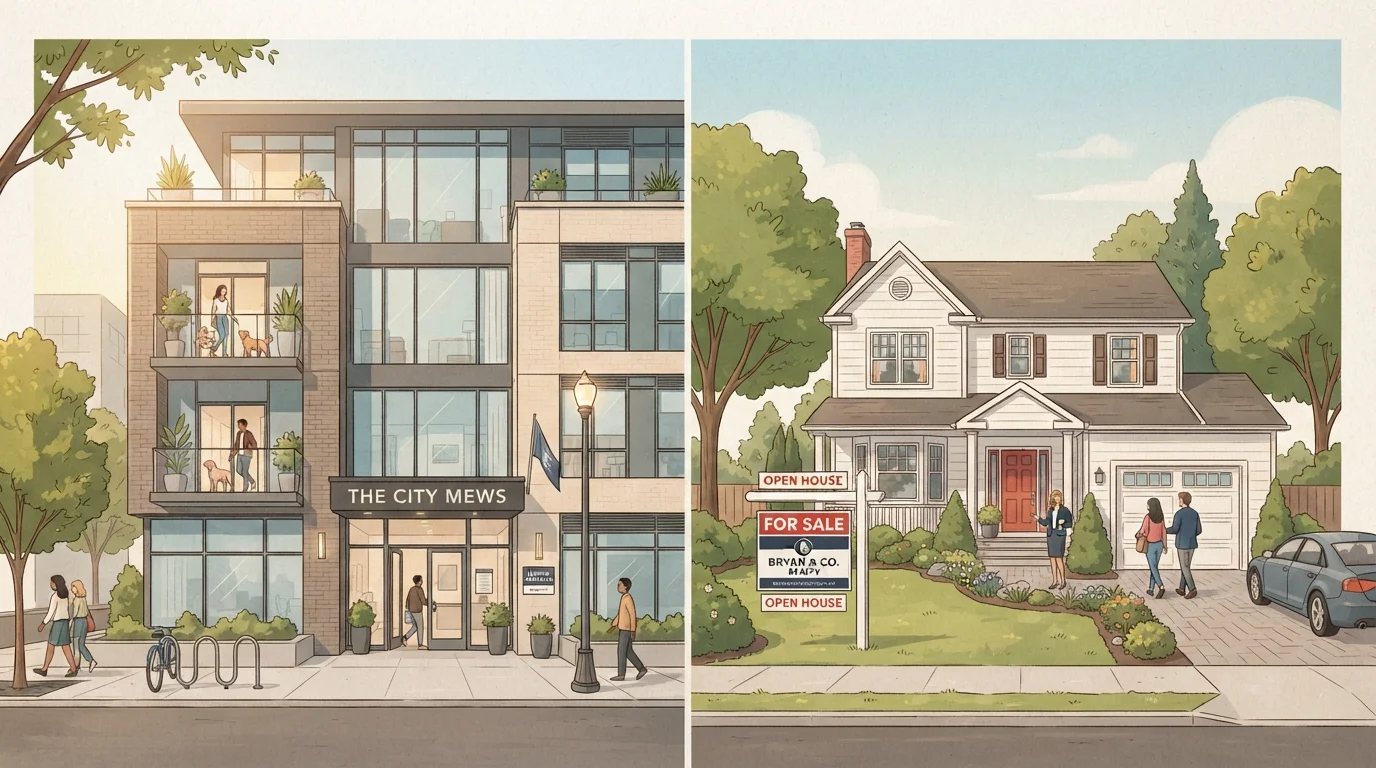
Option A
Renting
The flexible, lower-commitment path to housing.
Best for: People who value mobility, want predictable short-term housing costs, or aren't yet ready to take on homeownership responsibilities.
Option B
Buying
The long-term investment in stability and equity.
Best for: People with stable finances, a long planning horizon, and a desire to build equity and customize their living space.
Why This Decision Deserves a Framework, Not a Formula
Housing decisions rank among the most consequential financial choices most people make. Yet the conventional advice — "buying is always better than throwing money away on rent" — oversimplifies a genuinely complex trade-off. The truth is that renting and buying serve different needs at different life stages, and the financially smarter choice depends on factors that vary widely from person to person.
This isn't a decision that can be resolved with a single calculator or a rule of thumb. Instead, it helps to think through several distinct dimensions: your financial readiness, your expected timeline, your local housing market, and your personal priorities. Understanding how upfront cost compares to long-term value is a useful lens here — the cheaper monthly option isn't always the better deal over time.
| Criterion | Renting | Buying |
|---|---|---|
| Upfront costs | Security deposit, first/last month | Down payment, closing costs, reserves |
| Monthly cost predictability | Rent can rise at renewal | Fixed-rate mortgage is stable; taxes/insurance vary |
| Equity building | None | Yes, over time as mortgage is paid down |
| Flexibility to relocate | High — typically 30–60 days notice | Low — selling takes time and costs money |
| Maintenance responsibility | Landlord typically handles repairs | Owner responsible for all maintenance |
| Ability to customize | Limited by lease terms | Full control within local regulations |
| Best time horizon | Short to medium term | Five or more years typically needed to break even |
The Real Costs of Each Path
Monthly rent and a monthly mortgage payment are not equivalent comparisons. Homeownership carries a cluster of additional costs that renters typically don't face: property taxes, homeowner's insurance, HOA fees (where applicable), and maintenance. A general guideline — not a guarantee — is to budget roughly 1–2% of a home's value annually for upkeep. On a $350,000 home, that's $3,500–$7,000 per year in maintenance alone, separate from the mortgage.
Renting isn't cost-free either. Security deposits, renters insurance, and annual rent increases are real considerations. But renting typically requires far less capital upfront and places repair responsibilities on the landlord. If you're thinking about your first rental, our guide on what first-time renters should know before signing a lease covers costs that often catch people off guard.
~3–7 years
Typical break-even horizon for buying vs. renting
Real estate researchers broadly estimate this range, though it varies significantly by local market, mortgage rate, and down payment size.
2–5%
Typical closing costs as a share of purchase price
Closing costs are often overlooked by first-time buyers and can add thousands of dollars to the upfront cost of purchasing a home.
1–2%
Annual home maintenance cost as share of home value
This widely cited guideline helps homeowners budget for ongoing repairs and upkeep beyond the mortgage payment.
One concept worth understanding is the break-even horizon: the number of years you'd need to stay in a purchased home before the financial benefits of buying outweigh the costs of getting in. This varies by market, down payment size, and mortgage rate, but commonly falls between three and seven years. Buying and selling within that window often results in a net loss compared to renting.
Flexibility vs. Stability: A Personal Values Question
Beyond the numbers, renting and buying represent different relationships with place. Renters can respond to job changes, family needs, or neighborhood shifts with relative ease — typically with 30 to 60 days' notice. Homeowners trade that agility for stability: a fixed address, community roots, and the freedom to modify their space without asking a landlord's permission.
If you're someone who values the ability to experiment with where and how you live — or whose career or family situation is likely to shift — renting often preserves the options you need. If you've found a community you want to invest in long-term, the stability of ownership can align well with those goals. You might also consider how renting affects choices like furnishings: furnished versus unfurnished rentals carry different cost profiles that are worth thinking through before committing.
Renting Is Not 'Throwing Money Away'
The common claim that rent payments are wasted money ignores what renters receive: housing, flexibility, and freedom from repair costs and financial risk. Mortgage interest, property taxes, and maintenance are also expenses that build no equity. The real question isn't whether renting or buying wastes money — it's which path better fits your current financial position and goals.
Homeowners also gain access to certain long-term financial tools — home equity lines of credit, for example — but these come with real risks and shouldn't be treated as guaranteed benefits. Consult a licensed financial adviser before making decisions based on projected home equity.
How to Assess Your Own Readiness
A few honest questions can sharpen your thinking considerably:
- Down payment and reserves: Can you cover a 10–20% down payment plus closing costs (typically 2–5% of the purchase price) without depleting your emergency savings?
- Income stability: Is your income reliable enough to sustain a mortgage if your circumstances change over the next several years?
- Time horizon: Do you expect to stay in the same area for at least five years?
- Market conditions: In some markets, monthly ownership costs significantly exceed comparable rents — a gap worth quantifying before deciding.
If several of these answers are uncertain, renting is a reasonable default while you build clarity. That's not a failure — it's a sound approach to a high-stakes decision. For perspective on how to weigh major purchase paths more broadly, the framework used in buying versus leasing a vehicle applies similar logic: long-term cost, flexibility, and lifestyle fit all matter together, not in isolation.
This article is for general informational purposes only and does not constitute financial, legal, or real estate advice. Consult a qualified financial adviser or licensed real estate professional before making housing decisions.
The content on this site is for informational purposes only and is not a substitute for professional advice. Always consult a qualified professional for guidance specific to your situation.