

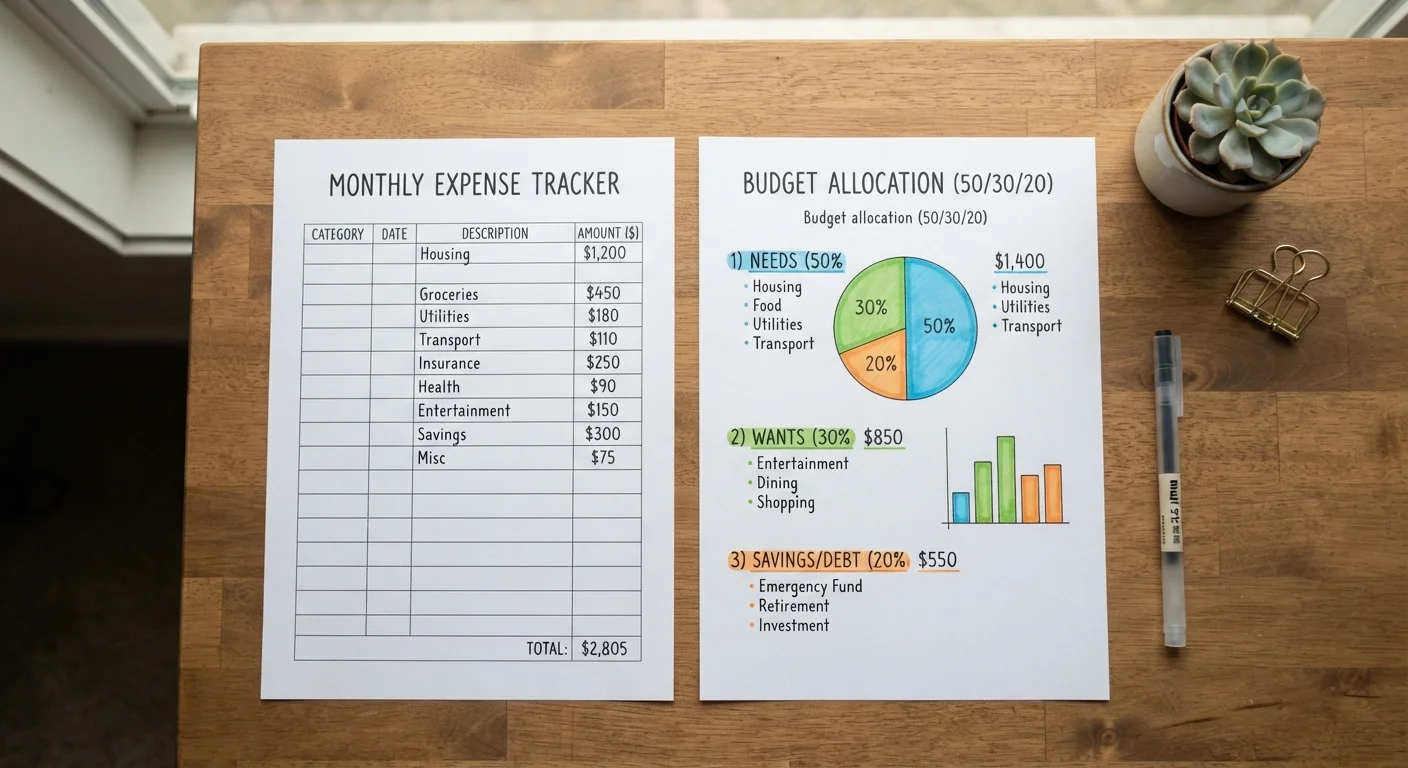
Option A
Zero-Based Budgeting (ZBB)
The meticulous, every-dollar-accounted-for approach.
Best for: People who want total visibility into their spending and are willing to rebuild their budget from scratch each month.
Option B
The 50/30/20 Rule
The streamlined, percentage-driven framework.
Best for: People who want a simple, low-maintenance structure that guides spending without granular tracking.
How Each Method Actually Works
Understanding the mechanics of each framework is the foundation for choosing between them. Before diving in, it helps to be comfortable with terms like discretionary spending and after-tax income — see our plain-language budgeting glossary if any terms here are unfamiliar.
Zero-Based Budgeting
Zero-based budgeting (ZBB) starts with your total monthly income and assigns every dollar to a category — housing, groceries, transportation, savings, debt repayment, and so on — until the math reaches zero. That final zero does not mean you spend everything; it means every dollar has a designated job, including dollars earmarked for savings or investments. The budget is rebuilt from scratch each month, which means it can flex around changing circumstances.
The 50/30/20 Rule
Popularized as a simplified personal finance framework, the 50/30/20 rule divides your after-tax income into three broad categories: 50% toward needs (housing, utilities, groceries, minimum debt payments), 30% toward wants (dining out, subscriptions, entertainment), and 20% toward savings and debt repayment beyond minimums. The percentages act as guardrails rather than a line-item plan. See our guide to common budget categories to understand what typically falls under each bucket.
| Criterion | Zero-Based Budgeting | 50/30/20 Rule |
|---|---|---|
| Setup time | High — rebuilt monthly from scratch | Low — set percentages, minimal rebuilding |
| Spending visibility | Very high — every category itemized | Moderate — broad bucket categories |
| Flexibility for variable income | Strong — adapts each month | Moderate — percentages shift with income |
| Best for beginners | Steep learning curve initially | Very beginner-friendly |
| Debt paydown focus | Explicit — assign dollars to debt | Grouped into 20% savings bucket |
| Ongoing maintenance | High — requires monthly attention | Low — periodic check-ins sufficient |
| Goal-specific saving | Precise — line-item savings categories | Less precise — all savings pooled at 20% |
Where Each Method Shines — and Where It Struggles
No budgeting framework is flawless. The strengths of one method often map directly onto the weaknesses of the other.
Zero-based budgeting excels at surfacing spending patterns you might otherwise miss. When you assign a dollar amount to every category, vague expenses like "miscellaneous" get replaced with specific line items. This granularity makes it a strong fit for households working to eliminate debt or redirect money toward a specific goal. The trade-off is time: rebuilding a budget from zero monthly takes real effort, particularly for people with complex or variable expenses.
The 50/30/20 rule is designed for speed and sustainability. Because it operates at a high level, it is far easier to implement and stick with over time — especially for people new to budgeting. Its weakness is precision: lumping all "needs" into one 50% bucket can obscure whether housing is crowding out groceries, or whether minimum debt payments are leaving no room to build an emergency fund.
Neither Method Requires Perfection
A common reason people abandon budgeting is one bad month derailing the whole plan. Both zero-based budgeting and the 50/30/20 rule are meant to be guides, not rigid contracts. If your spending exceeds a category in a given month, the goal is to understand why — not to feel like you have failed. Consistency over time matters far more than hitting every target every month.
For a deeper look at how these two methods compare alongside a third option, our three-method comparison covers the envelope method as well.
Choosing the Right Fit for Your Situation
The best budgeting method is the one you will actually maintain. That said, a few practical considerations can point you in a useful direction.
~33%
Americans with a detailed monthly budget
Gallup polling has consistently found that roughly one-third of U.S. adults report maintaining a detailed household budget, suggesting most people operate without a formal framework.
~30%
Of after-tax income average US household spends on housing
According to U.S. Bureau of Labor Statistics Consumer Expenditure Survey data, housing typically consumes close to 30% of after-tax income for average American households, challenging the 50% needs ceiling for many.
Consider zero-based budgeting if: your income varies month to month, you are actively managing debt, or you feel like money disappears without a clear explanation. The discipline of assigning every dollar tends to create clarity quickly. For a more thorough look at the philosophy behind this approach, our article on giving every dollar a job explores both its benefits and its real drawbacks.
Consider the 50/30/20 rule if: you have a predictable paycheck, you are building your first budget, or you want a structure that does not require monthly rebuilding. If you have never budgeted before, our ground-up guide for first-time budgeters can help you lay the foundation before adopting either framework.
Whichever method you choose, the habits you build around it matter as much as the framework itself. Our piece on spending habits worth building into any budget covers the practices that make any method more effective over time.
This article is for general informational and educational purposes only and does not constitute personalized financial advice. Consult a qualified financial professional for guidance specific to your circumstances.
The content on this site is for informational purposes only and is not a substitute for professional advice. Always consult a qualified professional for guidance specific to your situation.