

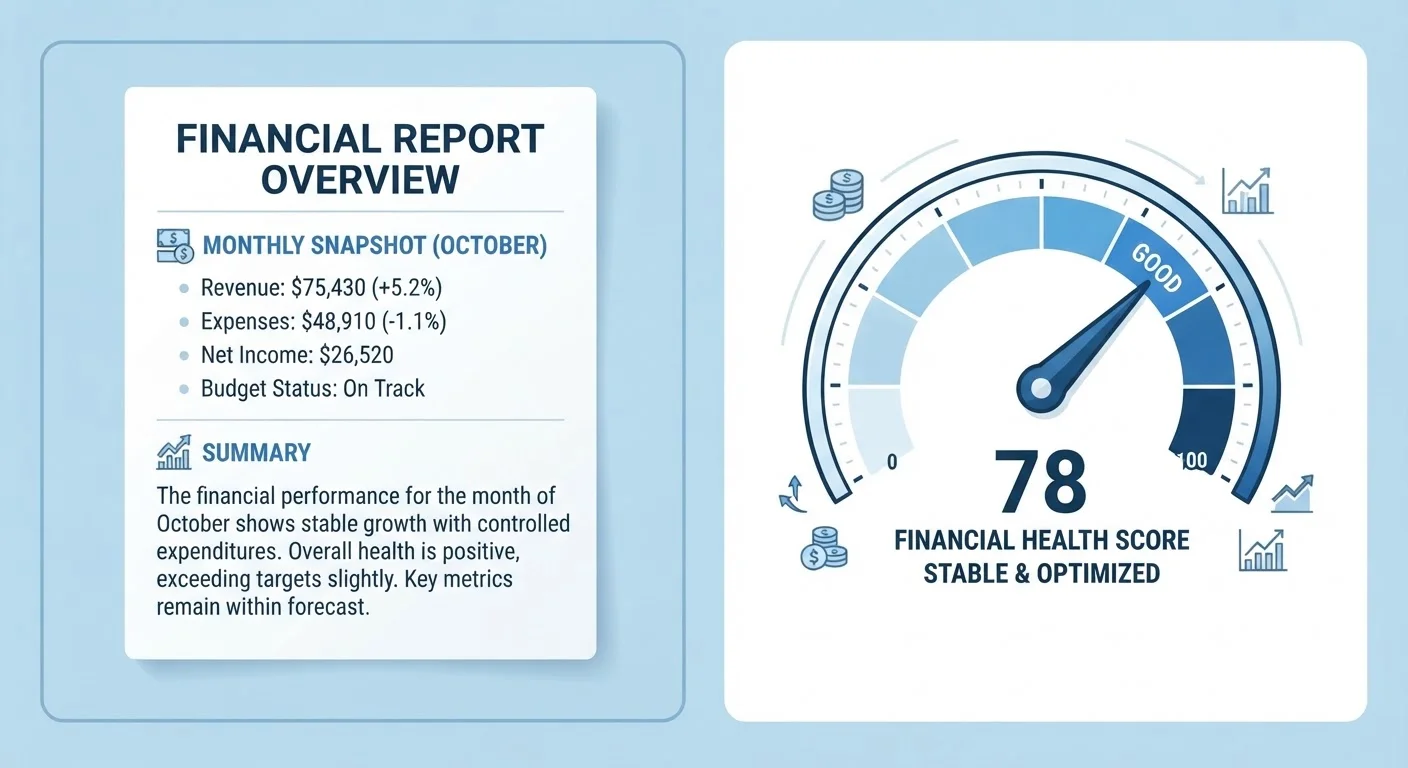
Option A
Credit Report
The complete financial history file.
Best for: Reviewing the accuracy of your credit history, disputing errors, and understanding what lenders see when they evaluate you.
Option B
Credit Score
The instant numerical summary.
Best for: Quickly gauging your creditworthiness and tracking changes in your financial standing over time.
What Each One Actually Is
Think of a credit report as a transcript and a credit score as the GPA. The transcript contains every test, paper, and attendance record; the GPA distills all of that into a single number. Neither one tells the whole story on its own.
A credit report is a detailed document compiled by the three major credit bureaus — Equifax, Experian, and TransUnion. It lists your open and closed accounts, payment history, credit inquiries, public records such as bankruptcies, and personal identifying information. There is no single universal report; each bureau maintains its own, and they may differ because not every lender reports to all three. For a full breakdown of what each section contains, see our plain-language walkthrough of every section in a credit report.
A credit score, by contrast, is a three-digit number — most commonly between 300 and 850 — generated by a mathematical model that reads the data in your credit report and assigns a value. The most widely recognized models are FICO and VantageScore. Importantly, you don't have just one score; different models and different bureaus' data can produce different numbers at the same moment.
| Criterion | Credit Report | Credit Score |
|---|---|---|
| Format | Detailed written document | Single three-digit number |
| Compiled by | Equifax, Experian, TransUnion | FICO, VantageScore, or others |
| How many you have | Three (one per bureau) | Many versions, varies by model |
| What it shows | Account history, inquiries, public records | Overall creditworthiness at a point in time |
| Free access | Weekly at AnnualCreditReport.com | Often via bank or credit card issuer |
| Can be disputed | Yes — directly with each bureau | No — fix the underlying report data instead |
| Impact of checking it yourself | No effect on score (soft inquiry) | No effect on score (soft inquiry) |
How They're Used — and by Whom
Lenders typically use both, but at different stages of a decision. When you apply for credit, a lender often pulls your score first as a quick filter. If your score meets their threshold, they may then examine your full report to assess the details — account types, payment patterns, and how long you've maintained credit relationships.
Landlords screening rental applicants frequently pull credit reports to look for patterns like missed rent payments or collections, while a score gives them a shorthand benchmark. For more on how credit affects housing, see the renter's credit guide.
Employers in some states may review a modified version of your credit report for certain roles, though they cannot see your score. Insurance underwriters in many states use credit-based insurance scores — a separate model — to help price policies.
1 in 5
Americans with credit report errors
A Federal Trade Commission study found approximately one in five consumers had a verified error on at least one of their three credit reports.
3
Separate credit reports per consumer
Each of the three major bureaus — Equifax, Experian, and TransUnion — maintains an independent report, and data in each can differ.
40+
FICO score versions in active use
FICO has released numerous scoring models over the years, and lenders use different versions depending on the type of credit being evaluated.
Why the Difference Matters for Your Financial Decisions
Conflating the two leads to real mistakes. The most common: assuming a good score means a clean report. A score can look acceptable even when your report contains outdated negative items, accounts that don't belong to you, or creditor errors. Those inaccuracies won't show up in a three-digit number, but a lender reading the full file will see them.
The reverse is also true. You might notice your score dipping and assume something is wrong with your behavior — when the real cause is a data error from a creditor that incorrectly reported a late payment. Without checking the underlying report, you can't locate or dispute the problem. Our article on what your credit score actually measures explains exactly which behaviors drive that number.
Checking Your Own Report Won't Hurt Your Score
Pulling your own credit report is classified as a soft inquiry and has no effect on any of your credit scores. You're entitled to free weekly access to all three bureau reports at AnnualCreditReport.com, the only federally authorized source. Reviewing your reports regularly is one of the simplest and most effective steps you can take to protect your financial standing.
Understanding how inquiries interact with both your report and score is also worth attention — not every credit check has the same effect. The distinction between hard and soft inquiries is explained in our guide on hard inquiries vs. soft inquiries.
This article is for general informational purposes only and does not constitute personalized financial or legal advice. Consult a qualified financial professional for guidance tailored to your situation.
The content on this site is for informational purposes only and is not a substitute for professional advice. Always consult a qualified professional for guidance specific to your situation.