

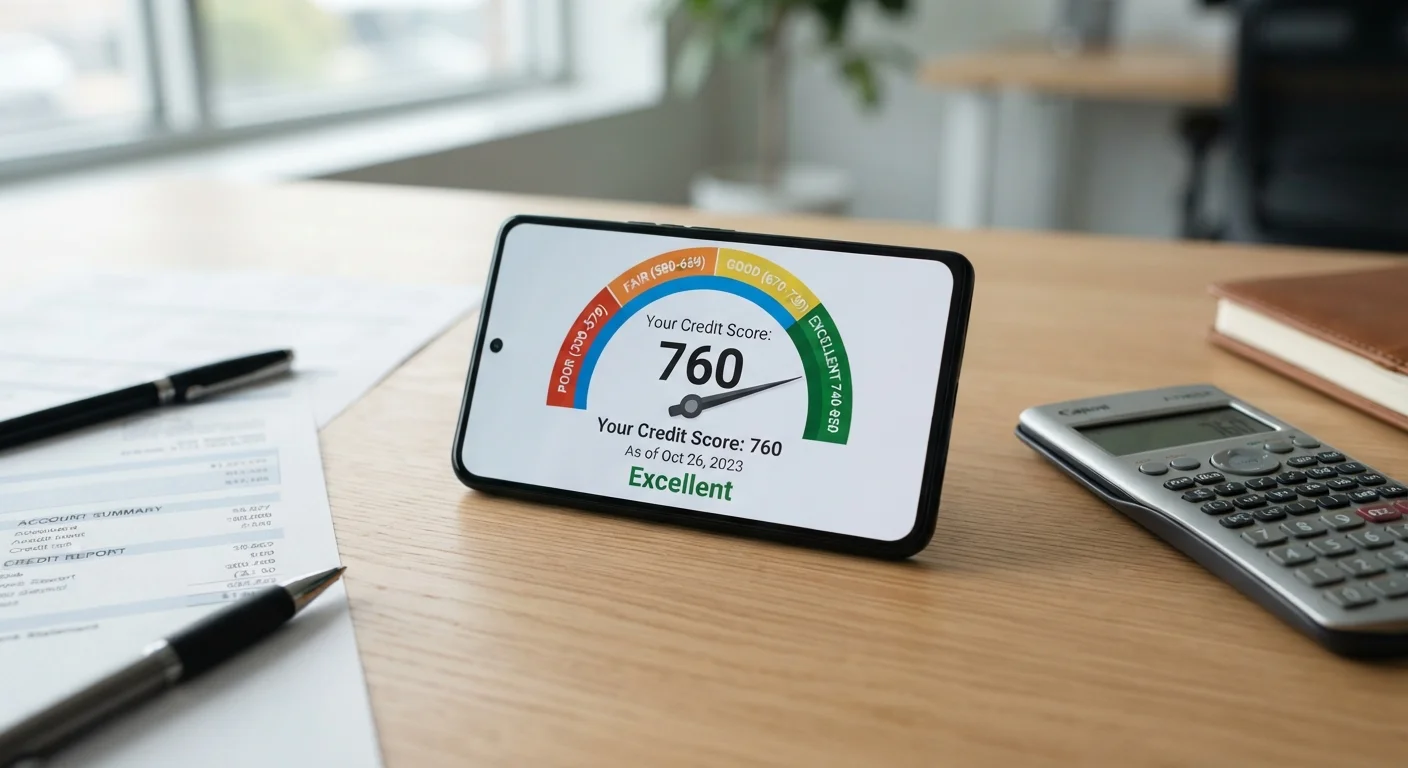
Five Factors, One Number
Your credit score doesn't emerge from a single behavior — it's a weighted composite of five distinct financial categories. Understanding what each one represents puts you in a far better position to improve or protect your score deliberately, rather than by guesswork.
The FICO Score model, used by the majority of US lenders, breaks down as follows:
- Payment history (35%): Whether you pay on time, every time.
- Credit utilization (30%): How much of your available revolving credit you're currently using.
- Length of credit history (15%): How long your accounts have been open, including your oldest account and the average age of all accounts.
- Credit mix (10%): The variety of credit types you manage — credit cards, auto loans, mortgages, and so on.
- New credit (10%): Recent applications for credit, reflected as hard inquiries on your report.
Each category measures a specific dimension of credit risk. Together, they give lenders a picture of how you've handled debt in the past — which they use as a proxy for how you're likely to handle it in the future.
35%
Weight of payment history in a FICO Score
According to FICO's published scoring model breakdown, payment history is the single largest factor in calculating your credit score.
30%
Weight of credit utilization in a FICO Score
FICO's model assigns credit utilization — the share of revolving credit in use — the second-largest weight among the five scoring factors.
300–850
FICO Score range used by most US lenders
The FICO Score scale runs from 300 (poorest) to 850 (best), with most lenders considering 670 or above to be a 'good' score threshold.
Payment History: The Factor That Dominates
At 35% of your FICO Score, payment history carries more weight than any other single factor. A single missed payment — especially one that goes 30 or more days past due — can cause a notable drop, and the record typically remains on your credit report for seven years.
What counts here: payments on credit cards, installment loans (like auto loans or student loans), mortgages, and some utility or medical accounts if they've been sent to collections. The model looks at whether you've paid on time, how late any missed payments were, and how recently they occurred.
Consistency matters most. A long run of on-time payments builds a strong foundation that can offset minor blemishes over time. This is also why setting up autopay for at least the minimum amount due is one of the most straightforward protective habits available to any borrower.
Set Autopay to Protect Your Score
Because payment history accounts for the largest share of your credit score, a single missed payment can have an outsized negative effect. Setting up automatic payments for at least the minimum due on each account removes the risk of forgetting a due date. You can always pay more manually — the autopay acts as a safety net.
Credit Utilization and Everything Else
Credit utilization — the ratio of your current revolving balances to your total credit limits — accounts for 30% of your score. If you have $2,000 in balances across cards with a combined $10,000 limit, your utilization is 20%. Keeping this ratio below 30% is a commonly cited guideline, though lower is generally better. For a deeper look at how this ratio works in practice, see Credit Utilisation: The Ratio That Quietly Shapes Your Score.
The remaining 30% of your score is split across length of credit history, credit mix, and new credit. These factors matter less individually, but they can make a meaningful difference at the margins:
- Length of history rewards accounts kept open and in good standing over many years. Closing an old card can shorten your average account age and reduce your total available credit — both of which may nudge your score down.
- Credit mix reflects whether you can responsibly manage different types of debt. You don't need every type, but having only one kind of account limits the scoring model's view of your behavior.
- New credit tracks hard inquiries from recent applications. Each hard inquiry may trim a few points from your score temporarily. Applying for multiple new accounts in a short window amplifies this effect. Learn more about how inquiries work in Hard Enquiries vs Soft Enquiries on Your Credit File.
What Your Score Doesn't Measure
Credit scores are sometimes misunderstood as a general measure of financial health. They are not. Your score reflects only what's in your credit report — which means several financially significant facts are invisible to it.
Income, savings, investment accounts, employment history, and net worth do not appear in your credit report and play no role in your credit score calculation. A person earning $200,000 a year with no credit accounts may have no score at all, while someone with a modest income and a decade of responsible credit use could have an excellent one.
This distinction is worth understanding because it clarifies what a credit score is actually designed to do: predict the likelihood that a borrower will repay a debt. It is not a judgment on your overall financial situation. For a clear breakdown of how your credit report — the underlying data that feeds your score — differs from the score itself, see Credit Reports and Credit Scores: Two Different Things.
This article is for general informational and educational purposes only and does not constitute personalized financial or legal advice. Consult a qualified financial professional regarding decisions specific to your situation.
Frequently Asked Questions
Under the FICO model, scores of 670 to 739 are generally considered 'good,' while 740 to 799 is 'very good' and 800 or above is 'exceptional.' Scores below 580 are typically classified as poor and may make it harder to qualify for credit at competitive rates.
No. Checking your own credit score is a 'soft inquiry' and has no impact on your score. Only hard inquiries — triggered when a lender reviews your credit in response to a new application — can temporarily lower it by a small amount.
Your credit score can change any time one of your creditors reports new activity to the credit bureaus, which typically happens monthly. Significant changes — like paying off a large balance or missing a payment — can shift your score more noticeably.
Yes, though a single account may limit how fully the scoring model can evaluate you. Lenders and scoring models generally favor a mix of account types and a track record across multiple accounts over time.
No. Credit scores are calculated solely from information in your credit report, which does not include your income, savings, or employment status. However, lenders may consider income separately when evaluating a full credit application.
The content on this site is for informational purposes only and is not a substitute for professional advice. Always consult a qualified professional for guidance specific to your situation.