

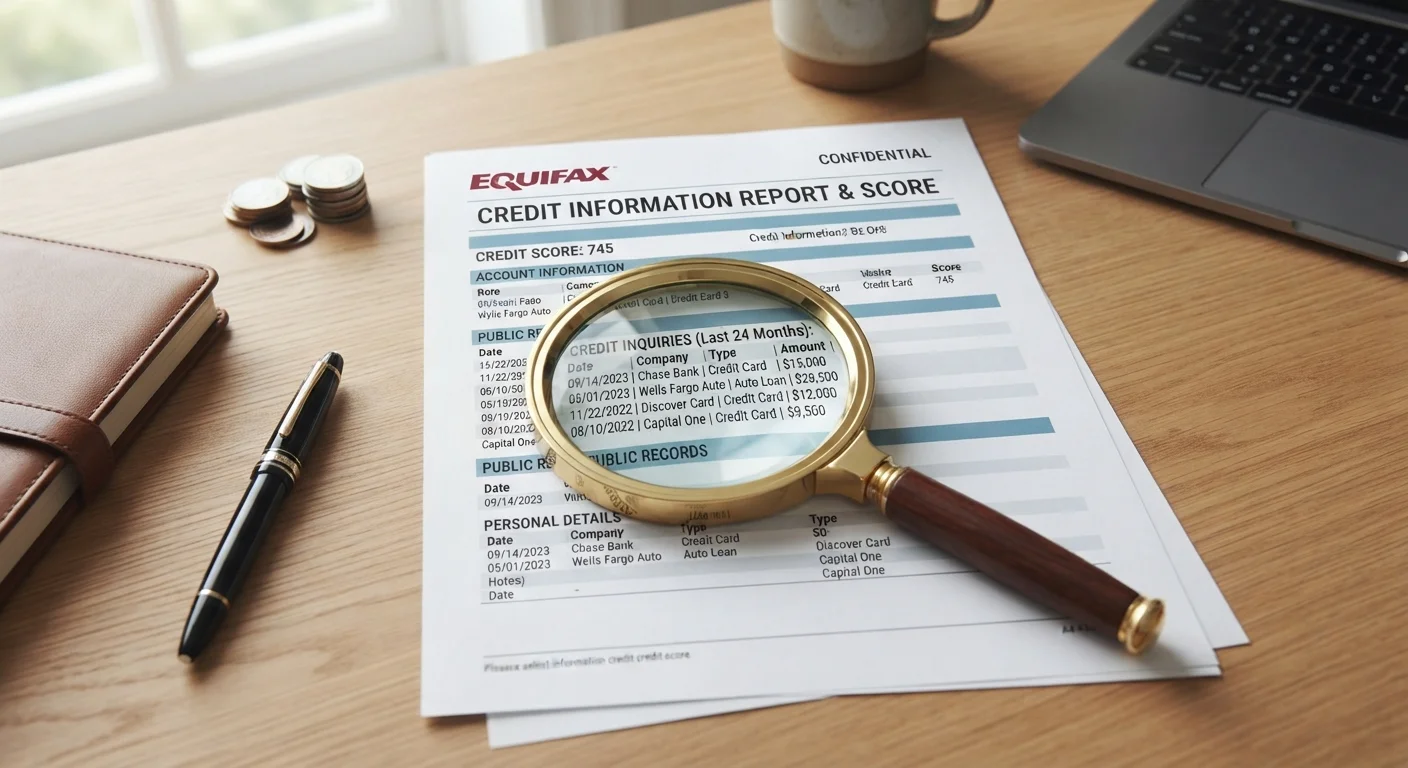
Option A
Hard Enquiry
The credit check that leaves a visible mark on your file.
Best for: Lenders assessing a formal application for credit, such as a mortgage, auto loan, or new credit card.
Option B
Soft Enquiry
The background check that has no impact on your score.
Best for: Prequalification offers, employer background checks, and personal credit monitoring.
What Triggers Each Type of Enquiry
Every time a lender or other authorized party accesses your credit file, that access is recorded as an enquiry. Whether it harms your score depends entirely on why the file was accessed.
A hard enquiry occurs when you voluntarily apply for new credit and the lender pulls your full credit report to make a lending decision. Common triggers include applying for a credit card, personal loan, auto loan, mortgage, or a new apartment lease with a credit check. Because a hard enquiry signals that you are actively seeking debt, credit scoring models treat it as a mild risk flag.
A soft enquiry happens in situations where no formal credit decision is being made based on that pull. Examples include checking your own credit report, a lender prescreening you for a preapproved offer, an employer running a background check, or a credit-monitoring service updating your dashboard. These enquiries do not signal new borrowing risk, so they carry no scoring consequence. Learn more about what else appears alongside your enquiries in The Anatomy of a Credit Report.
| Criterion | Hard Enquiry | Soft Enquiry |
|---|---|---|
| Score impact | Yes — typically 1–5 points | None |
| Appears on credit report | Yes — visible to lenders | Yes — visible only to you |
| Stays on report | 2 years | 2 years (not scored) |
| Common triggers | Credit card, loan, mortgage applications | Own checks, prequalification, employer screening |
| Requires your authorization | Yes — you initiate the application | Not always — prescreen offers can occur without applying |
| Rate-shopping protection | Yes — multiple same-type enquiries counted as one | N/A — no score impact regardless |
How Hard Enquiries Affect Your Score — and for How Long
A single hard enquiry typically reduces a credit score by fewer than five points, according to general guidance from major credit bureaus. That is a modest impact for most consumers, but the effect is larger if your credit file is thin or your score is already borderline.
<5 pts
Typical score drop per hard enquiry
Major credit bureaus indicate a single hard enquiry usually reduces a score by fewer than five points for most consumers.
12 months
Period hard enquiries actively affect your score
While enquiries remain on your report for two years, their scoring impact is generally limited to the first twelve months.
14–45 days
Rate-shopping protection window
FICO and VantageScore models group mortgage and auto loan enquiries made within this window and count them as a single enquiry.
Hard enquiries remain visible on your credit report for two years, but their influence on your score generally fades after twelve months. After that point, the enquiry is still listed but no longer factored into most scoring calculations.
One important protection: when you rate-shop for a mortgage, auto loan, or student loan, FICO and VantageScore models recognize that comparing lenders is financially responsible behavior. Multiple hard enquiries of the same loan type made within a condensed window — generally 14 to 45 days depending on the model version — are counted as a single enquiry for scoring purposes. This means shopping around for the best rate costs you no more than applying once. Before you begin that process, review the financial readiness checklist to make sure your application is as strong as possible.
Practical Strategies Around Enquiries
Understanding the distinction between hard and soft enquiries lets you take concrete steps to protect your score while still accessing credit when you need it.
- Use prequalification first. Many lenders offer a prequalification or preapproval process that uses a soft enquiry. This gives you a realistic picture of your approval odds and likely terms before you submit a formal application that triggers a hard enquiry.
- Space out applications. Applying for several unrelated credit products in quick succession generates multiple hard enquiries outside any rate-shopping protection window. Each one adds up, and lenders may interpret a cluster of recent applications as a sign of financial stress.
- Monitor your own file freely. Checking your own credit is always a soft enquiry. Use free annual reports available through the federally mandated system or paid monitoring services without any score penalty. Staying aware of your file also helps you catch unfamiliar hard enquiries — which can signal identity theft — early.
- Build your credit strategically. If your file is thin, tools like secured cards and credit-builder loans can add positive history without requiring you to accumulate hard enquiries across multiple applications.
Keep in mind that enquiries are just one factor in your overall credit profile. Payment history and credit utilisation carry significantly more weight. A single hard enquiry is rarely decisive — consistent, on-time payments and responsible utilisation matter far more over time.
This article is for general informational purposes only and does not constitute personalised financial or credit advice. For guidance specific to your situation, consult a qualified financial adviser or credit counsellor.
The content on this site is for informational purposes only and is not a substitute for professional advice. Always consult a qualified professional for guidance specific to your situation.