

The Common Misconception: More Is Not Merrier
When most people hear "diversify your portfolio," they picture buying a long list of different stocks. The more the better, right? Not quite. Owning 50 different tech company stocks does not meaningfully reduce your risk if they all plunge when the technology sector struggles. You have quantity without the protection diversification is actually supposed to provide.
The real principle behind diversification is correlation — a measure of how closely two investments move together. If asset A and asset B both drop whenever the same economic event occurs, they offer little protection against each other, regardless of how different their names sound. Before you invest a single dollar, it helps to understand how different asset classes behave so you can make meaningful choices rather than just adding to a list.
~20
Stocks needed to reduce unsystematic risk significantly
Academic research, including foundational work in Modern Portfolio Theory, suggests that randomly selected portfolios of around 20 uncorrelated stocks can eliminate much of company-specific risk — though sector and geographic diversification matter too.
0.0
Ideal correlation between diversifying assets
A correlation of zero means two assets move completely independently; negative correlation (closer to -1.0) provides even stronger diversification benefits, though such pairings are rare in practice.
What Effective Diversification Actually Looks Like
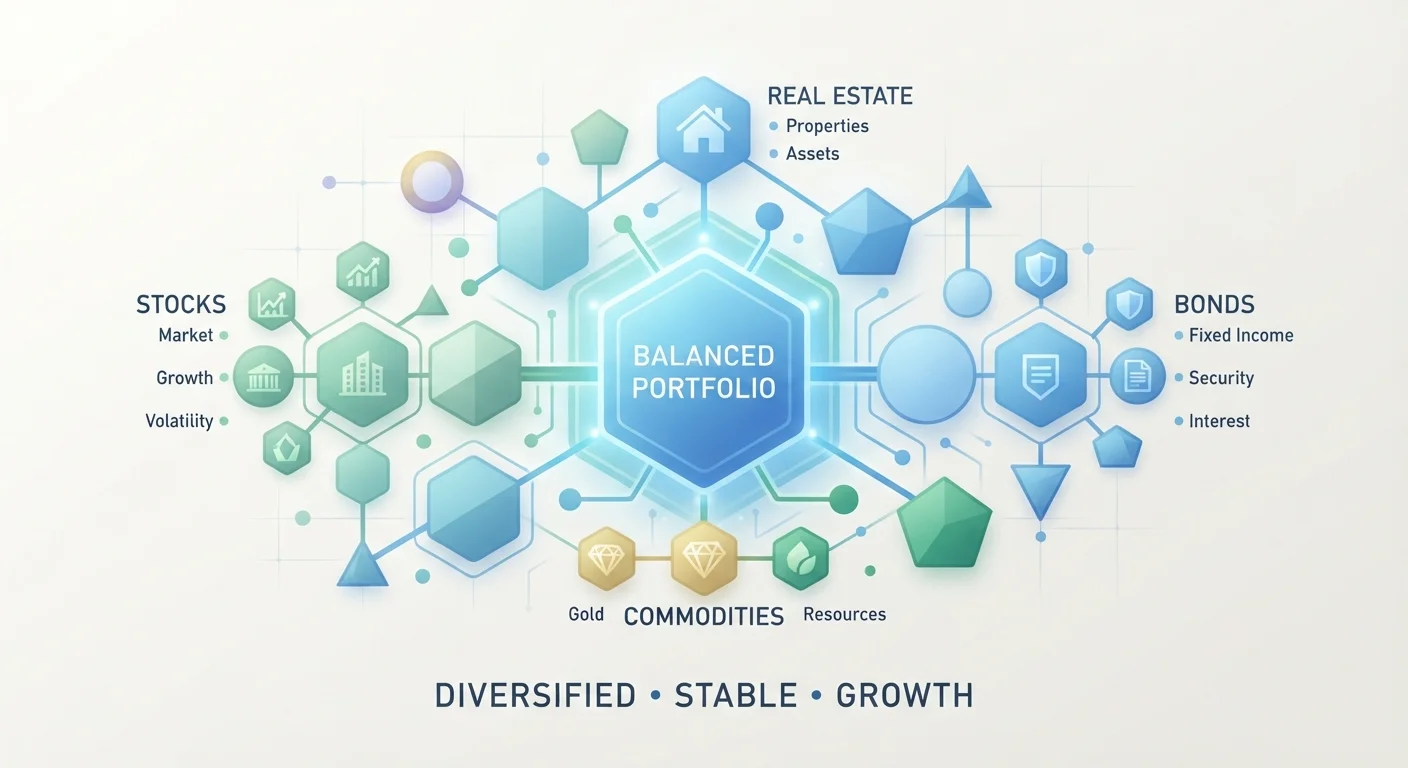
Genuine diversification involves owning assets across categories that respond differently to the same economic conditions. Stocks and bonds, for instance, have historically shown a tendency to move in opposite directions during certain market environments — when stocks fall sharply, investors often shift toward bonds, pushing bond prices up. That relationship is not guaranteed, but it illustrates the logic.
The main dimensions of diversification include:
- Asset class: Mixing stocks, bonds, cash equivalents, and potentially other categories.
- Sector: Spreading equity holdings across industries like healthcare, energy, consumer goods, and financials.
- Geography: Including domestic and international holdings so a downturn in one country's economy does not affect the whole portfolio equally.
- Company size: Holding a mix of large, mid, and small companies, which can behave differently across economic cycles.
Understanding your personal risk tolerance is essential here — the right diversification mix looks different for a 30-year-old saving for retirement versus someone five years from it.
The Limits of Diversification
Diversification is a powerful tool, but it is not a shield against all loss. Financial professionals distinguish between two types of risk. Unsystematic risk — the risk tied to a specific company or industry — can be substantially reduced through diversification. Systematic risk, sometimes called market risk, affects nearly all assets simultaneously and cannot be diversified away. A global financial crisis or a severe recession tends to drag most asset classes down together, at least initially.
This is why diversification works best as part of a broader financial strategy that includes an appropriate time horizon, an emergency fund, and realistic expectations. It is not a substitute for understanding when investing is right for your situation in the first place. New investors who skip this groundwork are more likely to stumble into common and costly early mistakes.
Start Simple: One Fund Can Diversify You
If building a multi-asset portfolio feels overwhelming, broad index funds or target-date funds offer built-in diversification across hundreds or thousands of securities in a single purchase. They are a practical starting point for first-time investors who want exposure without having to manage dozens of individual holdings. Always review a fund's prospectus and consider speaking with a licensed financial adviser before investing.
This article is for general informational and educational purposes only and does not constitute personalized investment, financial, or tax advice. Consult a qualified, licensed financial professional before making decisions about your own financial situation.
Frequently Asked Questions
Yes, if those investments genuinely behave differently from each other. A single broad-market index fund, for example, can provide exposure to hundreds of companies across many sectors. The number of holdings matters less than how those holdings are correlated.
Not necessarily. If all 20 stocks are in the same industry — say, technology — they tend to rise and fall together, providing little real protection. Diversification requires spreading across industries, asset classes, and sometimes geographies.
No. Diversification reduces certain types of risk but cannot prevent losses, especially during broad market downturns. It is a risk-management strategy, not a guarantee of returns. Past performance does not guarantee future results.
Asset allocation is the decision about how to divide a portfolio among major categories like stocks, bonds, and cash. Diversification is what happens within and across those categories. The two concepts work together but are not the same thing.
Yes. Even modest amounts can be diversified through instruments like broad index funds or target-date funds that hold a wide mix of assets in a single purchase. A qualified financial adviser can help you determine what approach fits your situation.
The content on this site is for informational purposes only and is not a substitute for professional advice. Always consult a qualified professional for guidance specific to your situation.