

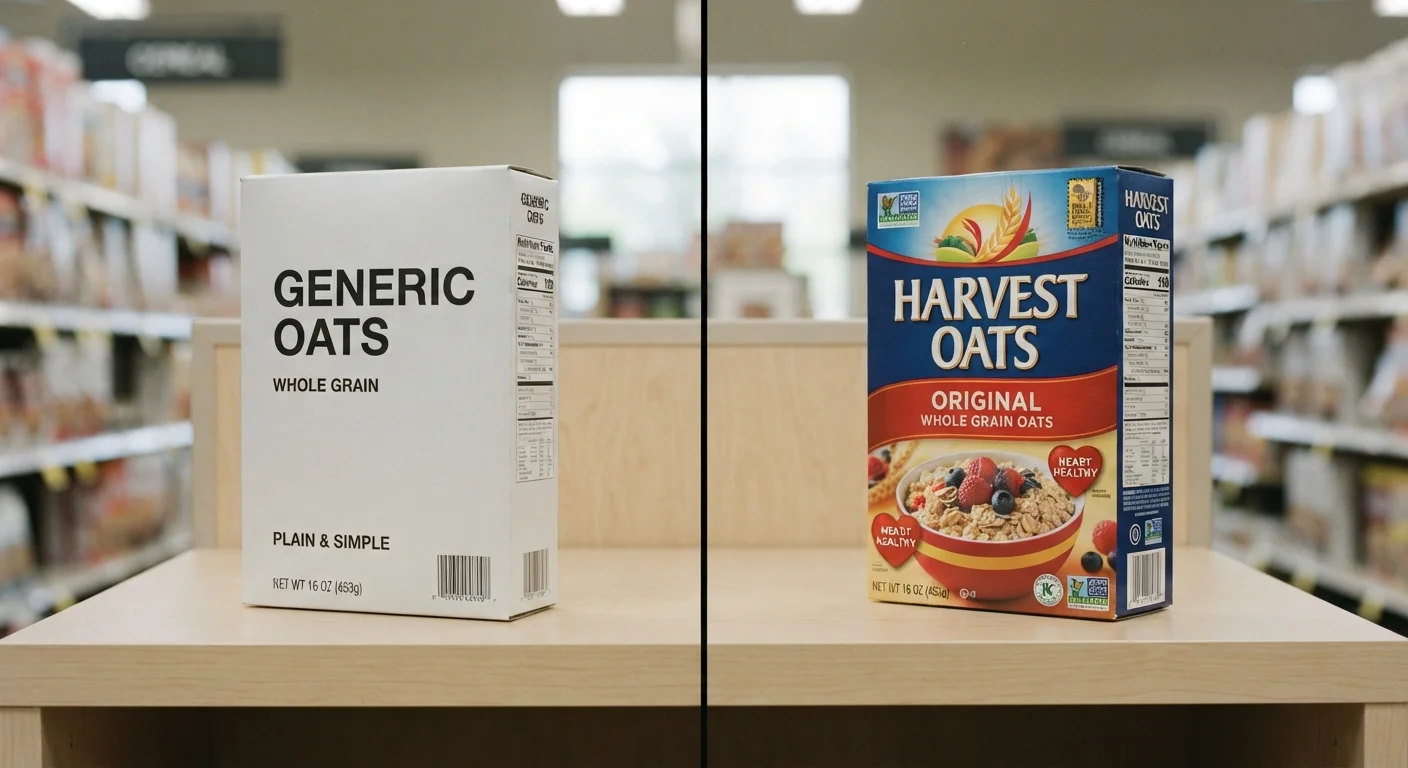
Option A
Generic Products
The stripped-down, often equivalent alternative.
Best for: Shoppers who want to minimize spending on categories where formulation, safety, or performance is standardized.
Option B
Name-Brand Products
The recognizable option backed by marketing — and sometimes genuine differentiation.
Best for: Buyers in categories where proprietary formulations, quality controls, or regulatory compliance genuinely affect outcomes.
The Brand Premium: What You're Actually Paying For
Walk down any grocery or pharmacy aisle and the choice confronts you constantly: the name on the box you recognize, or the store-label version sitting beside it for noticeably less. The instinct to trust the familiar brand is understandable — but it isn't always rewarded by what's inside the package.
Brand premiums exist for several distinct reasons, and they're not all equally valid. Some reflect genuine R&D investment, proprietary formulations, or rigorous quality controls that generics don't replicate. Others are largely the cost of advertising, retail placement fees, and decades of consumer conditioning. The challenge is knowing which is which before you spend the difference.
Understanding the distinction starts with recognizing that "generic" doesn't mean inferior. In regulated categories — particularly pharmaceuticals — the law defines what generic actually means. In unregulated or lightly regulated categories, the gap between store-brand and name-brand can be more variable. As a general principle, the more a product's performance depends on a proprietary process or formulation, the more the brand premium may be justified. For more on how to think through this, see our guide to price versus value.
| Criterion | Generic Products | Name-Brand Products |
|---|---|---|
| OTC Medications | FDA-mandated bioequivalence | Same active ingredient, higher cost |
| Pantry Staples | Often same supplier or facility | Premium largely reflects marketing |
| Cleaning Products | Matching active compounds typical | Brand recognition, similar formula |
| Safety Equipment | Testing rigor harder to verify | Established compliance, recall track record |
| Skincare with Actives | Delivery system may differ | Proprietary formulation stability |
| Electronics & Tools | Adequate for basic tasks | Material quality and tolerances vary |
Categories Where Generic Wins
Certain product categories are so well-standardized that paying a brand premium is difficult to justify on performance grounds.
Over-the-counter medications are the clearest example. The U.S. Food and Drug Administration (FDA) requires that generic drugs demonstrate bioequivalence to their branded counterparts — same active ingredient, same strength, same dosage form. The inactive ingredients (binders, fillers, coatings) may differ slightly, which can matter for a small number of people with specific sensitivities, but for the general population, generic ibuprofen, cetirizine, or omeprazole performs the same as the name-brand version at a fraction of the cost.
Pantry commodities — baking staples, canned goods, dried grains — are another area where generic typically holds up. These are standardized products governed by food safety regulations. Store-brand all-purpose flour isn't a lesser flour; it's often milled at the same facilities under the same USDA grading standards.
~85%
US prescriptions filled as generics
According to the FDA, generic drugs account for roughly 85% of all prescriptions dispensed in the United States, reflecting widespread regulatory confidence in their equivalence.
20–80%
Typical generic drug cost savings
The FDA notes that generic drugs can cost 20% to 80% less than their brand-name equivalents, while meeting the same standards for quality and safety.
Basic cleaning supplies follow similar logic. Bleach is sodium hypochlorite in water. Generic dish soap contains the same surfactant chemistry as its branded equivalent. Comparing the active ingredient concentrations on both labels is the most reliable test — and they're usually identical or very close.
The pattern: when the product's job is defined entirely by a standardized ingredient or composition, and regulatory bodies verify that composition, there's limited room for meaningful brand differentiation.
Categories Where the Brand Premium Earns Its Keep
Not every category is a commodity. Some involve enough complexity — in formulation, manufacturing precision, or safety consequence — that brand reputation carries real information.
Safety-critical products are the most important example. A budget car seat or an uncertified bicycle helmet may technically exist as a product, but if it hasn't been rigorously tested and manufactured to consistent tolerances, the lower price represents a transferred risk, not savings. Established manufacturers in these categories invest in crash testing, quality audits, and recall infrastructure that's harder to verify in generic alternatives. As a related consideration, understanding counterfeit and grey-market goods is especially important here.
Complex skincare and cosmetics with active ingredients present a subtler case. Unlike pharmaceuticals, cosmetics aren't required to prove efficacy. But formulation stability — how an active ingredient like retinol or vitamin C is protected, stabilized, and delivered — does vary between manufacturers. When you're paying for a specific cosmetic outcome driven by an active ingredient, the delivery system matters, and generic equivalents may not replicate it accurately.
Specialty tools and electronics occupy similar territory. In basic categories, a generic option is often fine. But in products where tolerances, material quality, and reliability over time affect safety or professional outcomes, brand history and verifiable certifications provide meaningful signal. See our guide to certifications and labels for how to evaluate those signals.
When Ingredient Lists Are Your Best Tool
For most non-pharmaceutical products, the ingredient or specification label is the most reliable way to compare generic and name-brand options. If the active ingredients, concentrations, and relevant certifications are identical, the formula is effectively the same regardless of which name is on the front. Knowing which certifications carry real weight makes this comparison faster and more reliable.
The underlying question: does the brand's product genuinely differ from the generic in a way that matters for how you'll use it? That requires looking past the packaging to the actual specifications, ingredients, and third-party testing behind each.
The content on this site is for informational purposes only and is not a substitute for professional advice. Always consult a qualified professional for guidance specific to your situation.