

Why Labels Don't Speak for Themselves
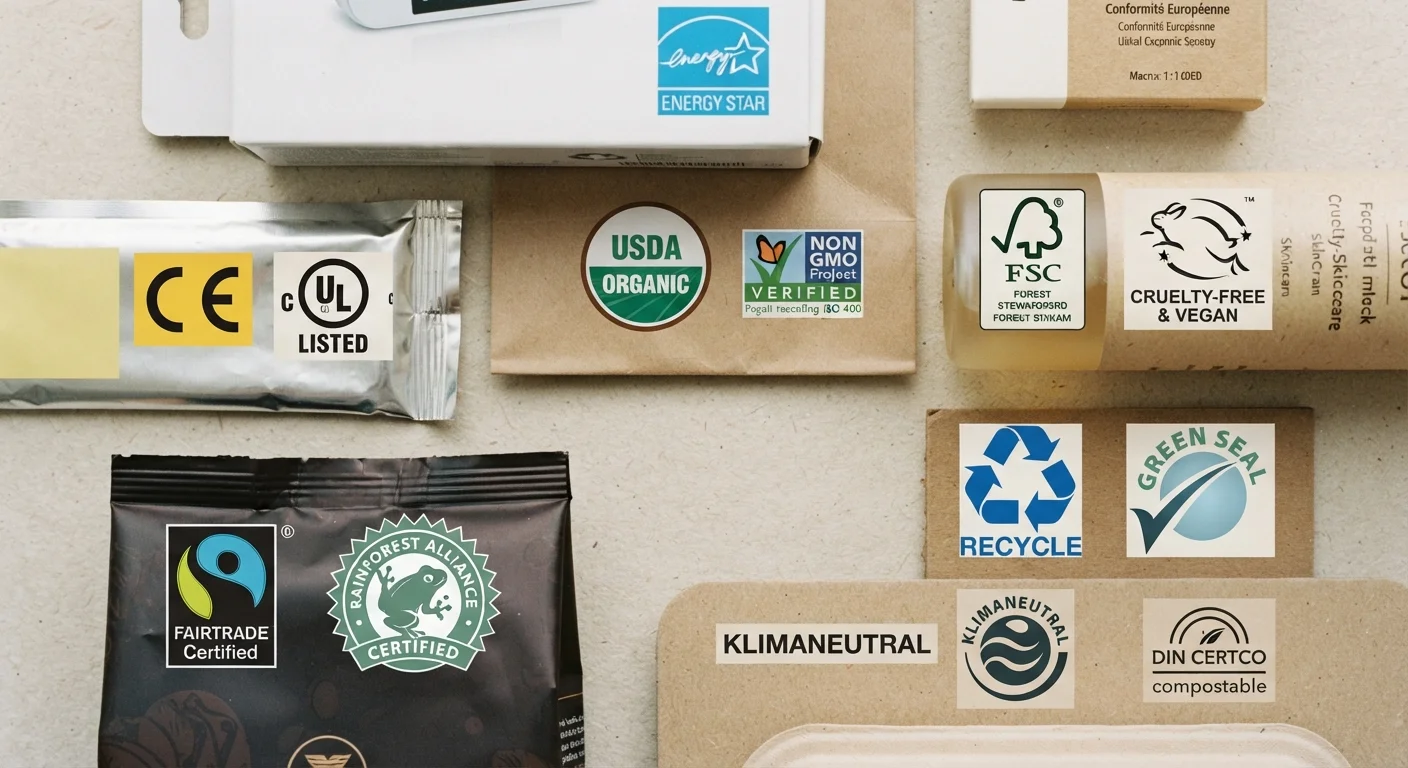
Walk down any store aisle and you'll see dozens of marks claiming a product is safe, sustainable, organic, or independently tested. The problem: some of those claims are backed by rigorous third-party audits, while others are designed solely by the company selling the product. Without knowing the difference, you can't tell whether a seal signals genuine accountability or just a well-designed logo.
Labels generally fall into three categories: government-mandated marks, third-party certifications, and self-declared claims. The first two carry external verification; the third does not. That distinction is the single most useful filter a consumer can apply.
For a deeper look at how this plays out on food packaging specifically, see what 'Organic,' 'Natural,' and 'Non-GMO' actually mean.
Third-party certification
An assessment carried out by an organization that is independent of both the manufacturer and the buyer. Third-party certifications are generally more credible than self-declared claims because the certifying body has no direct financial stake in the outcome.
Self-declared claim
A label or statement created and applied by the product's manufacturer without external review or verification. These claims may be truthful, but they cannot be independently confirmed without additional research.
Accreditation
A formal recognition that a certifying body meets established standards for competence and impartiality. Certifications issued by accredited bodies carry more weight because the certifier itself is subject to oversight.
Standard
A documented set of criteria — often developed by technical experts or government agencies — that a product, process, or organization must meet. Certifications are only as meaningful as the standard they reference.
Certifications That Carry Real Weight
The labels below are widely recognized, audited by independent or government bodies, and enforceable through established standards.
| USDA Organic oversight body | U.S. Department of Agriculture (USDA Agricultural Marketing Service) |
| ENERGY STAR program sponsors | U.S. EPA and Department of Energy (energystar.gov) |
| UL organization type | Independent, not-for-profit safety science company (UL Standards & Engagement) |
| 'Natural' label regulation (non-food) | No standard legal U.S. definition (Federal Trade Commission guidance) |
| NSF certification scope | Water, food service, supplements, and more (NSF International) |
- USDA Organic: Enforced by the U.S. Department of Agriculture. Products must meet strict production standards, and certifying agents conduct on-site inspections. The word 'organic' alone — without the seal — is not regulated at the same level.
- UL Listed / UL Certified: UL (Underwriters Laboratories) is an independent safety organization that tests electrical and other products against published safety standards. A UL mark means the product was tested, not just self-assessed.
- ENERGY STAR: A joint program of the U.S. Environmental Protection Agency and the Department of Energy. Products must meet verified efficiency specifications — manufacturers can't simply apply the mark without qualification testing.
- NSF Certification: NSF International certifies products — including water filters, dietary supplements, and food-service equipment — against public health and safety standards. Their audits include facility inspections and ongoing product testing.
What makes these credible: each requires documented compliance before a mark is applied, and most include periodic re-evaluation. For more on reading what product labels are legally required to disclose, see reading a product label without getting lost in the fine print.
Marks That Require More Scrutiny
Some labels look authoritative but have no independent oversight. A few patterns to recognize:
- Self-declared eco or 'natural' claims: Terms like 'eco-friendly,' 'clean,' or 'natural' on non-food products have no standard legal definition in the U.S. A company can print them without any external verification. This is distinct from third-party environmental certifications, which have published criteria.
- Proprietary seals created by retailers or manufacturers: A 'Tested for Quality' seal invented by the brand itself tells you only that the company chose to add it. Ask: tested by whom, against what standard?
- Wellness and beauty claims: Words like 'dermatologist-tested' indicate only that a dermatologist was involved — not that results were statistically significant or independently reviewed. See how haircare label claims are often marketing rather than regulated terms for how this pattern appears in personal care products.
When in Doubt, Look Up the Standard
Most legitimate certification bodies publish their criteria publicly on their websites. If you can't find a clear explanation of what a seal requires — including who audits compliance — that absence is itself informative. A credible program has nothing to hide about its methodology.
This same logic applies across categories. Brand premiums don't always reflect superior standards — sometimes a generic product holds the same certification as a name-brand equivalent at a lower price.
The content on this site is for informational purposes only and is not a substitute for professional advice. Always consult a qualified professional for guidance specific to your situation.