

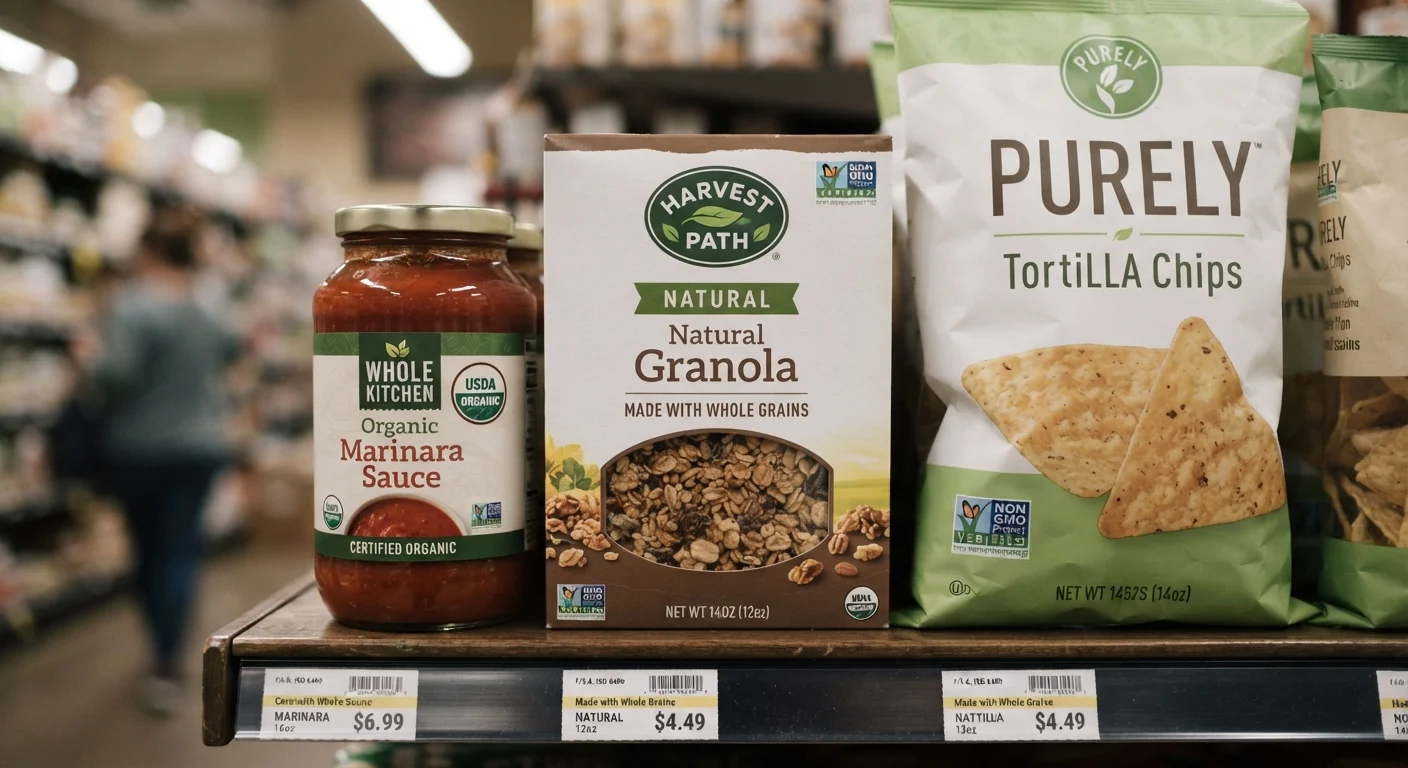
Our Verdict
Of the three labels, 'USDA Organic' carries the most rigorous, government-backed accountability. 'Non-GMO' offers meaningful third-party verification on a narrower claim. 'Natural' provides the least consumer protection, as it remains largely undefined and unpoliced. Knowing this hierarchy helps shoppers pay premiums only when a label actually delivers on its implied promise.
| Best for | Recommended |
|---|---|
| Shoppers prioritizing farming and production standards | USDA Organic |
| Those specifically concerned about genetically modified ingredients | Non-GMO Project Verified |
| Budget-conscious shoppers who want minimal processing | Read the ingredient list directly |
Why These Labels Cause So Much Confusion
Walk down any grocery aisle and you'll see the words Organic, Natural, and Non-GMO on packaging at every price point. They all sound reassuring. They are not, however, equal — not legally, not in terms of what was verified, and not in terms of what they can actually tell you about how a product was made.
The confusion is partly by design. Marketing language gravitates toward words that feel wholesome without triggering the cost or scrutiny of actual certification. Understanding what each label is legally required to mean — and who, if anyone, checked — puts you back in the driver's seat. For a broader look at how certification systems work across product categories, see which labels and seals carry real weight.
Breaking Down Each Label
USDA Organic is the most tightly defined of the three. It is governed by the National Organic Program (NOP), a federal regulatory framework administered by the U.S. Department of Agriculture. To carry the USDA Organic seal, a product must be certified by an accredited certifying agent. That means third-party inspections, documented practices, and restrictions on synthetic pesticides, synthetic fertilizers, antibiotics (in livestock), and, relevant to the next label, genetically engineered ingredients. "100% Organic" means every ingredient qualifies; "Organic" means at least 95% of ingredients do; "Made with Organic " means at least 70% qualify. The label has teeth.
Natural is almost the opposite. The FDA has historically not established a formal definition for "natural" on food labels, though it has stated it generally considers the term to mean no artificial or synthetic ingredients have been added. That guidance is not a legal standard — it is not consistently enforced, and no third party verifies it before it hits shelves. A product labeled "natural" could still contain high-fructose corn syrup, be heavily processed, or use pesticide-treated ingredients. The word is effectively marketing language.
Non-GMO sits in the middle. The most recognized version is the Non-GMO Project Verified seal, issued by the Non-GMO Project, a nonprofit organization. Verification involves testing and supply-chain traceability, making it a genuine third-party claim. Separately, the USDA's National Bioengineered Food Disclosure Standard (NBFDS) requires disclosure of bioengineered ingredients on certain packaged foods, using the term "bioengineered" rather than "GMO." Critically, Non-GMO says nothing about pesticide use, farming practices, or processing methods — only about genetic engineering status.
| USDA Organic | Natural | Non-GMO Project Verified | |
|---|---|---|---|
| Legally defined standard | Yes — federal regulation | No — informal FDA guidance only | No — private nonprofit standard |
| Third-party verification required | Yes — accredited certifying agent | No | Yes — Non-GMO Project audits |
| Restricts synthetic pesticides | Yes | No | No |
| Restricts genetically engineered ingredients | Yes | No | Yes — core purpose |
| Addresses farming/production practices | Yes — comprehensively | No | No |
| Speaks to nutritional content | No | No | No |
| Cost to producers to obtain | High — certification fees apply | None | Moderate — testing fees apply |
One nuance worth knowing: certified Organic products are already prohibited from using genetically engineered ingredients, so an Organic product is functionally Non-GMO — but not every Non-GMO product meets Organic standards.
What These Labels Can't Tell You
Even the most credible label on this list has limits. USDA Organic certification does not guarantee a product is nutritionally superior, lower in calories, or free of all pesticides (some approved organic pesticides exist). Non-GMO verification does not speak to pesticide residue, animal welfare, or environmental impact beyond gene-modification status. And neither label says anything about how much of a given nutrient a product contains.
The Ingredient List Never Lies
When a label feels ambiguous, flip to the ingredient list. Ingredients are listed in descending order by weight — whatever appears first is the largest component of the product. A short, recognizable ingredient list often tells you more about a product's actual composition than any front-of-package claim. This works regardless of whether the product carries any certification at all.
For that kind of nutritional detail, the ingredient list and Nutrition Facts panel are your most reliable tools — and they're federally mandated. See how to read a nutrition label without getting lost for a practical breakdown. If you want a broader understanding of how whole and minimally processed foods differ from heavily processed ones, what the science says about whole versus processed foods offers useful context.
Labels also vary by product type. Meat, poultry, eggs, and produce are handled by different regulatory bodies than packaged goods, so the same word on a chicken package versus a cracker box may carry different implied meanings. For a comprehensive guide to what product labels are legally obligated to disclose, reading a product label without getting lost in the fine print covers the full picture.
How to Use This at the Shelf
A practical approach: treat labels as a starting filter, not a final answer. If a specific claim matters to you — pesticide practices, farming methods, genetic engineering — identify which label actually addresses that claim and whether a credible body verified it. If none of the three labels address your concern, go directly to the ingredient list.
Price premium decisions become clearer through this lens. Paying more for "Natural" is rarely justified by the label itself, since the term is unverified. Paying more for "USDA Organic" reflects a real certification system with inspection requirements. Paying more for "Non-GMO Project Verified" is meaningful if GMO avoidance is specifically your priority — but it won't tell you anything about pesticide use or processing. Knowing what you're actually buying is the first step to buying it intentionally.
The content on this site is for informational purposes only and is not a substitute for professional advice. Always consult a qualified professional for guidance specific to your situation.