

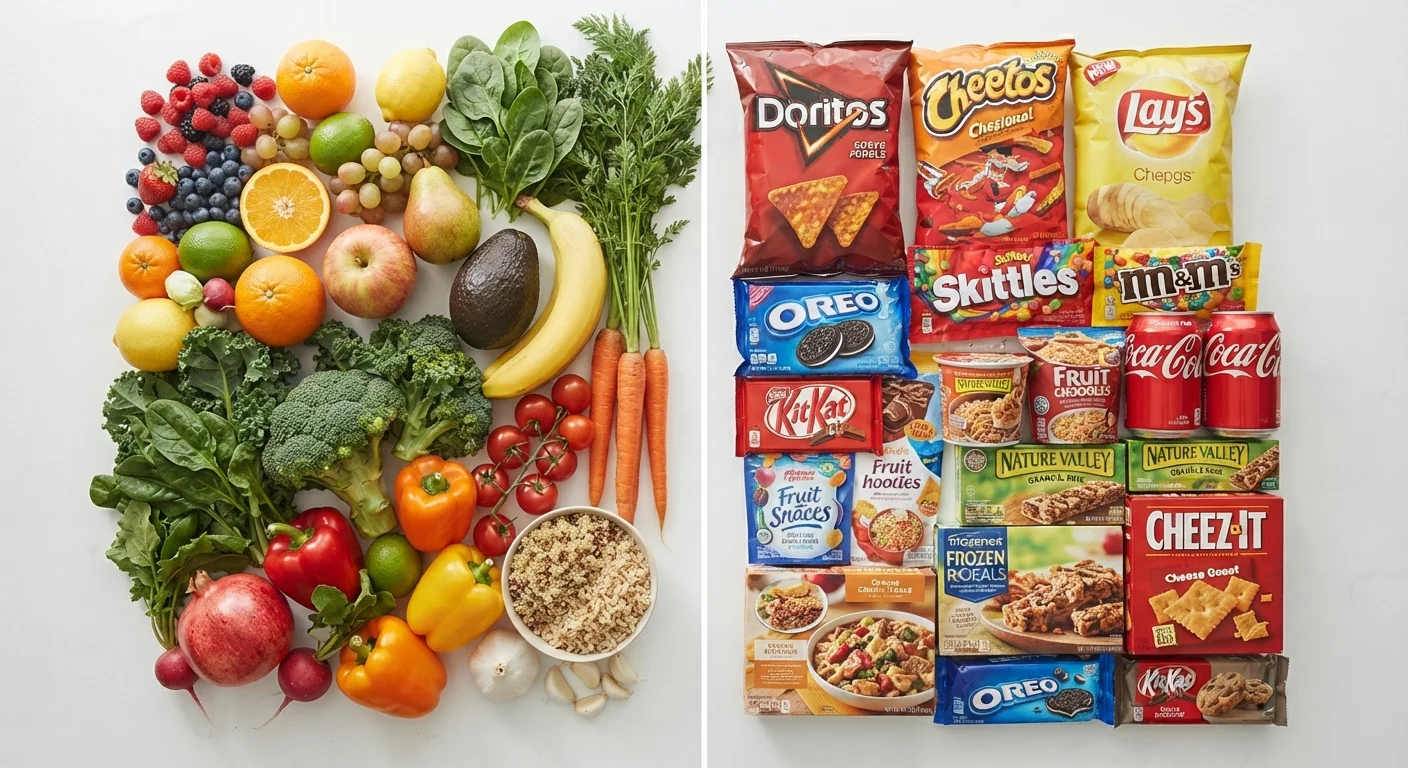
Option A
Whole Foods
Minimally altered, nutrient-dense foods as close to their natural state as possible.
Best for: People prioritizing nutrient density, fiber intake, and long-term dietary patterns linked to chronic disease prevention.
Option B
Processed Foods
Foods altered from their original state — ranging from lightly prepared to heavily reformulated.
Best for: Consumers who value convenience, affordability, and shelf stability, especially in busy or resource-limited situations.
Defining the Terms: What Do 'Whole' and 'Processed' Actually Mean?
The phrase "processed food" gets used as a blanket criticism, but the term covers an enormous range — from frozen spinach (minimally processed) to cheese crackers engineered with flavor enhancers and emulsifiers (heavily processed). Researchers have developed classification systems to bring order to this spectrum. The most widely cited is the NOVA framework, which groups foods into four categories based on the extent and purpose of processing:
- Group 1 — Unprocessed or minimally processed: Whole fruits, vegetables, eggs, plain meats, legumes, and nuts.
- Group 2 — Processed culinary ingredients: Oils, butter, sugar, salt, and flour — used to prepare Group 1 foods.
- Group 3 — Processed foods: Products made by adding salt, sugar, or other ingredients to whole foods — canned vegetables, cheese, cured meats, freshly baked bread.
- Group 4 — Ultra-processed foods (UPFs): Industrial formulations with little or no whole-food content, often containing additives like artificial flavors, colorants, emulsifiers, and preservatives.
This distinction matters because the science does not show that all processing is harmful — it shows that ultra-processing is where the clearest risks emerge. Common nutrition myths often collapse this spectrum, treating a bag of plain oats the same as a bag of cheese puffs. They are not the same.
What the Research Shows: Nutrition, Health Outcomes, and the Evidence Gap
The scientific case for whole foods rests on several converging lines of evidence. Large cohort studies — including data from the NIH-AARP Diet and Health Study and multiple European cohorts — consistently associate higher consumption of fruits, vegetables, whole grains, and legumes with lower rates of cardiovascular disease, type 2 diabetes, and certain cancers. These associations hold even after adjusting for overall calorie intake and lifestyle variables.
On the ultra-processed side, a landmark 2019 randomized controlled trial published in Cell Metabolism found that participants assigned to an ultra-processed diet consumed significantly more calories and gained more weight over two weeks than those eating an unprocessed diet matched for sugar, fat, fiber, and macronutrients — suggesting that something about ultra-processing itself, beyond simple nutrient content, may drive overconsumption.
57%
Share of US calories from ultra-processed foods
Research published in BMJ Open estimated that ultra-processed foods account for roughly 57% of total caloric intake among US adults.
+500 kcal/day
Extra calories consumed on ultra-processed diet
A 2019 NIH randomized controlled trial found participants eating ultra-processed foods consumed approximately 500 more calories per day than those on an unprocessed diet.
30%+
Higher risk of cardiovascular mortality
Multiple large prospective cohort studies have associated the highest ultra-processed food consumption with over 30% greater risk of cardiovascular-related mortality compared to the lowest consumption groups.
It's important to be transparent about the evidence's limits. Most large dietary studies are observational, meaning they show association, not proven causation. Dietary patterns are notoriously hard to isolate from other lifestyle factors. Still, the consistency of findings across different populations and study designs gives researchers reasonable confidence in the general direction of these relationships.
Whole foods also tend to preserve what nutritionists call the food matrix — the physical structure of a food that influences how nutrients are absorbed and how quickly glucose enters the bloodstream. An apple and apple juice contain similar sugars, but the fiber matrix in a whole apple slows absorption meaningfully. Processing often disrupts this matrix. To understand how individual macronutrients function within whole foods, see our macronutrients explainer.
Head-to-Head: How Whole and Processed Foods Compare
Here's how whole foods and processed foods compare across the dimensions that matter most for everyday dietary decisions.
| Criterion | Whole Foods | Processed Foods |
|---|---|---|
| Fiber content | Naturally high (especially plants) | Often significantly reduced |
| Micronutrient density | Generally higher per calorie | Variable; some are fortified |
| Added sugars/sodium | Minimal to none | Often elevated in UPFs |
| Food matrix integrity | Preserved — affects absorption | Often disrupted by processing |
| Shelf life & convenience | Shorter; requires prep time | Longer; often ready to eat |
| Cost accessibility | Variable; fresh produce costly | Often lower per serving |
| Additives & preservatives | None | Present; range widely by type |
| Association with chronic disease | Lower risk in observational data | UPFs linked to higher risk |
One often-overlooked dimension is food label transparency. Many processed products carry terms like "natural" or "non-GMO" that do not indicate overall nutritional quality. Understanding what those labels mean — and don't mean — is a separate but related question. Our packaging labels guide breaks this down clearly.
Practical Reality: Why the Either/Or Framing Doesn't Serve Most People
Framing whole foods and processed foods as binary opposites sets up a false choice. The practical reality for most American households involves some combination of both — shaped by income, time, geography, cultural tradition, and individual health needs.
Canned beans are processed. So is pasteurized milk, whole-grain bread, and plain Greek yogurt. These foods can anchor genuinely nutritious eating patterns. The goal supported by nutrition research is not elimination of all processing but rather a meaningful shift in proportion: more minimally processed whole foods as a dietary foundation, with thoughtful choices among the processed options that fill in the rest.
Not All Convenience Foods Are Equal
Frozen vegetables, canned legumes, and plain rolled oats are technically processed but retain most of their nutritional value and fiber. When choosing processed options, looking for shorter ingredient lists and lower added sugar and sodium levels is a practical starting point — not a guarantee of nutritional quality, but a useful signal. A registered dietitian can help you evaluate specific choices in the context of your overall diet.
For those interested in plant-forward eating specifically, plant-based eating approaches naturally emphasize whole foods while leaving room for minimally processed products. Similarly, understanding protein sources across animal and plant categories can help you build meals that are both whole-food-forward and nutritionally complete.
This article provides general nutrition information and education only, not personalized dietary or medical advice. Consult a registered dietitian or qualified healthcare provider before making significant changes to your diet, particularly if you have a health condition or specific nutritional needs.
The content on this site is for informational purposes only and is not a substitute for professional advice. Always consult a qualified professional for guidance specific to your situation.