

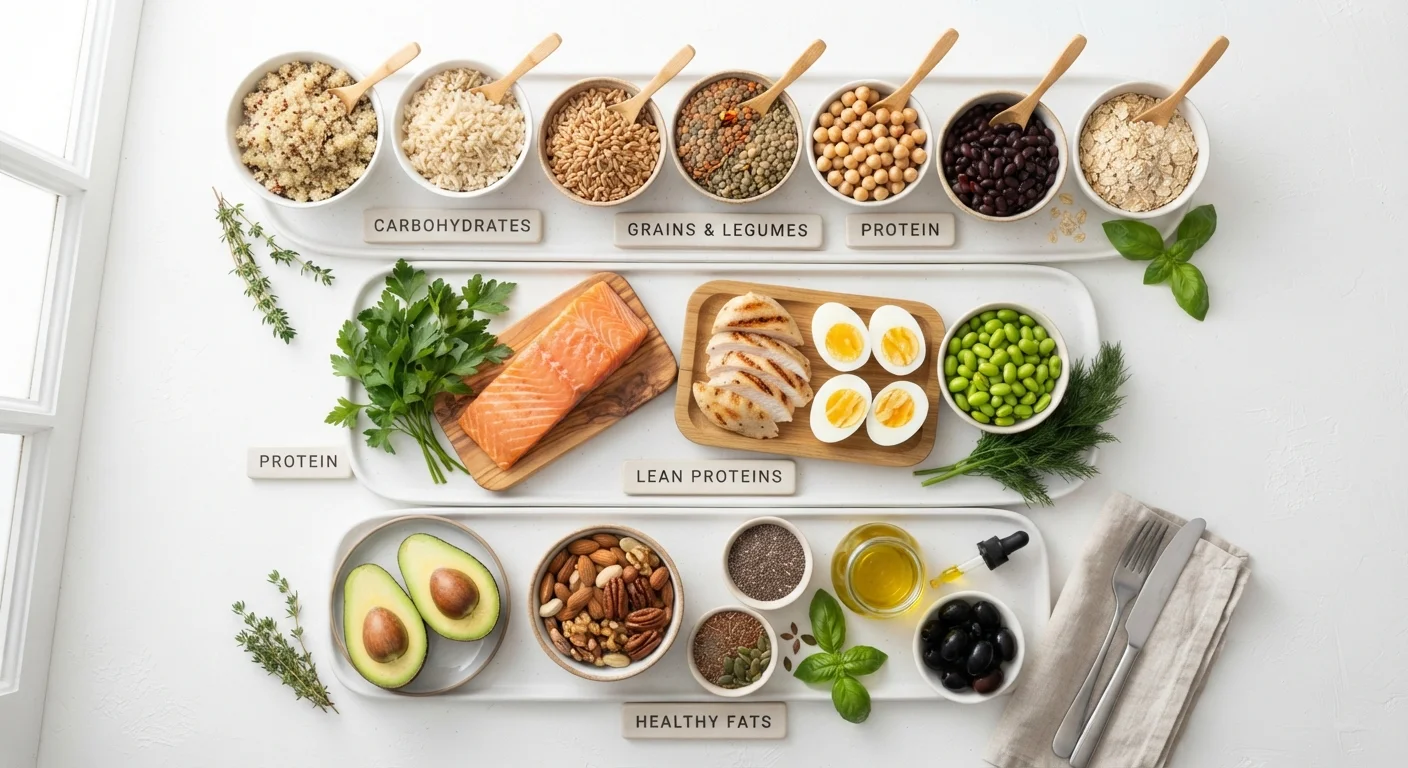
Why Macronutrients Matter
Nutrition conversations often fixate on calories, but calories alone don't tell the full story. What those calories are made of — and what your body does with each component — is where macronutrients become important. Carbohydrates, proteins, and fats each perform jobs that no other nutrient can fully replace.
Understanding macronutrients isn't about obsessive tracking. It's about recognizing that food is functional: what you eat shapes how your body produces energy, repairs tissue, regulates hormones, and maintains the systems that keep you functioning day to day. This knowledge can help you move past fad-diet logic and toward a more durable, evidence-based relationship with food.
For a deeper look at the smaller but equally critical nutrients that work alongside macros, see our guide to vitamins and minerals your body can't make itself.
45–65%
Recommended share of daily calories from carbohydrates
According to the Dietary Guidelines for Americans, carbohydrates should make up the largest share of daily caloric intake for most adults.
10–35%
Recommended daily calorie range from protein
The USDA Dietary Reference Intakes set a wide acceptable range for protein to account for differences in activity level, age, and health status.
~95%
Of Americans fall short of daily fiber recommendations
Research published in nutrition journals consistently finds that most US adults consume well below the recommended 25–38 grams of dietary fiber per day.
Carbohydrates: Your Body's Preferred Fuel
Carbohydrates are the body's primary and most efficient energy source. When you eat carbs, they're broken down into glucose, which fuels your brain, muscles, and organs. Your liver and muscles store excess glucose as glycogen — a ready energy reserve for physical activity or periods between meals.
Not all carbohydrates behave the same way. Simple carbohydrates (sugars found in candy, white bread, and sweetened drinks) digest quickly and can spike blood sugar rapidly. Complex carbohydrates — found in whole grains, legumes, vegetables, and fruit — digest more slowly, deliver fiber, and provide more sustained energy.
Fiber, a type of carbohydrate the body can't fully digest, is particularly important. It supports digestive health, helps regulate blood sugar, and is associated with reduced risk of several chronic diseases. Most Americans fall well short of recommended fiber intake.
The case against carbohydrates as a category is not well supported by long-term nutritional science. It's the type and source that matters most. Nutrition myths that refuse to die — including the idea that carbs are inherently fattening — are worth examining critically.
Protein: More Than Just Muscle
Protein is often associated exclusively with muscle building, but its roles extend far beyond the gym. Proteins are made of amino acids — the structural components your body uses to build and repair tissue, produce enzymes and hormones, support immune function, and transport molecules through the bloodstream.
Of the 20 amino acids, nine are considered essential, meaning the body cannot synthesize them and must obtain them from food. Animal proteins (meat, fish, eggs, dairy) contain all nine essential amino acids and are called complete proteins. Most plant proteins are incomplete on their own, but a varied plant-based diet can readily supply all essential amino acids across the day.
“Protein is unique among the macronutrients because the body has no dedicated storage depot for it. Every gram of dietary protein serves a functional purpose — from enzymes and antibodies to structural tissue and signaling molecules.”
— National Institutes of Health, Office of Dietary Supplements, US Federal Agency for Nutritional Research and Public Health Information
Protein is also the most satiating macronutrient — it tends to promote feelings of fullness more effectively than carbohydrates or fat, which may support appetite regulation. Protein needs vary based on age, activity level, and health status; a registered dietitian can help identify what's appropriate for your individual situation.
Fats: Essential, Not the Enemy
Dietary fat has spent decades unfairly maligned, but the science is clear: fat is essential. It supports brain function (the brain is roughly 60% fat by dry weight), enables absorption of fat-soluble vitamins (A, D, E, and K), regulates hormones, and provides a concentrated energy reserve.
Fat quality matters enormously. Unsaturated fats — found in olive oil, avocados, nuts, seeds, and fatty fish — are consistently linked to cardiovascular and cognitive health benefits. Saturated fats, found in red meat and full-fat dairy, are associated with elevated LDL cholesterol when consumed in excess. Trans fats, largely the product of industrial hydrogenation, are strongly linked to heart disease risk and have been largely removed from the US food supply, though trace amounts remain in some products.
Replacing fat with refined carbohydrates — a common strategy during the low-fat diet era — did not improve public health outcomes, a finding that helped reshape how nutrition researchers think about dietary fat. What the science says about whole vs. processed foods offers useful context on how food processing affects fat quality.
Focus on Fat Sources, Not Fat Totals
Rather than aiming for a specific fat percentage, most people benefit more from shifting toward unsaturated fat sources — olive oil, nuts, seeds, fatty fish — and limiting processed foods high in trans fats. This approach is more aligned with what the evidence actually supports than tracking a gram target.
Balance Over Elimination
One of the most durable findings in nutrition science is that balance — not the elimination of any macronutrient — is associated with the best long-term health outcomes. Extremely low-fat or low-carbohydrate diets may work short-term for some individuals, but they're difficult to sustain and can crowd out important nutrients when food variety shrinks.
A practical approach focuses on the quality of each macronutrient source: prioritizing whole grains over refined ones, lean and varied protein sources over processed meats, and unsaturated fats over trans fats. What a balanced diet actually looks like in practice explores this concept in more depth.
When you're reading food labels to assess macronutrient content, decoding a nutrition label can help you make sense of the numbers without guesswork.
This article is for general informational and educational purposes only and is not a substitute for professional medical or dietary advice. Consult a qualified healthcare provider or registered dietitian before making significant changes to your diet, especially if you have an existing health condition.
Frequently Asked Questions
Tracking is one tool, but it's not necessary for most people. Understanding the general role of each macronutrient and focusing on whole, minimally processed foods can support good nutrition without counting grams. Tracking may be helpful in specific clinical contexts — your healthcare provider or a registered dietitian can advise.
Dietary fat is not inherently bad. Healthy unsaturated fats found in foods like olive oil, nuts, and fatty fish are linked to heart and brain health. The type of fat matters: research consistently suggests limiting trans fats and being mindful of saturated fat intake, rather than eliminating fat altogether.
General dietary guidelines suggest roughly 0.8 grams of protein per kilogram of body weight for sedentary adults, though needs vary with age, activity level, and health status. Older adults and people who exercise regularly often benefit from higher intakes. A registered dietitian can help you determine what's appropriate for your situation.
No. Carbohydrates are the body's preferred energy source, and research does not support singling them out as uniquely fattening. What matters more is total calorie intake, food quality, and overall dietary pattern. Low-carb diets work for some people, but they're not superior for everyone.
Simple carbohydrates (like sugars) are digested quickly and can cause rapid blood sugar spikes. Complex carbohydrates (like whole grains and legumes) digest more slowly, providing steadier energy and more fiber. Most dietary guidance favors complex carbs from whole food sources.
Yes. Plant-based foods like legumes, tofu, tempeh, edamame, quinoa, and nuts all contain protein. Combining a variety of plant protein sources throughout the day helps ensure you get all the essential amino acids your body needs.
The content on this site is for informational purposes only and is not a substitute for professional advice. Always consult a qualified professional for guidance specific to your situation.