

Our Verdict
All three condition grades can represent genuine value, but they carry meaningfully different risk profiles. Refurbished offers the most structure and protection; open-box can be a near-new deal if the source is reliable; pre-owned demands the most due diligence from the buyer. The label alone doesn't tell the full story — who stands behind it does.
| Best for | Recommended |
|---|---|
| Shoppers who want a lower price with some guarantee | Certified Refurbished |
| Buyers comfortable inspecting items and comfortable with return policies | Open-Box |
| Those prioritizing lowest possible cost and accepting higher uncertainty | Pre-Owned (private seller) |
Why the Label Matters More Than You Think
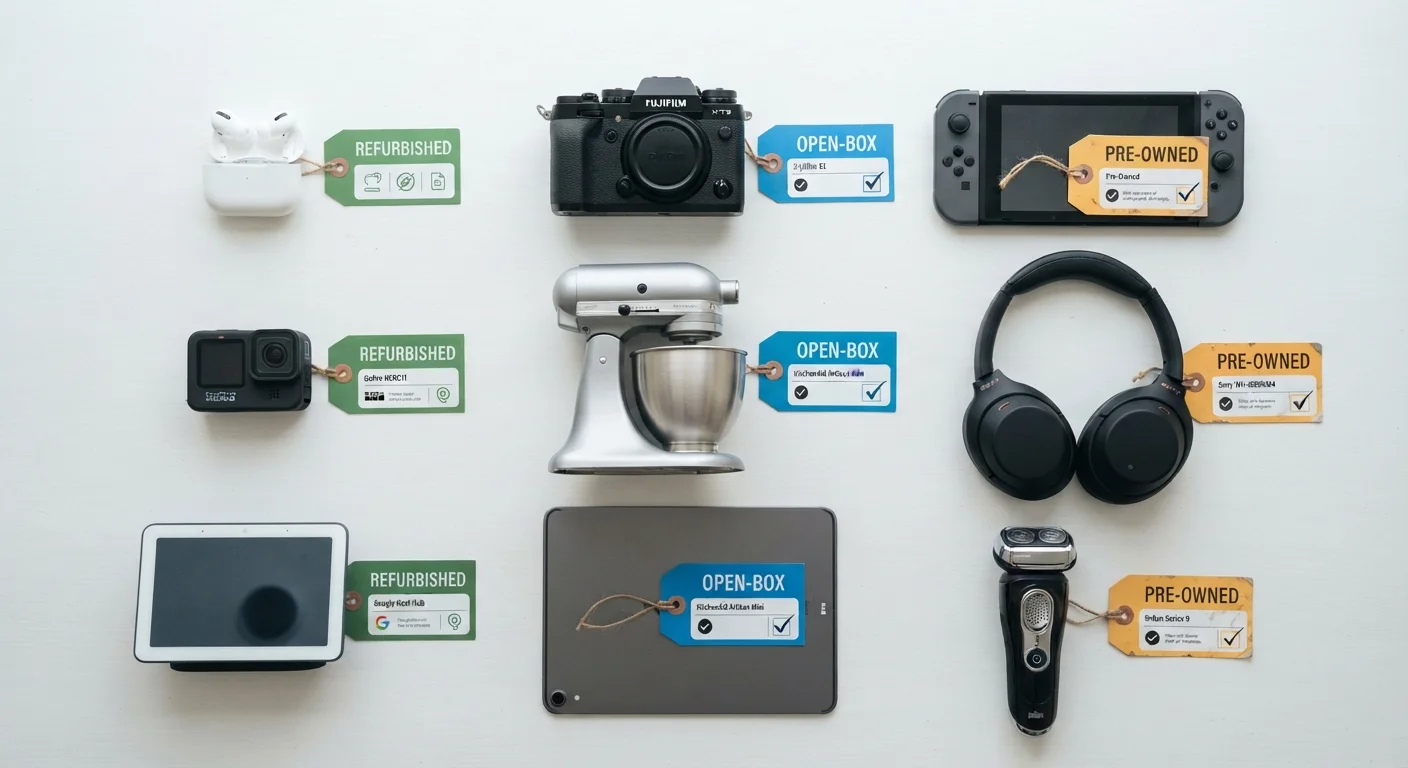
Retailers and resellers use "refurbished," "open-box," and "pre-owned" to signal that an item isn't brand new — but the similarity stops there. Each term carries different implications for who tested the product, what repairs were made, and what recourse you have if something goes wrong.
Confusing them can mean overpaying for something with weak protections, or misjudging risk on a product that's actually in excellent shape. This is particularly relevant when buying electronics, appliances, or anything with a meaningful price tag. Understanding what each grade actually signals is the first step toward making a confident, informed purchase. For a broader checklist before any major purchase, see Things to Verify Before Making Any Major Purchase.
Refurbished: The Most Structured Condition Grade
"Refurbished" indicates that a product was returned, inspected, repaired as needed, and tested to confirm it meets functional specifications. It is the most process-heavy of the three grades — though what that process looks like varies by source.
Manufacturer-refurbished products go through the original maker's quality process, often with replacement parts and a formal warranty. Retailer-refurbished items are processed by the seller's own team, which may or may not follow the same standards. Third-party refurbishers operate on a wide spectrum — some are meticulous, others less so.
The word "certified" before "refurbished" typically means a defined inspection process was followed, though the criteria differ by seller. Always check what the warranty actually covers. For help reading warranty language, Warranty Terms Decoded breaks down what limited, full, and extended coverage really means.
| Refurbished | Open-Box | Pre-Owned | |
|---|---|---|---|
| Typically tested/inspected | Yes — formally | Varies by retailer | Rarely, if ever |
| Repairs made before resale | Often yes | Not typically | No standard process |
| Warranty usually included | Yes — limited or full | Sometimes (check terms) | Uncommon |
| Condition consistency | Higher — grade-driven | Moderate — grade varies | Low — seller-dependent |
| Return policy | Typically available | Usually available (retail) | Limited or none (private) |
| Typical price discount vs. new | 10–30% | 5–25% | Highly variable |
Open-Box: Near-New, but Read the Details
Open-box products were returned by customers — often quickly, sometimes unused. They go back on shelves (or to online listings) at a reduced price. The condition can range from "looks brand new" to "missing accessories" to "cosmetically damaged."
Most major retailers assign open-box grades: terms like "Excellent," "Good," and "Fair" map to specific criteria. An "Excellent" open-box item at a large electronics retailer might have no visible wear and all accessories included. A "Fair" item might have scratches and a missing cable.
Open-Box Grading Is Not Standardized
There is no universal industry standard for open-box condition grades. "Like New" at one retailer may not mean the same thing as "Excellent" at another. Before purchasing, look up that specific retailer's grade definitions — most publish them on their website. If no grading system is listed, treat the item as a higher-risk purchase.
The key question with open-box is whether the original manufacturer's warranty still applies. In many cases, the warranty clock started when the first buyer purchased the item, meaning you may inherit a shortened coverage period. Check the purchase date on any included documentation. For return policy specifics — which matter more here than with new purchases — Return Policy Red Flags Every Shopper Should Recognise covers what terms to scrutinize.
Pre-Owned: The Widest Variation in Quality and Protection
"Pre-owned" simply means someone else used it. Unlike the other two grades, this label carries no implied testing, repair, or recertification standard. A pre-owned item might be nearly flawless or heavily worn — the label itself doesn't tell you which.
The level of protection you get depends almost entirely on who you're buying from. A large retailer selling pre-owned goods typically offers a return window and some grade description. A private seller offers neither by default. This parallels the dynamic in vehicle purchasing — Private Seller vs. Dealership illustrates how seller type shapes risk and recourse regardless of the product category.
For pre-owned purchases, ask for photos, usage history, and any available documentation. Understand that in a private sale, your consumer protections under federal and state law are generally more limited than in a retail transaction. This is also where counterfeit or non-genuine products can appear — Counterfeit Products and Grey-Market Goods explains how to spot the difference.
~15%
Average discount on open-box electronics at major retailers
Retailer pricing data consistently shows open-box discounts ranging from roughly 10–25% depending on condition grade and category.
42%
Of consumers who have purchased a refurbished product
A 2023 survey by the Consumer Technology Association found that a significant share of US adults had purchased a refurbished tech product.
How to Evaluate Any Non-New Purchase
Regardless of which condition grade you're considering, a few questions consistently separate a good deal from a regrettable one:
- Who stands behind it? Manufacturer, retailer, or private individual — each offers a different level of accountability.
- What does the warranty cover, and for how long? Confirm this in writing, not just verbally. An extended service plan isn't the same as a manufacturer warranty — Extended Warranties vs. Manufacturer Warranties explains why.
- What's the return window? For open-box and pre-owned especially, a short or nonexistent return period amplifies risk.
- Is the price reduction proportionate to the risk? A 5% discount on a heavily used item with no warranty is rarely a fair trade.
Condition grades are a starting framework, not a guarantee. The due diligence you apply before buying is what determines whether you walk away satisfied or stuck.
The content on this site is for informational purposes only and is not a substitute for professional advice. Always consult a qualified professional for guidance specific to your situation.