

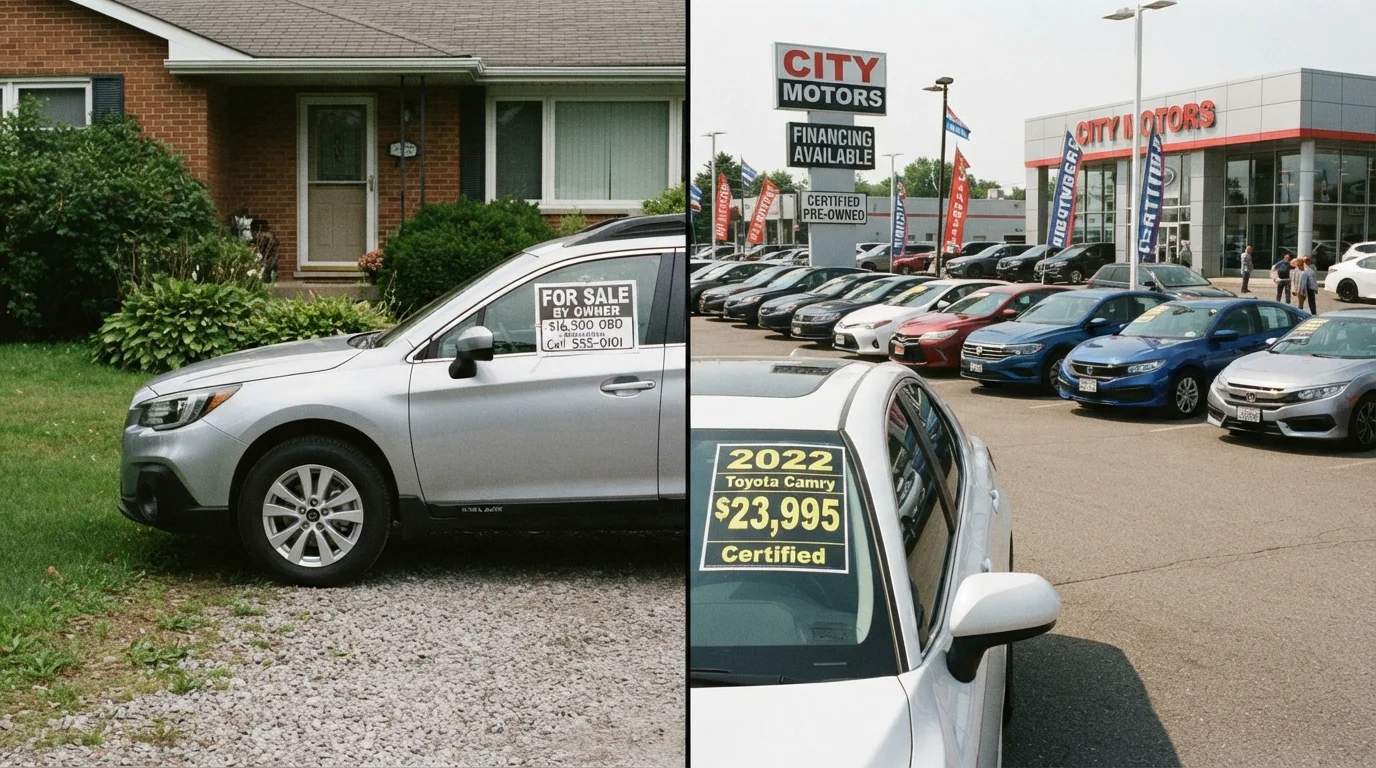
Option A
Private Seller
The flexible, lower-overhead alternative.
Best for: Buyers comfortable doing their own research and due diligence who want to negotiate directly on price.
Option B
Dealership
The structured, protection-rich channel.
Best for: Buyers who value financing options, warranty coverage, and a paper trail for consumer protection.
What Actually Separates the Two Channels
When you buy from a private seller, you are dealing directly with an individual — typically a previous owner looking to move on from a vehicle. There is no intermediary, no reconditioning process, and no regulatory licensing requirement governing how that person sells. That simplicity is both the appeal and the risk.
Dealerships, by contrast, are licensed businesses subject to state consumer protection laws, Federal Trade Commission regulations, and — if selling certified pre-owned vehicles — manufacturer standards. They must disclose known defects in many states and maintain documentation trails. That accountability layer adds cost, but it also adds structure that many buyers value.
Understanding this fundamental difference shapes every other trade-off. As our guide on price vs. value explains, the sticker price is only one variable in a smarter purchasing calculation.
| Criterion | Private Seller | Dealership |
|---|---|---|
| Typical asking price | Generally lower | Generally higher |
| Warranty coverage | None (as-is in most states) | Varies; CPO includes warranty |
| Financing available | Must arrange independently | On-site, multiple lenders |
| Consumer protections | Minimal; buyer beware | State and federal regulations apply |
| Title and paperwork | Buyer manages transfer | Dealer handles most steps |
| Vehicle variety | Wide, including rare models | Curated, reconditioned stock |
| Negotiation flexibility | High; direct with owner | Moderate; structured process |
| Post-sale recourse | Limited to none | Complaint channels available |
The Price Reality: Savings That May or May Not Hold
Private sellers are often priced below dealership equivalents because they have no reconditioning costs, no sales staff salaries, and no lot overhead to recover. On paper, that can translate to a meaningful difference — sometimes several thousand dollars on a mid-range used vehicle.
But that gap narrows faster than many buyers expect. Dealership fees are negotiable in some cases and always disclosed in writing. Private sales, meanwhile, can carry hidden costs: deferred maintenance, undisclosed repair needs, or a title with complications that require legal resolution. A pre-purchase inspection by an independent, licensed mechanic — highly recommended for any private purchase — itself costs money and time.
~40%
Used vehicle sales via private party
Industry estimates consistently place roughly 40% of used vehicle transactions as private-party sales in the United States.
$1,000–$3,000
Typical private vs. dealer price gap
Consumer research suggests private listings often run one to three thousand dollars below comparable dealer listings, though the gap varies by vehicle age and condition.
$100–$200
Pre-purchase inspection cost
Independent mechanic inspections typically range from $100 to $200 — a modest investment relative to the cost of an undetected mechanical issue.
Sales tax is assessed the same way in most states regardless of who you buy from, so that expense doesn't differentiate the channels. What does differ is the recourse available if problems emerge after the sale. Private sellers in most states sell "as-is," with no obligation to remedy post-sale issues. Dealers are generally bound by implied warranty of merchantability standards and, for certified pre-owned vehicles, explicit warranty terms.
Financing, Paperwork, and Consumer Protections
One of the most practical advantages of buying from a dealer is the ability to arrange financing at the point of sale. Dealers work with multiple lenders and can process loan approval, title transfer, and registration in a single transaction. That convenience has genuine value, even if dealer financing isn't always the most competitive rate option.
Private sales require buyers to arrange financing independently — typically through a bank or credit union — before completing the purchase. Some lenders won't finance vehicles over a certain age or mileage, which can limit options for older private-sale vehicles.
On documentation, dealers are required to provide a Buyers Guide disclosing warranty terms (or lack thereof), a clear title, and an odometer disclosure statement under federal law. Private sellers must also provide an odometer disclosure, but verification of vehicle history falls more squarely on the buyer. Pulling a vehicle history report from a recognised reporting service is a minimum step, not an optional one, when buying privately.
Title Checks Are Non-Negotiable
Before completing any private vehicle purchase, verify that the seller holds a clean, lien-free title in their name. A vehicle with an outstanding loan attached has a lienholder who must be paid before title can legally transfer to you. Skipping this step is one of the most common and costly errors private buyers make. Your state's DMV can explain the title transfer process specific to your location.
For buyers considering a certified pre-owned vehicle specifically, our overview of new, used, and certified pre-owned differences explains what that designation actually guarantees.
Making the Call: Matching the Channel to Your Situation
Neither channel is universally superior. The right choice depends on your risk tolerance, your ability to evaluate a vehicle independently, your financing situation, and how much you value post-sale protection over upfront savings.
Buyers who are mechanically informed, willing to invest in an independent inspection, and comfortable navigating title transfers on their own can often get good value from private sales. Buyers who want a structured process, need financing arranged on-site, or are purchasing a higher-value vehicle where warranty coverage matters will generally find the dealership route better suited to their needs.
If you've already owned the car and are considering selling it yourself, it's worth reading about why trade-in decisions often disappoint sellers — the same dynamics that make dealer trade-ins convenient tend to make them financially suboptimal compared to private sales.
Whatever channel you choose, the discipline of researching fair market value, verifying the vehicle's history, and having any used vehicle inspected before purchase applies equally. The channel shapes your protections; your preparation shapes your outcome.
The content on this site is for informational purposes only and is not a substitute for professional advice. Always consult a qualified professional for guidance specific to your situation.